Amy Jacques Garvey: The Blueprint for Black Organizational Strategy and Sovereignty Systems
Amy Jacques Garvey didn't just support the movement — she systematized it. We break down her organizational blueprint for building Black sovereignty in 2026.
POLITICAL, EMPLOYMENT, & BUSINESS SOVEREIGNTY
The Black Metrics
3/20/20268 min read
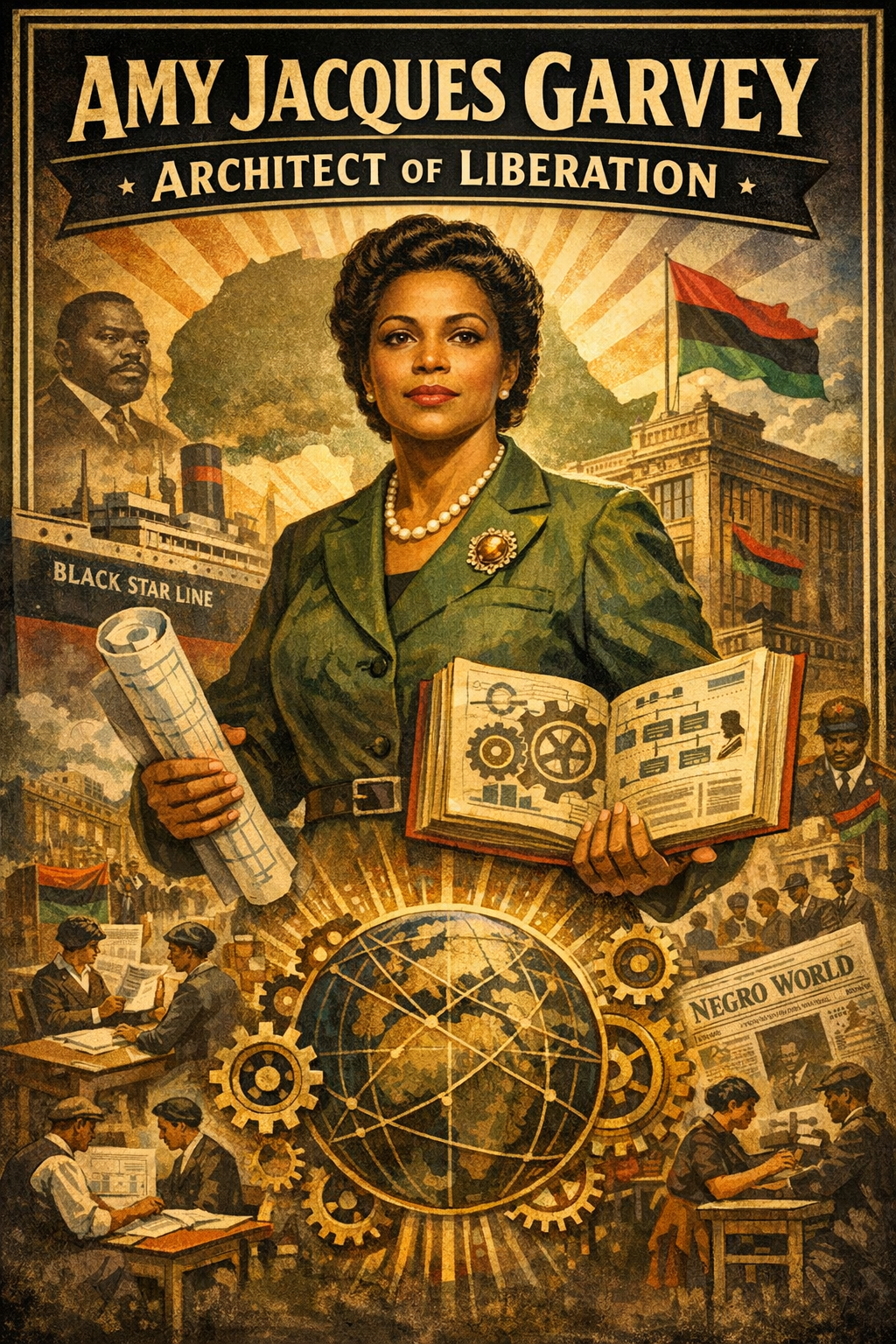
Amy Jacques Garvey: Blueprint for Black Organizational Strategy
Peace and blessings, family. As we continue our Strategic Briefings for Women's History Month, we move from the intellectual foundation of Anna Julia Cooper to the organizational execution of Amy Jacques Garvey. We acknowledge the ancestors who built these frameworks and we acknowledge you for doing the work to manifest them today.
Setting the Record Straight
In our study of history, accuracy is a metric of power. It is essential to distinguish between the two Amys of the Garvey movement. Amy Ashwood Garvey was a powerful co-founder, activist, and organizer whose contributions deserve their own full analysis. This briefing focuses on Amy Jacques Garvey, the strategic mind who managed the Universal Negro Improvement Association during its most difficult years and who converted Marcus Garvey's vision into documented, transferable operational infrastructure. She was the one who took thousands of pages of notes, speeches, and directives and edited them into the definitive plan for Black liberation.
That distinction matters. Vision without documentation is inspiration. Documentation without vision is administration. Amy Jacques Garvey combined both with a discipline that kept the largest Black mass movement in history operational under conditions designed to destroy it.
Why Organizational Strategy Is a Sovereignty Issue
Before we examine her specific contributions, we need to establish why organizational strategy belongs in a sovereignty framework at all.
Most discussions of Black liberation focus on political demands, economic goals, or cultural reclamation. All of these are necessary. None of them are sufficient without the organizational infrastructure to pursue and sustain them. The history of Black liberation movements is filled with visionary leaders, powerful moments, and righteous demands that did not produce durable structural change. Not because the vision was wrong but because the organizational infrastructure was insufficient to outlast the suppression applied against it.
Amy Jacques Garvey understood this with precision. She understood that a movement is only as durable as its systems. When Marcus Garvey was imprisoned on federal charges in 1925 and eventually deported in 1927, the UNIA continued to function because she had built the operational infrastructure that made his continued physical presence unnecessary for the day-to-day work. That is not a small achievement. That is the difference between a movement and an institution.
The same principle applies to every sovereignty-building project in 2026. If your organization, business, or community initiative cannot operate effectively when its founder is absent, it is a personality project, not a sovereignty project. For the full analysis of how the UNIA functioned as a prototype state, read Marcus Garvey and the UNIA: How the Largest Black Movement in History Built the Blueprint for Global Black Sovereignty.
The Universal Negro Improvement Association: A Government in Exile
To understand Amy Jacques Garvey's contribution, you must understand the scale and ambition of what she was administering.
The UNIA was not a social club or an advocacy organization. At its peak in the early 1920s, it had chapters across North America, the Caribbean, Central America, Latin America, and Africa. It had its own flag, its own anthem, its own system of titles and governance, its own newspaper, its own economic enterprises including the Black Star Line shipping company, and its own annual conventions that attracted tens of thousands of delegates.
This was an organization operating as a parallel governance structure for a global population. It was, in the most literal sense possible, an attempt to build the institutional infrastructure of sovereignty for Black people everywhere without waiting for any existing state to grant it. The ambition was historic. The operational challenge of sustaining it was equally historic. And the person who made the operational infrastructure function was Amy Jacques Garvey.
The Engine of Sovereignty: The Politics Pillar in Practice
Amy Jacques Garvey did not just manage people. She managed a System of Coordination. To understand her success, we analyze it through the Politics Pillar, which in The Black Metrics framework is not about voting for someone else. It is about how we organize ourselves to be our own bosses.
Think of the movement as a powerful engine. For that engine to run, it needs two things: a blueprint and a manual.
The Organizational Chart: The Blueprint
An organizational chart is the blueprint of the engine. It defines who is responsible for each part of the work. It establishes clear lines of accountability, removes the anxiety of role ambiguity, and ensures that when one component fails, the system knows how to compensate.
Without an organizational chart, organizations operate on informal hierarchy, which means they operate on personality. When the dominant personality is removed, through death, imprisonment, deportation, or exhaustion, the organization collapses into conflict over who leads and how decisions are made. This is the failure mode that has ended more Black liberation organizations than external suppression.
Amy Jacques Garvey built the UNIA's organizational structure to function beyond any individual. Roles were defined. Responsibilities were assigned. Lines of succession were established. The machine was not Marcus Garvey. Marcus Garvey ran the machine. There is a critical difference.
Standard Operating Procedures: The Instruction Manual
Standard Operating Procedures are the instruction manual for the engine. Even a perfect machine will stop if no one knows how to maintain it. SOPs are written steps that anyone can follow: how we welcome new members, how we protect community funds, how we publish our communications, how we respond to external attacks, how we resolve internal disputes.
Amy Jacques Garvey wrote the rules so the machine kept running even when key leaders were away, imprisoned, or under surveillance. This is called system strength, and it is the specific quality that separates organizations that last from organizations that require constant maintenance from a single exceptional leader.
The most powerful application of this principle in 2026 is documentation. If you have built something, write it down. Every process that exists only in your head is a single point of failure. Every procedure that depends on your personal memory is a liability. Write it down. Test it with someone who was not involved in building it. Refine it until someone with no prior knowledge can execute it at an acceptable standard.
The Global Signal: Communication as Organizational Infrastructure
To keep engines running together across the world, you need a communication system that reaches every part of the network with consistent information. Amy Jacques Garvey used the Negro World newspaper as this global signal.
She served as editor of the Negro World during some of the most difficult years of the UNIA's operation. This was not a ceremonial role. Editorial control of the movement's primary communication channel was one of the most strategically significant positions in the organization. It determined what the global membership understood about the movement's direction, priorities, and identity. It shaped how hundreds of thousands of people across dozens of countries understood their relationship to each other and to the project of Black sovereignty.
If a person in Jamaica and a person in New York are both reading the same manual, they are working together even if they never meet. That is Pan-Africanism in practice. That is what a Global Signal delivers at scale. Claudia Jones understood this when she founded the West Indian Gazette a generation later. Both women used owned media as organizational infrastructure rather than as communication supplemental to organizational work. For the full analysis of that strategic parallel, read Claudia Jones: The Blueprint for Black Economic Internationalism and Pan-African Sovereignty.
In 2026, the Global Signal is digital. It is your newsletter list, your website, your podcast, your platform. The medium has changed. The strategic principle, that consistent messaging across a distributed network creates coordinated movement, has not changed at all.
Editing as Political Work: Philosophy and Opinions of Marcus Garvey
One of Amy Jacques Garvey's most enduring contributions is often framed as editorial rather than political. It should be understood as both.
After Marcus Garvey's imprisonment, she compiled, edited, and published the two volumes of The Philosophy and Opinions of Marcus Garvey, which gathered his speeches, essays, and directives into a single accessible document. This was not archival work. It was the conversion of a leader's vision into a transferable document that the movement could use, teach, and build from whether or not the leader was physically present.
This act of documentation was itself a sovereignty act. It ensured that the intellectual infrastructure of the movement could not be imprisoned or deported. Ideas in a document can be distributed. Ideas in a leader's head are vulnerable to every form of suppression that can be applied to that leader's body. Amy Jacques Garvey understood this and acted on it. The result is that Garveyism as an intellectual tradition survived the physical suppression of its founder and continued to influence Pan-African thought for generations.
The lesson for 2026 is direct. Document your philosophy. Write down the principles behind the decisions you make. Convert your organizational culture from something that lives in the founders into something that can be taught, tested, and transmitted. The goal is institutional knowledge that belongs to the institution, not just to the people who currently run it.
Three Implementation Steps for 2026
Amy Jacques Garvey's model translates into three concrete implementation steps for anyone building sovereignty infrastructure today.
Step One: Build the Machine, Not the Persona
Sovereignty requires systems that can outlive the founder. If your business or project stops when you stop, it is a job, not a system. This week, draw the organizational chart for your current project. Even if you are a team of one, draw the roles that need to exist for the vision to scale. Then identify which roles only you can fill right now and which ones could be filled by someone else with proper documentation and training. That gap is your first build priority.
Step Two: Practice Collective Employment
Use the Employment & Business Sovereignty Pillar to ensure that your success creates opportunities for others. The UNIA had its own groceries, laundries, and economic enterprises precisely because it understood that political sovereignty without economic employment is unstable. Look at your current projects and ask: how many people in my community am I employing or creating income for? How much of my supply chain is owned by people who look like me? For the full employment sovereignty framework, read Black Employment Sovereignty: Why the Job Is Just the Starting Point to Real Wealth.
Step Three: Coordinate the Diaspora
True Pan-Africanism means finding ways to connect your work to the global Black market. Use modern digital tools to build a network that spans beyond your local city. The Amy Jacques Garvey model is not about managing one chapter in one city. It is about creating the coordination infrastructure that allows dozens of chapters across dozens of cities to operate with the same clarity of purpose and the same quality of execution. When we coordinate our spending and production across borders, we build an economic force that local suppression cannot contain.
The Core Truth
The blueprint is already there. Amy Jacques Garvey left us the manual. She proved that when we are organized, we are a machine that cannot be stopped.
It is time to stop being a crowd and start being a system.
The UNIA's ultimate fate is not the measure of this model. The fact that the most ambitious Black sovereignty project in human history continued to function under imprisonment, deportation, surveillance, and federal prosecution for as long as it did is the measure. It functioned because one woman understood that movements outlive their leaders only when the leaders build systems rather than dependencies.
Build the system. Write the manual. Train the next layer. That is the work.
The Bantaba: Discussion Questions
System vs. Personality: How does Amy Jacques Garvey's leadership approach challenge the idea of personality-driven movements? What is currently at risk in your organization if its central personality becomes unavailable?
Organizational Blueprint: If you were to create an organizational chart for your current project, what roles would need to exist for it to function without you? Where are the current gaps?
Standard Operating Procedures: What are three key processes in your work that could be turned into written procedures today? How would documenting them increase stability and scalability?
System Strength Under Pressure: The UNIA faced constant external pressure including federal prosecution. What systems can you build now to ensure your work continues during disruption or crisis?
Communication Infrastructure: Amy Jacques Garvey used the Negro World as a unifying Global Signal. What is your modern equivalent? How are you ensuring consistent messaging across your network?
Recommended Reading
The Philosophy and Opinions of Marcus Garvey edited by Amy Jacques Garvey — The primary manual of the UNIA. Read it as both historical document and organizational template.
Garvey and Garveyism by Amy Jacques Garvey — Her own account of the movement's operational logistics and how the Business and Politics Pillars functioned under pressure.
The Veiled Garvey: The Life and Times of Amy Jacques Garvey by Ula Yvette Taylor — The definitive modern analytical biography of her strategic role and specific contributions.
This is the work of Employment & Business Sovereignty. The full strategic framework, 12 chapters, real-world case studies, and a sovereignty assessment checklist, is in Volume Three.
→ Get your copy → Employment & Business Sovereignty
Stay focused. Stay strategic.
THE BLUEPRINT
Contact
hello@blackmetrics.space
Copyright © 2026 The Black Metrics. All Rights Reserved.
The BlaCK METRICS
The Pillars
Strategic Stream Blog