Anna Julia Cooper | The Metric of Intellectual Power
What is the difference between learning to survive and learning to lead? This briefing breaks down the strategic legacy of Anna Julia Cooper, the woman who refused to let the world set a ceiling on our intelligence. We analyze her fight for "Classical Education" over "Vocational Labor" as a masterclass in the Education Pillar. By looking at the hard data of 19th-century literacy and her global influence at the first Pan African Congress, we define a new yardstick for our community: The Metric of Intellectual Power.
EDUCATION, JUSTICE, & POLITICAL SOVEREIGNTY | PAN AFRICAN HISTORY
The Black Metrics
3/12/20266 min read
Anna Julia Cooper | The Metric of Intellectual Power
Peace and blessings to the family. As we transition from the foundational lessons of February into the strategic focus of Women’s History Month, we continue our journey of turning data into direction. We acknowledge the ancestors who built the intellectual foundations we stand upon. We also acknowledge you, the community, for choosing to move from survival to sovereignty.
Welcome to this strategic briefing on Anna Julia Cooper. We are not just observing the past. We are mining it for the tools we need to build our future.
Redefining the Metric
In most spaces, people talk about metrics as cold numbers on a screen. But in this series, we define a metric as a yardstick for power. If you are building a house, you use a ruler to ensure the wood is the right length. If you are building a sovereign community, you use metrics to ensure your growth is real.
For the pillar of Education, our metric is Intellectual Power. This is the ability to define your own reality without seeking validation from external systems. Anna Julia Cooper spent 105 years teaching us how to hold this yardstick.
The Data of Radical Growth
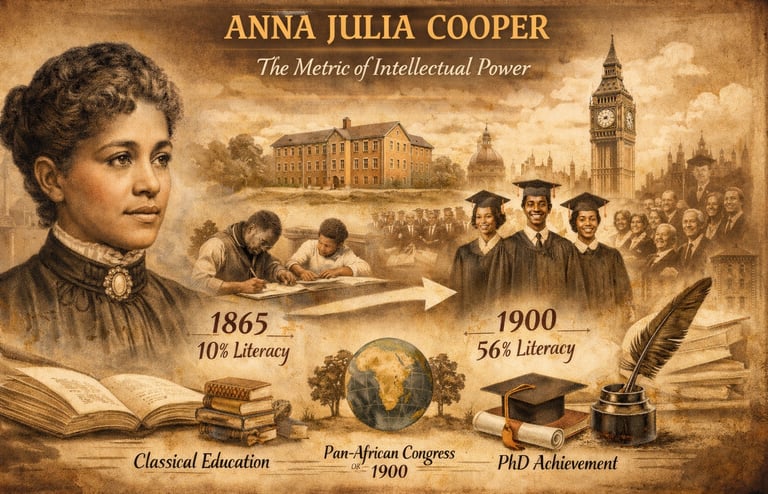
To understand Cooper’s strategy, we must look at the raw data of her era. In 1865, at the end of the Civil War, it is estimated that only 10 percent of Black Americans had basic reading and writing skills. This was the result of centuries of laws that made it illegal for us to learn.
By the year 1900, the literacy rate for the Black community had climbed to roughly 56 percent. This represents one of the most massive leaps in human history. In just 35 years, more than half of a population that had been systematically denied information became literate. Anna Julia Cooper was a primary driver of this trend. She saw these numbers not just as school statistics, but as a measure of our potential for self rule.
The Battle for the Mind: Classical vs. Vocational
Anna Julia Cooper was born in 1858 in Raleigh, North Carolina. While her life began in the era of slavery, her mind was always free. One of the most important chapters of her life was her time as the principal of the M Street High School in Washington DC.
During this time, there was a major debate in the Black community. Some leaders believed we should only focus on vocational training, which meant learning trades like farming or carpentry. They believed this was the only way to survive in a world that was often hostile.
But Cooper disagreed. She knew that survival is not the same thing as sovereignty. She fought for a Classical Education, insisting that Black children learn Latin, Greek, higher mathematics, and philosophy. She did not want us to just be workers; she wanted us to be thinkers and leaders.
The Metric of Excellence at M Street: Under her leadership, M Street was not just a school; it was a laboratory for Black excellence.
Harvard Acceptance: Her students were accepted into Harvard for the first time in the history of the school.
Competitive Edge: Her students consistently outperformed their peers in other schools on standardized exams, proving that intellectual capacity is a matter of access and standards, not race.
The College Pipeline: She successfully sent graduates to Brown, Yale, and Mount Holyoke, proving that excellence is a tool for political leverage.
The 1900 Pan African Congress: A Global Strategy
In July of 1900, Cooper traveled to London for the first Pan African Conference held at Westminster Town Hall. This was a pivotal moment for the Politics Pillar. She was one of only a few women present among roughly 37 official delegates and 10 observers from the United States, the Caribbean, and the African continent.
She helped the global community understand that our struggle was not isolated. She connected the dots between the struggle in the American South and the colonial struggles across the continent of Africa. She helped write the address to the nations of the world, demanding self government. She taught us that sovereignty must be global.
The Power of the Fourth: The PhD Milestone
Anna Julia Cooper proved that the pursuit of excellence has no expiration date. She is famously known as the fourth Black woman to earn a PhD. To understand the weight of this achievement, look at the timeline of intellectual sovereignty:
Georgiana Simpson (June 14, 1921)
Sadie T. M. Alexander (June 15, 1921)
Eva B. Dykes (June 22, 1921)
Anna Julia Cooper (December 29, 1925)
Cooper achieved this at the Sorbonne in Paris at the age of 67. She wrote her thesis in French, analyzing the history of slavery and the French Revolution. She did not seek education for personal gain; she sought it as a form of resistance. She understood that if we did not define ourselves, our enemies would do it for us.
A Voice from the South: The Framework of Justice
In 1892, she published her masterpiece, A Voice from the South. In this text, she laid out a framework for the Pillar of Justice.
She famously argued that the progress of the race is not measured by the achievements of its most successful men, but by the status of its women. She believed that when the Black woman rises, she brings the entire community with her. This is not just a social statement; it is a strategic one. It means that our justice systems must protect and empower everyone, starting with those who have been marginalized the most.
Integrating the Eight Pillars
Education Pillar: The fight for high level classical curriculum.
The Modern Metric: Owning our own digital platforms, schools, and content.
Justice Pillar: Advocating for the central role of women in liberation.
The Modern Metric: Ensuring our community systems protect and empower every member.
Politics Pillar: Leadership at the 1900 Pan African Congress.
The Modern Metric: Building global networks and coordination between the diaspora.
The Modern Application: Digital Sovereignty
How does a woman born in 1858 help a digital creator in 2026? Today, the battle for the mind happens on social media and through algorithms. If we do not define our own culture, the algorithm will define it for us.
Stop Seeking Validation: Cooper did not ask for permission to be excellent. She simply was. We must build our platforms, like The Bantaba, based on our own standards, not the standards of external tech giants.
Invest in Deep Knowledge: Intellectual power is not found in 15 second clips alone. It is found in deep study and the creation of manuals, workbooks, and long form content that preserves our history.
Think Globally: Use the tools of the modern world to connect with the diaspora. Sovereignty is a team sport that spans the globe.
The Core Truth
Anna Julia Cooper proved that even if you start with nothing, your mind can take you anywhere. She lived to be 105 years old, seeing the world move from the era of slavery to the era of the space race.
The metric is clear: Intellectual Power. When we define our own reality, we win.
Suggested Reading
For those who want to deepen their understanding of Intellectual Power and the legacy of Anna Julia Cooper, the following works provide important context and insight.
Primary Works
A Voice from the South – Cooper’s most influential work, outlining her philosophy on education, justice, and the role of Black women in the advancement of society.
The Voice of Anna Julia Cooper – A broader collection of Cooper’s essays, speeches, and reflections.
Related Historical Context
The Souls of Black Folk – A foundational exploration of Black intellectual life and the debate around education and leadership.
Up from Slavery – Provides context for the vocational education perspective that Cooper debated during her lifetime.
Modern Analysis
Anna Julia Cooper: Visionary Black Feminist – Examines Cooper’s intellectual contributions and their influence on modern thought.
Community Discussion (The Bantaba)
Growth happens when ideas move from reading to reflection. Use these prompts to guide discussion and collective learning.
1. Defining Intellectual Power
Cooper believed intellectual power meant defining reality on our own terms.
What does intellectual sovereignty look like in the digital age?
How can communities measure intellectual power today?
2. Classical vs. Vocational Education
During Cooper’s time, there was a major debate between vocational and classical education.
Do you believe communities should prioritize skills training or deep academic study?
Is it possible to build a system that integrates both?
3. Education as a Strategy for Sovereignty
Cooper viewed education not just as learning, but as a pathway to self-rule.
What institutions must exist for a community to control its own knowledge systems?
What role do independent schools, digital platforms, and community learning spaces play today?
4. The Role of Women in Community Advancement
In A Voice from the South, Cooper argued that the status of women reflects the progress of the entire community.
How can modern institutions ensure women’s leadership and protection remain central?
What systems should exist to support this principle in practice?
5. Intellectual Power in the Digital Era
Today, much of culture and knowledge flows through platforms and algorithms.
How can communities protect their narratives and knowledge online?
What role should independent platforms like The Bantaba play?
Strategic Reflection
The life of Anna Julia Cooper reminds us that education is not just a personal achievement. It is infrastructure for freedom.
If sovereignty requires systems, then intellectual power is the system that shapes every other pillar.
The question for our generation is simple:
What institutions will we build to protect and grow that power?
Stay focused. Stay strategic.
THE BLUEPRINT
Building the future of the global African Diaspora through data-driven storytelling and the Eight Pillars of Sovereignty. From survival to ownership.
Contact
Subscribe To the NewsLETTER
hello@blackmetrics.space
Copyright © 2026 The Black Metrics. All Rights Reserved.
The BlaCK METRICS