Anna Julia Cooper: The Blueprint for Black Educational Sovereignty and Intellectual Power
Anna Julia Cooper turned a 10% literacy rate into Harvard acceptances. We break down her strategic framework for Black educational sovereignty in 2026.
EDUCATIONAL, JUSTICE, & POLITICAL SOVEREIGNTY
The Black Metrics
3/12/20269 min read
Anna Julia Cooper: The Blueprint for Black Educational Sovereignty
Peace and blessings to the family. As we transition from the foundational lessons of February into the strategic focus of Women's History Month, we continue our journey of turning data into direction. We acknowledge the ancestors who built the intellectual foundations we stand upon. We also acknowledge you, the community, for choosing to move from survival to sovereignty.
Welcome to this strategic briefing on Anna Julia Cooper. We are not just observing the past. We are mining it for the tools we need to build the future.
Redefining the Metric
In most spaces, people talk about metrics as cold numbers on a screen. But in this series, we define a metric as a yardstick for power. If you are building a house, you use a ruler to ensure the wood is the right length. If you are building a sovereign community, you use metrics to ensure your growth is real and measurable.
For the pillar of Education, our metric is Intellectual Power. This is the ability to define your own reality without seeking validation from external systems. Anna Julia Cooper spent 105 years teaching us how to hold this yardstick. She demonstrated that intellectual sovereignty is not the absence of obstacles. It is the refusal to let obstacles define the ceiling.
Why Educational Sovereignty Is the Foundation
Before examining Cooper's specific contributions, we need to establish why Educational Sovereignty is the foundational pillar from which all others draw their strength.
Sylvia Wynter's analysis is essential here. The modern definition of full humanity was constructed around a specific figure, European, male, propertied, and rational, and embedded into every institution that followed. Educational systems were designed not to liberate but to reproduce that hierarchy by training the included to lead and the excluded to serve. When Black children are educated within systems built on that definition, they are receiving programming, not education. The distinction is critical. Programming installs beliefs about what is possible. Education builds the capacity to define what is possible for yourself. For the full philosophical framework on how that definitional process operates, read Who Decides What It Means to Be Human? Du Bois, Wynter, and the Foundation of Black Sovereignty.
Educational Sovereignty is the reclamation of the power to define intelligence, history, and human capacity on our own terms. Without it, every other pillar operates on a foundation that the system can undermine. Economic strategies built without educational sovereignty will reproduce the limiting beliefs the system installed. Political strategies built without educational sovereignty will seek inclusion rather than demanding independence. Anna Julia Cooper understood this with a clarity that was decades ahead of her era.
The Data of Radical Growth
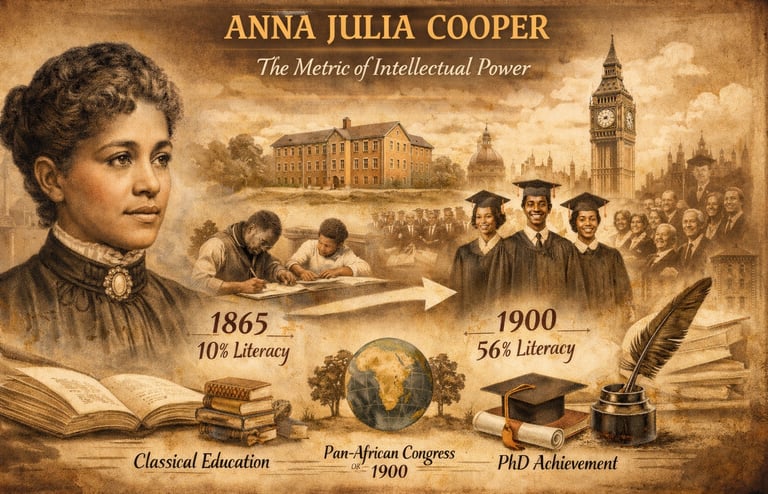
To understand Cooper's strategy, we must start with the raw data of her era. In 1865, at the end of the Civil War, it is estimated that only 10 percent of Black Americans had basic reading and writing skills. This was the direct result of centuries of laws that made it illegal for enslaved people to learn.
By 1900, the literacy rate for the Black community had climbed to roughly 56 percent. This represents one of the most extraordinary transformations in educational history. In just 35 years, more than half of a population that had been systematically denied access to information became literate. Anna Julia Cooper was a primary architect of this transformation. She saw these numbers not just as school statistics but as a measure of the community's potential for self-rule.
The connection she drew between literacy and self-determination was not metaphorical. It was structural. An illiterate community must rely on others to mediate its relationship with legal documents, financial systems, political processes, and historical records. A literate community can access, evaluate, and challenge those systems directly. Literacy is not the end goal of Educational Sovereignty. It is the entry point. Cooper's entire career was built on pushing further from that entry point toward full intellectual capacity.
The Battle for the Mind: Classical vs. Vocational
Anna Julia Cooper was born in 1858 in Raleigh, North Carolina. While her life began in the era of slavery, her mind was never contained by it. One of the most strategically significant chapters of her life was her time as principal of the M Street High School in Washington D.C.
During this period, there was a major debate running through the Black intellectual community. One dominant position, associated with Booker T. Washington and the industrial education model, argued that Black people should focus on vocational training: learning trades like farming, carpentry, and domestic service that the white economic structure had determined were available to them. The argument was pragmatic. It framed Black survival within the constraints of white supremacy's economic appetite rather than challenging those constraints.
Cooper rejected this framework root and branch.
She understood the difference between survival and sovereignty that shapes the entire Black Metrics framework. Survival adjusts to the constraints of hostile systems. Sovereignty builds the capacity to define new constraints. Vocational education, as she understood it in its Washington model, was training Black people to fit more efficiently into a structure designed to exclude them from power. Classical education, which she defended with her career and her reputation, was training Black people to be the architects of new structures.
This was not an abstract philosophical position. She put it into practice at M Street and the results were documented and undeniable.
The Metric of Excellence at M Street
Under Anna Julia Cooper's leadership, M Street was not just a school. It was a laboratory for what Black intellectual capacity produces when given the resources and the standards to develop fully.
Her students were accepted to Harvard for the first time in that institution's history. They consistently outperformed their peers in other schools on standardized examinations, proving in empirical terms that intellectual capacity is a matter of access and standards, not race. She established a college pipeline that sent graduates to Brown, Yale, and Mount Holyoke at a time when Black students at those institutions were practically unheard of.
The political establishment was not pleased. Her results were so strong that she attracted powerful enemies who wanted the M Street curriculum replaced with the vocational model. She was eventually removed as principal in 1906 through a campaign that was explicitly about suppressing the model of Black classical excellence she had built. The attacks on her were not about her competence. They were evidence of her effectiveness.
Here is the strategic lesson that 2026 builders must internalize: when your educational model produces results that the system cannot explain within its own framework, the system will attack the model rather than update its framework. Excellence that contradicts the installed hierarchy is treated as a threat. Anna Julia Cooper's removal was proof of concept. Build anyway.
The 1900 Pan-African Congress: Education as Global Strategy
In July of 1900, Cooper traveled to London for the first Pan-African Conference held at Westminster Town Hall. This was a pivotal convergence of the Education and Politics Pillars at the global level.
She was one of only a few women among roughly 37 official delegates from the United States, the Caribbean, and the African continent. Her presence was not ceremonial. She helped write the Address to the Nations of the World, a formal document demanding self-government for colonized peoples that connected the domestic struggle of Black Americans to the anti-colonial struggles across Africa and the Caribbean.
This is a critical strategic insight that 2026 organizers must hold: educational sovereignty cannot be pursued only locally. The same definitional hierarchy that underfunded Black schools in Washington D.C. was extracting resources from colonized nations in Africa. The same framework that told Black children their intellectual capacity was limited was justifying the exploitation of entire continents. Cooper saw this connection clearly and acted on it globally. She taught us that sovereignty must be coordinated at the scale of the problem it is addressing. For the full analysis of how global coordination amplifies local sovereignty efforts, read Kwame Nkrumah & Funmilayo Ransome-Kuti: Independence vs Black Sovereignty.
The PhD at 67: Sovereignty Has No Expiration Date
Anna Julia Cooper is famously known as the fourth Black woman in American history to earn a PhD. The timeline of that achievement deserves full attention.
Georgiana Simpson received her PhD on June 14, 1921. Sadie T.M. Alexander received hers on June 15, 1921. Eva B. Dykes received hers on June 22, 1921. Anna Julia Cooper received hers on December 29, 1925, at the Sorbonne in Paris, at the age of 67. She wrote her thesis in French, analyzing the attitudes toward slavery in eighteenth-century French revolutionary literature.
She did not seek this degree for personal validation. She sought it as a form of resistance. She understood that if we do not define ourselves on the highest intellectual terms available, our enemies will define us in the lowest terms that serve their interests. A 67-year-old Black woman earning a doctorate in French at the Sorbonne was a political act. It was evidence, produced in the language of the colonizer and validated by the colonizer's highest institution, that no ceiling imposed by a hostile system is structural. All ceilings are political. Political ceilings can be removed.
A Voice from the South: The Justice Framework
In 1892, Cooper published A Voice from the South, the work that established her as a foundational intellectual in African American thought. Within it, she articulated one of the most strategically important claims in the history of Black liberation thinking: the progress of a community is not measured by the achievements of its most successful men but by the status of its women.
This is not only a social justice argument. It is a strategic measurement framework. If you want to know whether a community's liberation project is producing real sovereignty, look at the condition of the people within that community who have been most marginalized. If they are still marginalized within the liberated community, the liberation project has only succeeded in rearranging who sits at the top of a hierarchy rather than dismantling the hierarchy itself.
This metric has direct implications for every pillar of sovereignty in The Black Metrics framework. An Economic Sovereignty project that circulates wealth among community men while leaving community women in economic precarity is not sovereignty. A Political Sovereignty project that builds organizational power while excluding women from leadership is not sovereignty. It is reproduction of a different hierarchy. Cooper's metric demands more. For the full analysis of how this justice framework connects to modern community organizing, read Funmilayo Ransome-Kuti's organizing model in Kwame Nkrumah & Funmilayo Ransome-Kuti: Independence vs Black Sovereignty.
The Modern Application: Digital Educational Sovereignty
How does a woman born in 1858 help a digital creator, educator, or community builder in 2026? The battleground has changed from a school building in Washington D.C. to the algorithmic infrastructure of the internet, but the war is the same.
Today, the battle for the mind happens on social media, through search engine results, through the curriculum of underfunded schools, and through the data sets that train the artificial intelligence systems that increasingly mediate access to information. If we do not define our culture, our history, and our intellectual frameworks on platforms we own, the algorithm will define them for us in ways that reproduce the hierarchy Cooper spent her life challenging.
Stop seeking validation. Cooper did not ask for permission to be excellent. She was excellent and documented the results. We must build our platforms, our schools, our curriculum libraries, and our digital archives based on our own standards rather than the standards of external tech giants whose interests are not aligned with Black intellectual sovereignty.
Invest in deep knowledge. Intellectual power is not found in fifteen-second clips alone. It is found in deep study, in long-form content, in books and workbooks and courses that preserve our history and transmit it with the rigor it deserves. The algorithm rewards short-form engagement. Sovereignty requires long-form depth. Build both.
Think globally. Use the tools of the modern world to connect Black intellectual production across the diaspora. A curriculum developed in London should be accessible in Lagos. A historical framework built in Atlanta should be in conversation with scholars in Accra. Sovereignty is a team sport that spans the globe. Cooper understood this at the 1900 Pan-African Congress. We have better tools for it than she did. The question is whether we are using them with the same strategic intention.
The Bantaba: Discussion Questions
Cooper argued that survival and sovereignty are different goals requiring different strategies. In what area of your community's current educational approach are you optimizing for survival within the system rather than sovereignty outside it?
Her results at M Street were so strong they attracted institutional attacks. Where is excellent Black educational work currently being suppressed or undermined, and what would defending it look like?
A Voice from the South argues that the status of the most marginalized women in a community is the true measure of its progress. Apply that metric to your current organization or community. What does it reveal?
Cooper earned her PhD at 67. What limiting beliefs about when it is too late to build, learn, or launch are operating in your community? Where did those beliefs come from?
She connected the local struggle for Black education to the global anti-colonial movement in 1900. What global connections does your local educational work need to build to operate at the scale of the problem it is addressing?
Recommended Reading
A Voice from the South by Anna Julia Cooper — Her most influential work. Read it as a sovereignty framework, not just a historical document.
The Voice of Anna Julia Cooper — A broader collection of her essays and speeches that reveals the full scope of her strategic thinking.
The Souls of Black Folk by W.E.B. Du Bois — Essential companion text for understanding the intellectual context Cooper was building within.
Anna Julia Cooper: Visionary Black Feminist — A modern analytical examination of her intellectual contributions and their continued relevance.
This is the work of Educational Sovereignty. Volume Four, Reclaiming the Mind, drops May 2026.
→ Join the waitlist → Ebooks
Stay focused. Stay strategic.
THE BLUEPRINT
Contact
hello@blackmetrics.space
Copyright © 2026 The Black Metrics. All Rights Reserved.
The BlaCK METRICS
The Pillars
Strategic Stream Blog