Black Employment Sovereignty: Why the Job Is Just the Starting Point to Real Wealth
Your job is not the destination. It's the starting capital. We break down the employment trap and the five-step framework for Black business sovereignty.
ECONOMIC, EMPLOYMENT, & BUSINESS SOVEREIGNTY
The Black Metrics
4/12/20269 min read
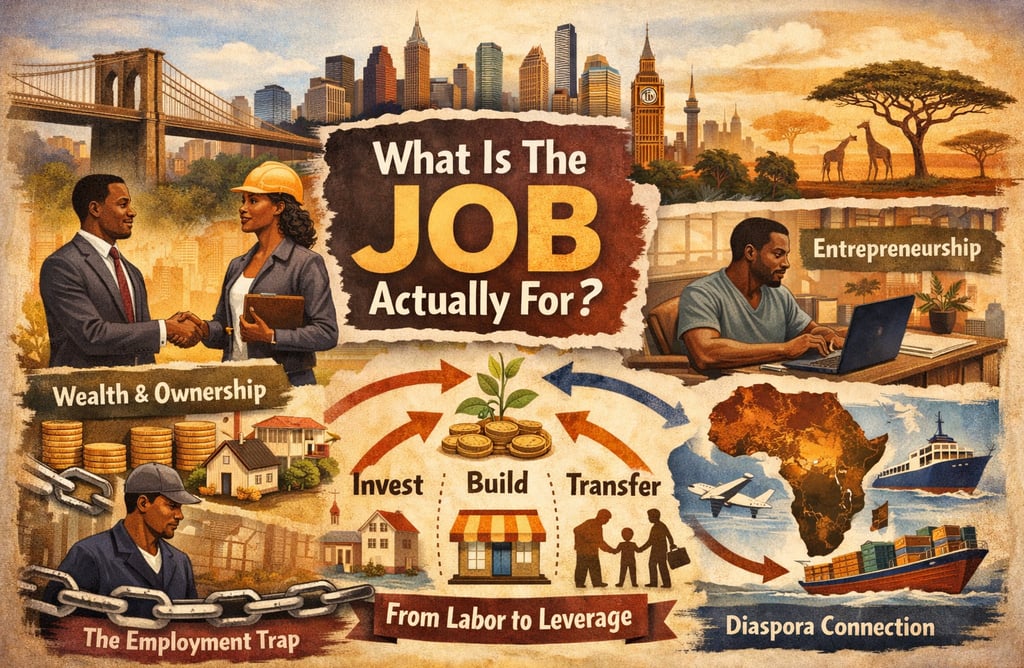
Black Employment Sovereignty: Why the Job Is Just the Starting Point
There is a question that does not get asked enough in our communities.
Not "how do I get a good job?" We have been asking that for generations. The question that changes everything is this: what is the job actually for?
For most Black families across the diaspora, in Brooklyn, Atlanta, London, Toronto, Lagos, and Kingston, employment was positioned as the destination. Get the degree. Get the job. Keep the job. That was the blueprint handed down through generations shaped by survival, not sovereignty. And it worked, in the sense that it kept people alive, fed families, and produced a generation of educated, skilled, capable workers.
But it did not produce wealth. It did not produce ownership. And it did not produce power.
This is the gap that Employment & Business Sovereignty is designed to close.
Why the Question Matters More Than the Answer
Before we get to the framework, we need to sit with the question itself. Because the question you ask determines the strategy you build.
If the question is "how do I get a good job," the strategy is resume optimization, credential accumulation, and network access within existing institutional structures. That strategy produces employment. It does not produce sovereignty.
If the question is "what is the job for," the strategy changes entirely. Now you are asking about purpose, leverage, and direction. You are asking how employment fits into a larger architecture of ownership rather than treating it as the architecture itself.
This shift in framing is not semantic. It is structural. Every ancestor examined in The Black Metrics briefing series understood this distinction intuitively. Marcus Garvey did not build the UNIA by optimizing for employment within the colonial system. He built infrastructure outside of it. Claudia Jones did not launch the West Indian Gazette by climbing the British media ladder. She built her own press. Amy Jacques Garvey did not serve the movement by seeking institutional validation. She built the systems that made the institution function. For the full analysis of how that organizational model applies today, read Amy Jacques Garvey: The Blueprint for Black Organizational Strategy and Sovereignty Systems.
The job is the starting capital. The question is what you are building with it.
The Employment Trap: A Structural Analysis
Let us be precise about what a job actually is.
A job is an agreement. You sell a fixed number of hours to an organization in exchange for a wage. That wage covers your cost of living: housing, food, transportation, healthcare, and if you are disciplined, perhaps a small surplus that goes into savings or retirement. The organization, meanwhile, takes the value your labor generates and converts it into revenue, profit, and equity. None of which belongs to you.
This is not a moral argument against employment. It is a structural observation. And the data confirms it.
According to the Federal Reserve's Survey of Consumer Finances, the median White family holds approximately eight times the wealth of the median Black family. That gap is not primarily explained by income differences. Black workers earn less, yes, but the wealth gap persists even when income levels are comparable. The difference is ownership. White households accumulate wealth through business equity, real estate, and inherited assets. Black households, historically locked out of those pathways through explicit policy and systemic exclusion, accumulate primarily through wages, which by definition do not compound.
A paycheck spends once. Ownership compounds for generations.
The redlining that prevented Black families from accessing federally backed mortgages, the discriminatory lending practices that denied Black entrepreneurs capital, the legal systems that stripped Black-owned land and businesses through violence and policy: these were not failures of individual effort. They were structural exclusions from the compounding mechanisms of wealth. The employment trap is what remains when every pathway to ownership has been systematically blocked. Understanding the full structural context of that exclusion is essential before building the path out of it. For the historical blueprint, read When the Declaration Became Conditional: Black Sovereignty and America's Broken Promise.
The Psychology of the Trap
Beyond the structural barriers, there is a psychological dimension to the employment trap that operates at the level of installed belief.
Many Black families transmitted the job-as-destination blueprint not because they lacked vision but because survival required certainty. In environments where discrimination made self-employment risky and where capital access was blocked, employment in a stable institution represented the most reliable pathway to stability. That was rational strategy under specific conditions.
The challenge is that strategies developed for hostile survival conditions can persist long after the conditions have partially shifted, becoming constraints rather than tools. The cycle of internalized programming explains how beliefs installed during periods of necessity get transmitted as permanent truths. Children raised in households where employment security was the highest attainable goal absorb that ceiling without inheriting the historical context that produced it. For the full analysis of how that transmission works and how to interrupt it, read The Cycle of Internalized Programming: How Beliefs Are Installed, Reinforced, and How to Break the Loop.
Naming this is not blame. It is diagnosis. And accurate diagnosis is the prerequisite for effective strategy.
What Employment & Business Sovereignty Actually Means
Employment & Business Sovereignty is the eighth pillar of the Sovereignty Series, and it is one of the most misunderstood. It does not mean "quit your job and start a business." That is not a strategy. That is a slogan.
What it actually means is this: transform your relationship to work from labor sold to leverage built.
That transformation happens in stages and it looks different for everyone. For some, it begins with redirecting a portion of employment income into a business that generates parallel revenue. For others, it means converting existing skills, the same skills you sell to an employer, into a service you own and deliver independently. For diaspora builders operating across borders, it means identifying the capital concentrated in Western economies and connecting it intentionally to the productive capacity and opportunity on the African continent.
The mandate of this pillar is clear: bridge diaspora capital with continental opportunity to build cross-border enterprises and generational legacies.
The strategic metric we track is equally specific: the growth of Black-owned equity stakes and the longevity of Pan-African cross-border enterprises. Not just businesses that open but businesses that last, that transfer, that scale, and that create ownership for the next generation.
The Three Barriers We Have to Name
Before we build, we have to be honest about what has held us back. Three structural barriers appear consistently in both the data and on the ground.
The Access to Capital Gap
Black-owned businesses receive a disproportionately small share of small business loans, venture capital, and institutional investment. A 2023 Federal Reserve report found that Black business owners are denied credit at nearly twice the rate of White business owners, and when they do receive funding, they receive smaller amounts at higher rates. This is not about creditworthiness. It is about a system designed to gatekeep capital from communities it was never intended to build.
The venture capital landscape tells the same story. Black founders receive less than one percent of venture capital funding annually despite representing a growing share of new business formation. The issue is not pipeline. It is access to the rooms where funding decisions are made. Those rooms were built deliberately over decades to exclude us. Building our own investment networks, angel funds, and Community Development Financial Institutions is not optional. It is the infrastructure that makes everything else possible. The mutual aid and credit union strategies outlined in Stop Asking Start Building: The Blueprint for Black Community Economic Self-Determination are the community-level foundation of this infrastructure.
The Scale Ceiling
The majority of Black-owned businesses in the United States are sole proprietorships: one person, no employees, no equity to distribute, no infrastructure to transfer. They generate income for one person. They do not build institutional capacity. They do not create procurement budgets that support other Black-owned vendors. They have nothing worth transferring when the founder is ready to exit.
A sole proprietorship is self-employment. It is better than being purely employed by someone else, but it is not sovereignty. Sovereignty requires employer firms with employees, systems, and succession plans. An employer firm with five employees generates income for five families, builds institutional knowledge, creates a supply chain that can support other Black-owned businesses, and has something worth transferring when the founder exits. Scale is not about ego. It is about how many people one business decision can stabilize. We need more employer firms, not just more entrepreneurs.
The Diaspora Disconnect
There are over 200 million people of African descent outside the African continent. That is an enormous concentration of skills, education, and capital. And yet the flow of coordinated investment between diaspora communities and the continent remains a fraction of what it could be. The connections exist culturally. They have not yet been structured economically.
The African Continental Free Trade Area, now the world's largest free trade zone by number of participating countries, represents a historic opening. It is creating conditions for intra-African trade and investment at a scale that did not exist a decade ago. Diaspora entrepreneurs who position themselves now, as importers, distributors, technology partners, and capital connectors, will be early movers in an economic shift that will define the next generation of Black wealth. The window is open. The question is whether we are organized enough to walk through it together. For the full analysis of how the AFCFTA changes diaspora positioning, read Kwame Nkrumah & Funmilayo Ransome-Kuti: Independence vs Black Sovereignty.
The Blueprint in Practice
Here is what this looks like when it moves from theory to execution.
Step One: Audit Your Labor
What skills do you sell to your employer? Write them down specifically. Not your job title. Your actual skills. Communication, financial analysis, project management, software development, research, logistics, client relationship management, curriculum design, healthcare coordination. These skills have market value outside of your employment contract. That list is the foundation of your parallel economy. You already have the inventory. The question is whether you are selling it wholesale to one buyer or building a business around it.
Step Two: Build a Parallel Income Stream
Before you exit employment, build beside it. Freelance, consult, create, generate independent revenue using the skills you already have. Prove the market before you bet everything on it. This is not about working two jobs indefinitely. It is about validating the business model with real market data while employment income covers your baseline costs. When parallel revenue consistently meets or exceeds employment income, you have evidence. Build from evidence, not from hope.
Step Three: Redirect Capital Intentionally
A portion of every paycheck should move toward equity: business ownership, property, or investment in Black-owned enterprises. This is not about sacrifice. It is about reallocation. Every dollar that circulates within our economic ecosystem touches more hands, creates more jobs, and builds more ownership before it exits the community. The goal is to extend the velocity of the dollar from hours to days. For a community-level framework on redirecting capital, read Stop Asking Start Building: The Blueprint for Black Community Economic Self-Determination.
Step Four: Connect Across the Diaspora
Find your counterparts. The entrepreneur in Atlanta needs to know the manufacturer in Accra. The developer in London needs to know the real estate opportunity in Nairobi. The tech founder in Toronto needs to know the talent pipeline in Lagos. These connections do not happen by accident. They require infrastructure, intentional relationship building, and platforms designed to facilitate them. Claudia Jones understood this when she used the West Indian Gazette to connect Black communities across the Atlantic. The mechanism has changed. The strategic principle has not. For the full analysis of how she built cross-diaspora economic infrastructure, read Claudia Jones: The Blueprint for Black Economic Internationalism and Pan-African Sovereignty.
Step Five: Build to Transfer
A business that cannot outlast its founder is not sovereignty. It is self-employment with more complexity. From the beginning, build with systems, documentation, and succession in mind. Write the standard operating procedures. Build the organizational chart. Train the next layer of leadership. The goal is not just a business that works while you run it. The goal is an institution that runs without you and eventually transfers to the next generation with its value intact. Amy Jacques Garvey spent years ensuring the UNIA could function when its central figures were removed. That is the standard.
The Metric We Track
The Black Metrics does not just frame problems. We track progress.
The metric for Employment & Business Sovereignty is not the number of businesses opened. It is the number that survive beyond five years. It is the number that have employees. It is the volume of Black-owned equity that exists a decade from now compared to today. It is the strength of the economic bridge between diaspora capital and continental opportunity.
We are not just building companies. We are building the infrastructure of sovereignty. And that infrastructure is measured not by launches but by longevity, not by revenue but by ownership, not by individual success but by collective capacity.
Your job is not the goal. It is the starting capital for something bigger.
The Bantaba: Discussion Questions
What skills are you currently selling exclusively to one employer? What would it take to begin selling those same skills independently, even at small scale?
The scale ceiling keeps most Black-owned businesses at sole proprietorship level. What would it take to hire your first employee and what would that change about the business's capacity?
The diaspora disconnect between Black communities in the West and productive opportunity on the African continent is structural, not cultural. What specific economic bridge could you build between your current location and the continent?
Building to transfer requires systems documentation from the beginning. What is one process in your current work that could be documented this week?
The employment trap is partly structural and partly psychological. Which dimension is the primary barrier for you right now, and what is the specific next step to address it?
Recommended Reading
The Wealth of Nations vs. The Poverty of Nations — Understanding how capital accumulation operates at the structural level before attempting to build at the individual level.
The E-Myth Revisited by Michael Gerber — The foundational text on building systems rather than self-employment, directly relevant to the scale ceiling analysis.
How to Be an Antiracist by Ibram X. Kendi — Essential context for understanding the policy dimension of the capital access gap.
The Alchemist of Race — For understanding the long history of Black entrepreneurship and the structural barriers that have consistently limited its scale.
This is the work of Economic and Employment & Business Sovereignty. The full blueprint is in Volume Two and Volume Three. → Get Volume Two: Economic Sovereignty → Get Volume Three: Employment & Business Sovereignty
THE BLUEPRINT
Contact
hello@blackmetrics.space
Copyright © 2026 The Black Metrics. All Rights Reserved.
The BlaCK METRICS
The Pillars
Strategic Stream Blog