Claudia Jones: The Blueprint for Black Economic Internationalism and Pan-African Sovereignty
Claudia Jones built a newspaper and a carnival under suppression. We break down her operational framework for Black economic internationalism in 2026.
ECONOMIC & POLITICAL SOVEREIGNTY
The Black Metrics
3/28/20269 min read
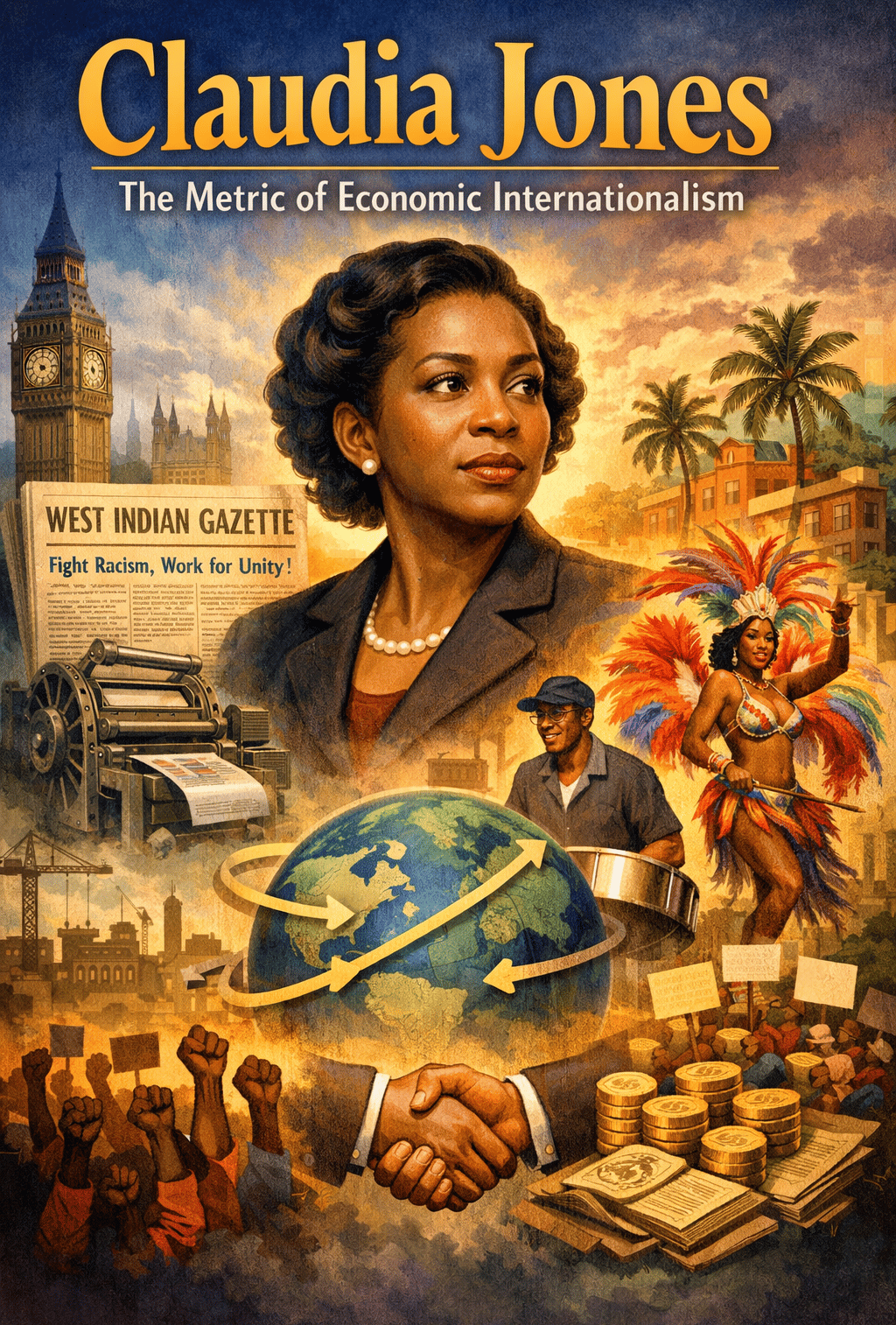
Claudia Jones: Blueprint for Black Economic Internationalism
Peace and blessings, family. As we conclude our Women's History Month Strategic Briefings, we acknowledge the ancestors who built the operational frameworks of our liberation. We also acknowledge you, the strategic community, for doing the work to manifest them today. Welcome to this briefing on the revolutionary mind of Claudia Jones.
Beyond Activism: The Strategic View
At The Black Metrics, we analyze history to find the standard operating procedures that create sovereignty. When we study Claudia Jones, we do not just see an activist. We see an architect of Economic Internationalism.
Economic Internationalism is our metric for this briefing. It is the ability of a community to use its economic power to protect its people regardless of the physical borders they live within. It is the deliberate construction of economic infrastructure that connects Black communities across national boundaries and makes collective power durable against any single government's hostility.
Claudia Jones understood something that most of her contemporaries were still debating: a community cannot achieve political power without independent economic infrastructure, and that infrastructure must be built to function under hostile conditions, not just favorable ones. She proved that when the Economics Pillar and the Politics Pillar work together, the result is a force that cannot be easily dismantled.
What makes her model especially powerful is that she built it under active suppression. She was surveilled by the FBI for over a decade. She was imprisoned multiple times. She was deported. And still, within two years of arriving in London with almost nothing, she had launched a newspaper and begun organizing a carnival. That is not resilience as inspiration. That is systems thinking as operational strategy. The infrastructure she built was not dependent on favorable conditions. It was designed to function in hostile ones. For the full framework on building sovereign systems that survive disruption, read Marcus Garvey: The Pan African Blueprint for Black Sovereignty.
Who Was Claudia Jones: The Full Strategic Biography
Claudia Jones was born Claudia Vera Cumberbatch in 1915 in Port of Spain, Trinidad. At age eight, she emigrated with her family to Harlem, New York. The conditions of her early American life were not abstract. Her mother died young from overwork and poverty. She herself contracted tuberculosis, a disease strongly associated with the overcrowded, underserved conditions of Harlem tenement life. These were not personal misfortunes. They were the documented outcomes of a system designed to extract labor from Black and immigrant communities while providing minimal infrastructure in return.
Jones understood this from lived experience before she understood it theoretically. When she encountered Marxist and Pan-African thought in her late teens and early twenties, she had the analytical framework to name what she had already experienced structurally. She joined the Communist Party of the United States not as an ideological conversion but as a strategic alignment with the most organized force in her environment that was actively fighting for Black and working-class rights.
Her theoretical contributions were significant. Her 1949 essay "An End to the Neglect of the Problems of the Negro Woman" was a foundational document in what we would today call intersectional analysis. She argued that Black women occupied the most exploited position in American society: as workers, as women, and as Black people simultaneously. She did not frame this as victimhood. She framed it as a strategic observation: the liberation of the most oppressed member of a community is the measure of the liberation of the whole community. Anna Julia Cooper had made this same argument in A Voice from the South half a century earlier. For the full analysis of Cooper's framework, read Anna Julia Cooper: The Blueprint for Black Educational Sovereignty and Intellectual Power.
The FBI, the Deportation, and the Strategic Pivot
For most of the 1940s and early 1950s, Jones was under continuous FBI surveillance. She was arrested multiple times under the Smith Act, which criminalized membership in organizations that advocated the overthrow of the government. She was imprisoned and her health, already compromised by tuberculosis, was severely damaged by the conditions of her incarceration.
In 1955, she was deported to the United Kingdom, framed as a Trinidadian national despite having lived in the United States for over four decades. The intention was to silence her. The outcome was the opposite.
The deportation is strategically instructive because of what Jones did next. She did not retreat. She did not seek accommodation within the British system that had received her. She arrived in London and immediately began building infrastructure. This is the operational discipline that defines her as a model rather than simply a martyr. She understood that the work does not wait for conditions to improve. The work is what improves conditions.
The Blueprint: The West Indian Gazette
Jones's first strategic move in London was to found the West Indian Gazette in 1958. This was not a side project or a community newsletter. It was her primary economic and political infrastructure simultaneously.
By owning the means of production, which is to say the press itself, she secured the community's ability to communicate without external censorship. Every editor, every journalist, every vendor, every reader of the West Indian Gazette was participating in an act of economic self-determination. The paper was funded by community subscriptions, not by colonial institutions or corporate advertisers whose interests might require editorial compromise. It employed Black journalists in a media landscape that refused to hire them. It connected the West Indian community in Britain to anti-colonial movements in Africa and the Caribbean through its reporting.
The Negro World newspaper, which Amy Jacques Garvey edited for the UNIA, had performed this same function for a global Black audience a generation earlier. The West Indian Gazette was the same strategic infrastructure deployed in a different context. Both newspapers understood something that remains true in 2026: whoever controls the signal controls the narrative, and whoever controls the narrative shapes the conditions under which organizing is possible. For the full analysis of the Negro World as organizational infrastructure, read Amy Jacques Garvey: The Blueprint for Black Organizational Strategy and Sovereignty Systems.
The modern equivalent of the West Indian Gazette is not a newspaper. It is a website you own, an email list you control, a platform whose algorithm you are not subject to. The Black Metrics website at blackmetrics.space is built on this same principle. The medium changes. The strategic necessity does not.
The Strategy: Transforming Culture Into Commerce
Following the racist attacks in Notting Hill in 1958, which targeted West Indian residents in coordinated mob violence, Claudia Jones recognized that the community needed both a voice and an economy. She did not simply lead a protest, though protest was warranted and necessary. She created a system. She founded an indoor Caribbean Carnival, the direct forerunner to what became the Notting Hill Carnival.
This was a masterful execution of Pan-African economic strategy operating on multiple levels simultaneously.
The Politics Pillar was activated through public statement. The carnival was a declaration of unity and defiance. It governed the community's narrative about itself and reclaimed public space that violence had attempted to take.
The Economic Pillar was activated through production. The event became a micro-economy. It created jobs for Black artists, caterers, designers, photographers, and entrepreneurs. It circulated money within the community rather than extracting it outward. Jones understood what she called the Economics of Joy: cultural expression is not separate from economic infrastructure. It is one of the most powerful forms of it.
The deeper lesson is sequencing. Jones did not wait for political safety before building economically. She built the economic infrastructure as the political act. The carnival was simultaneously a press conference, a fundraiser, a hiring program, and a community bond instrument. That is what a sovereign system looks like in motion: multiple pillars activated through a single strategic deployment.
This is directly relevant to community builders in 2026 who are trying to determine where to begin. The answer is not to wait until conditions are more favorable. The answer is to build in a way that creates favorable conditions as a byproduct of the building itself. Every Black-owned business that hires from its community is activating the Employment Pillar. Every community event that deliberately contracts Black vendors is activating the Economic Pillar. Every platform that carries Black history to Black audiences is activating the Educational Pillar. For a complete framework on how to activate multiple pillars simultaneously through economic action, read Stop Asking Start Building: The Blueprint for Black Community Economic Self-Determination.
The Four Operational Directives
We use the Metric of Economic Internationalism today to measure our readiness for sovereignty in 2026. Claudia Jones's model gives us four operational directives that are as applicable now as they were in 1958.
Directive One: Secure Your Own Platform
You must stop renting space on platforms you do not control. While social media provides reach, your core business, your database, your content library, and your community relationships must exist on infrastructure you own. A platform you do not own can de-platform you. An algorithm you do not control can suppress you. Your owned platform is your modern West Indian Gazette.
The question to ask yourself this week: if every social media platform you use disappeared tomorrow, would your community still have a way to find you, fund you, and follow your work? If the answer is no, that is your next build. Not your next post. Your next build.
Directive Two: Turn Cultural Capital Into Community Wealth
Every event, conference, festival, and gathering must be designed as an intentional economic engine. When Black communities gather, the Economics of Joy must be applied deliberately: hire your own caterers, photographers, security, designers, and vendors. Require it as a condition of your participation in organizing. If our events do not produce wealth that stays in our community, they are community experiences without community infrastructure. The gathering should be the mechanism through which the community's economic network is activated and strengthened, not just celebrated.
Directive Three: Coordinate Globally
Use modern digital tools to ensure that when we produce wealth, its collective effect is durable. Economic Internationalism in 2026 means a business in Trinidad can coordinate economically with a creator in London and a product team in Lagos simultaneously. The technology to do this exists. The organizing infrastructure to use it strategically does not yet exist at the scale we need. Building it is the work. When we coordinate our spending, production, and investment across borders, we create an international economic network that no single government can disrupt because it does not live within a single jurisdiction.
This is what Malcolm X was reaching toward when he argued for taking the Black struggle from civil rights to human rights jurisdiction. The same jurisdictional logic applies economically. A community whose economic infrastructure spans multiple nations is harder to suppress than one whose economic life is entirely contained within the borders of a single hostile state. For the full analysis of Malcolm X's jurisdictional strategy, read Malcolm X & Queen Mother Moore: The Blueprint for Black Reparations and Sovereignty.
Directive Four: Build for Hostile Conditions
Claudia Jones did not build the West Indian Gazette assuming peace. She built it knowing the system would push back. She built it knowing she might be imprisoned again. She built it to function anyway.
Every piece of infrastructure you build must be designed to survive disruption. Ask this question about every system you are building: if the primary external support for this disappeared tomorrow, does the core infrastructure survive? If your community organization depends on a single social media platform, it does not survive. If your revenue depends entirely on one client or one platform, it does not survive. Distributed infrastructure is sovereign infrastructure. Build redundancy in from the beginning.
The Core Truth
The manual has been written. Claudia Jones proved that when we are organized, our cultural, political, and economic power are not separate forces. They are a single force expressed through different channels simultaneously.
She was imprisoned. She was deported. She was surveilled. She built anyway. And what she built, the West Indian Carnival tradition, continues to generate millions of pounds of economic activity annually in the city that tried to break her.
Stop being a crowd. Start being a system.
The Bantaba: Discussion Questions
Claudia Jones built the West Indian Gazette because she understood that rented platforms cannot be trusted in hostile conditions. What infrastructure do you currently own versus rent? What is your plan to shift the balance?
The Economics of Joy turns cultural gatherings into economic engines. What Black events in your community are currently missing the economic activation layer? What would it take to add it?
Jones built under active government suppression including imprisonment and deportation. What is the current threat environment for Black economic infrastructure in your community, and how are you building for it?
Economic Internationalism requires cross-border coordination. What is one economic connection you could intentionally build between your local community and another Black community in a different country this year?
The West Indian Carnival now generates millions annually. What cultural assets in your community have economic potential that has not yet been activated or captured by the community itself?
Recommended Reading
Left of Karl Marx: The Political Life of Black Communist Claudia Jones by Carole Boyce Davies — The definitive strategic biography. Essential reading for understanding how her political theory informed her economic practice.
Beyond the Mother Country: West Indians and the Notting Hill White Riots by Edward Pilkington — Essential context for understanding the Justice Pillar dimension of the carnival's founding.
Claudia Jones: Beyond Containment edited by Carole Boyce Davies — A collection of her own writings that reveals the full scope of her theoretical and strategic thinking.
This is the work of Economic Sovereignty. The full blueprint, 10 chapters, cooperative economics frameworks, land trust strategies, and a 10-year wealth plan, is in Volume Two.
→ Get your copy → Economic Sovereignty
THE BLUEPRINT
Contact
hello@blackmetrics.space
Copyright © 2026 The Black Metrics. All Rights Reserved.
The BlaCK METRICS
The Pillars
Strategic Stream Blog