From Surviving to Scaling: How Black Businesses Build Generational Institutions
A strategic breakdown of how Black-owned businesses move from survival to scale by building institutions through cooperative economics, vertical integration, and connected ecosystems that generate lasting wealth.
EMPLOYMENT & BUSINESS SOVEREIGNTY
The Black Metrics
4/28/20269 min read
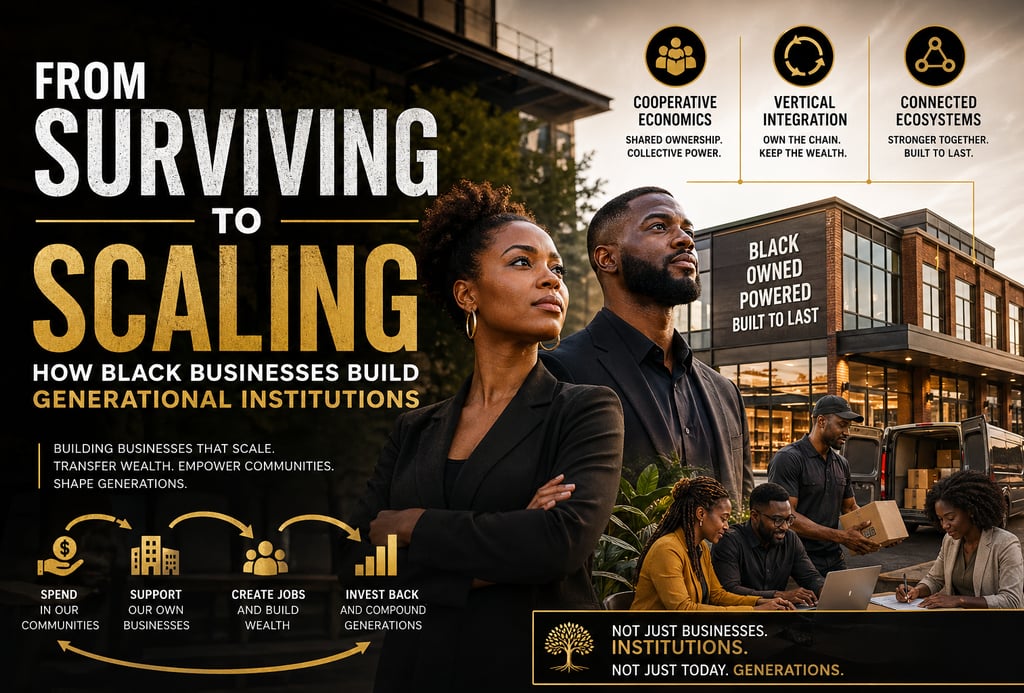
From Surviving to Scaling: How Black Businesses Build Generational Institutions
Most Black-owned businesses are built to survive. The ones that change communities are built to scale, transfer, and compound.
That distinction is not about ambition. It is about architecture. It is about whether a business is built around a person or built as an institution. Whether it generates income for one household or creates ownership for an entire ecosystem.
The third and final pillar of this month's strategic briefing addresses exactly that transition. Not the barriers we face. We have named those. Not the theory of what sovereignty means. We have laid that foundation. This is the operational answer to one specific question:
Once we decide to build, what does building to last actually look like?
The answer lives in three interlocking strategies: cooperative economics and shared ownership models, vertical integration and the Sovereignty Loop, and the connected business ecosystem. Together, these three frameworks represent the architecture of institutions that do not just survive. They compound.
The Structural Problem: Why Individual Ownership Has a Ceiling
Before we get to the solution, we need to be precise about the problem.
Chapter 2 of Employment and Business Sovereignty introduced the Sovereignty Deficit, which is the gap between the growth in Black-owned business quantity and the near-absence of growth in employer firms, defined as businesses with more than one employee. As of 2025, only 3.4 percent of Black-owned businesses are employer firms.
That number reflects a structural ceiling, not a personal one. Individual ownership without collective infrastructure produces businesses that are fragile by design. When the founder is sick, the business stops. When the founder retires, the business closes. When the founder cannot secure capital alone, the business stalls.
The dominant narrative of entrepreneurship in America centers the lone founder. One visionary, one company, one outcome. That model was never designed to produce community-wide economic transformation. It produces income. It does not produce institutions.
Institutions are built differently. They are built cooperatively, vertically, and systemically. Here is what each of those looks like in practice.
Cooperative Economics: The Model That Scales Beyond the Individual
Cooperative economics is not a new concept. It is a proven model that has been deployed globally to build durable economic ecosystems. What distinguishes it within a sovereignty framework is intentionality. The goal is not simply shared ownership. It is strategic coordination.
When multiple individuals align their capital, labor, and expertise under a unified structure, they create an entity that is greater than the sum of its parts. This is how small players compete in large markets. This is how fragmented effort becomes coordinated power.
Employee Stock Ownership Plans
An Employee Stock Ownership Plan is a retirement benefit plan that allows employees to become partial or full owners of the company they work for. Instead of profits being extracted by a single owner or external investors, they are reinvested and shared internally.
When a Black-owned business transitions to an Employee Stock Ownership Plan, workers are transformed from wage earners into equity holders. That shift has measurable implications. Employees who own shares are more likely to remain with the company, more likely to increase productivity, and more likely to think long-term about the health of the institution. Retention improves because the incentive structure changes. Workers are no longer just earning income. They are building assets.
From a sovereignty perspective, Employee Stock Ownership Plans serve as a wealth distribution mechanism that keeps value circulating within the community rather than extracting it outward. Over time, worker-owners accumulate equity that can be leveraged for homeownership, business creation, or further investment.
In practice, this model has been used by Black-owned manufacturing and service firms whose founders prepared for retirement. Rather than selling to external buyers, which often results in layoffs, relocation, or closure, these founders converted their companies into Employee Stock Ownership Plans. Employees gradually acquired shares. Leadership was transitioned internally. Jobs remained local, institutional knowledge was preserved, and wealth stayed within the community.
Cooperative Retail and the Power of Collective Scale
Beyond Employee Stock Ownership Plans, cooperatives allow small entrepreneurs to pool resources in ways that individually would be impossible.
Bulk purchasing lowers the cost of goods sold. Individually, small businesses often lack the purchasing power to negotiate favorable pricing. Collectively, they operate at scale, reducing input costs, increasing margins, and improving competitiveness against larger corporate entities.
Shared marketing compresses one of the most capital-intensive costs of running a business. Large corporations dominate visibility through sustained advertising budgets. Cooperatives enable shared marketing platforms, joint campaigns, collective branding, and centralized digital presence, allowing smaller firms to reach broader audiences without bearing the full cost individually.
Collective bargaining secures better rates for insurance, shipping, and logistics. These services are typically priced based on scale. A cooperative creates that scale. By negotiating as a unified entity, members secure lower rates and better terms, reducing overhead and increasing profitability across the entire network.
A documented example of cooperative power in action comes from collective retail models where multiple small producers unified under a single distribution brand. Instead of each entrepreneur attempting to secure shelf space independently, the cooperative negotiated as a group with retailers and built its own distribution channels. Black-owned food and consumer goods producers who operated this way entered markets that would otherwise have been inaccessible.
Cooperative economics does not eliminate entrepreneurship. It amplifies it.
Vertical Integration: Owning the Entire Value Chain
Vertical integration is the strategy of owning multiple stages of the value chain, from production and logistics to distribution and retail. It is one of the most powerful mechanisms for retaining wealth within a community because it closes the leak points where money exits.
Every outsourced function is a potential point of value loss. When a business pays an external shipping company, that money leaves the ecosystem. When a business pays an external marketing agency, that money leaves the ecosystem. When inventory is purchased from an external supplier with no community connection, that money leaves the ecosystem.
Vertical integration converts those exits into internal circulation.
The Sovereignty Loop: A Practical Model
Chapter 7 of Employment and Business Sovereignty introduces a framework called the Sovereignty Loop through a specific example that makes the principle concrete.
Consider a community-owned furniture brand. Under what the book calls the Extraction Model, the brand manufactures a chair but pays an external shipping company 30 percent of the sale price for delivery. That 30 percent immediately leaves the community. It pays an external driver, maintains an external truck, and generates profit for an external company.
Under the Sovereignty Model, the furniture brand partners with a community-owned logistics fleet. The shipping fee stays within the ecosystem, paying a local driver and maintaining a local truck. The wealth remains internal. It circulates.
That single structural decision changes the economic outcome of every transaction the business ever makes. Multiplied across dozens of businesses and thousands of transactions, the Sovereignty Loop becomes the mechanism by which community spending is retained and converted into local wealth.
A real-world illustration of this principle comes from independent e-commerce brands that shifted from third-party fulfillment providers to in-house or partner-owned logistics operations. As they scaled, some transitioned to owning or co-owning warehouse spaces and delivery operations, reducing costs, increasing delivery speed, and creating additional revenue streams by offering fulfillment services to other businesses. In communities where this model is applied collectively, logistics becomes not just a support function but a standalone economic engine.
The Specialty Coffee Framework: A Blueprint Across Industries
The eBook uses the specialty coffee industry to illustrate how vertical integration produces structural dominance within a market. Historically, Black communities have been positioned as the primary producers of the raw material and heavy consumers of the finished product. The wealth gap exists in the middle, the high-margin stages of roasting, branding, and wholesale distribution.
A sovereign enterprise does not simply open a storefront to sell another company's product. It establishes its own roasting facility. By owning the production, the intellectual property, and the retail outlet, the business captures the entire value chain. It creates high-skilled manufacturing jobs, keeps markup profits within the community ecosystem, and ensures that the business is not dependent on external suppliers who could raise prices or cut off access at any moment.
This framework is replicable across industries, food production, textiles, construction materials, and beyond. The principle is constant: control the middle, capture the margin.
True power is not found in the transaction. It is found in the infrastructure that makes the transaction possible.
Connected Business Ecosystems: The Architecture of Interdependence
Isolation is the enemy of scale. When Black businesses operate as independent islands, each one is forced to independently solve for capital access, service procurement, customer acquisition, and infrastructure development. That redundancy increases costs, limits scalability, and eliminates collective bargaining power.
A connected ecosystem changes the structural math. Each business in the network strengthens the next. Value circulates internally before it exits. Costs decrease. Reach expands. Resilience increases.
The Business-to-Business Community Strategy
The first layer of a connected ecosystem is internal procurement, the deliberate decision to contract with other community-owned businesses for services that every enterprise requires.
Legal and accounting services determine compliance, scalability, and risk exposure. When these are sourced externally, revenue consistently exits the ecosystem. By building internal professional service capacity, the community retains capital while developing specialized expertise that serves the entire network.
Marketing and public relations determine narrative control. External agencies may lack the cultural competency to represent Black-owned brands with accuracy and depth. A network of internal marketing professionals ensures that storytelling, branding, and positioning are culturally aligned with sovereignty objectives.
Information technology and cybersecurity determine operational security and digital infrastructure. A community-owned information technology ecosystem ensures that digital infrastructure remains under aligned control rather than being outsourced to providers with no stake in community outcomes.
Regional Hubs and Economic Anchor Districts
The second layer of a connected ecosystem is geographic concentration, the deliberate clustering of complementary businesses within defined districts that become magnets for talent and investment.
When businesses operate in close proximity, they share infrastructure, reduce transaction costs, and create the innovation density that produces new ventures, partnerships, and knowledge transfer. What begins as isolated enterprises becomes a coordinated economic zone.
A documented example of this clustering effect can be seen in urban innovation districts where Black-owned businesses have co-located within designated redevelopment zones. In one such district, a legal firm provided services to multiple startups in the area, a marketing agency handled branding across several neighboring companies, and an information technology firm managed digital infrastructure for the entire network. As a result, operational costs decreased while inter-business referrals increased significantly. Over time, the district attracted external investors and municipal support, expanding infrastructure and visibility.
Economic Anchor Districts also function as signaling mechanisms for external capital. When a region demonstrates concentrated business activity, it attracts investment, policy attention, and workforce migration. Over time, these hubs evolve from isolated clusters into recognized economic zones with institutional weight.
The Metric We Are Building Toward
The Black Metrics does not just frame problems. We track progress.
The metric for Employment and Business Sovereignty is not the number of businesses that open. It is the number of cooperative structures that form. It is the number of vertical integrations that close value leakage. It is the number of connected ecosystems that are deliberately built, measured, and expanded.
It is the strength of the Sovereignty Loop in every community where these strategies are deployed.
Individual entrepreneurship produces income. Cooperative economics, vertical integration, and connected ecosystems produce institutions. And institutions, not individuals, are what close generational wealth gaps.
This is the architecture of sovereignty. Every framework in this briefing exists somewhere in practice already. The work ahead is not invention. It is coordination.
From Data to Destiny. The blueprint is yours.
The Bantaba: Discussion Questions
Your business currently outsources at least one function to an external provider. What would it take to route that function through a community-owned business instead, and what would change about your cost structure if you did?
The Sovereignty Loop argues that every outsourced function is a potential point of value loss. Map one full transaction in your business from production to delivery. Where does value exit the community ecosystem, and at which point could a community-owned alternative close that leak?
An Employee Stock Ownership Plan transforms employees from wage earners into equity holders. If your business transitioned to this model, who would benefit and what would change about how decisions are made?
Economic Anchor Districts create clustering effects that reduce costs and increase collaboration. What complementary businesses exist in your area that could benefit from deliberate co-location or a shared services arrangement?
Cooperative economics requires trusting other community members with shared capital and shared decision-making. What specific trust infrastructure, including agreements, governance structures, and accountability systems, would your community need to build before a cooperative model could work at scale?
Recommended Reading
The E-Myth Revisited by Michael Gerber. The foundational text on building systems rather than self-employment, directly relevant to the scale ceiling analysis in this post.
Collective Courage by Jessica Gordon Nembhard. The most comprehensive analysis of Black cooperative economics in American history.
The Wealth of Nations vs. The Poverty of Nations. Understanding how capital accumulation operates at the structural level before attempting to build at the individual level.
Employment and Business Sovereignty, Volume 3 of The Sovereignty Series. The full framework, twelve chapters, real-world case studies, legal structures, and the complete Sovereignty Strategic Assessment Checklist.
The full strategic framework is in Volume 3.
Twelve chapters. Historical diagnosis. Verified data. Cooperative ownership models with legal structures. Vertical integration frameworks. Capital access vehicles. Technology strategy. Global diaspora collaboration. And a Sovereignty Assessment Checklist you can apply to your organization today.
→ Get Employment and Business Sovereignty, Vol. 3
Next month: Educational Sovereignty, Reclaiming the Mind. Vol. 4 drops Friday 5/8. Before we can free our pockets, we must first free our minds.
THE BLUEPRINT
Building systems of sovereignty for the global African Diaspora through data-driven storytelling, historical analysis, and the Eight Pillars of Sovereignty. From fragmented survival to coordinated ownership, this is where history becomes structure and insight becomes execution.
Contact
Subscribe To the NewsLETTER
hello@blackmetrics.space
Copyright © 2026 The Black Metrics. All Rights Reserved.
The BlaCK METRICS