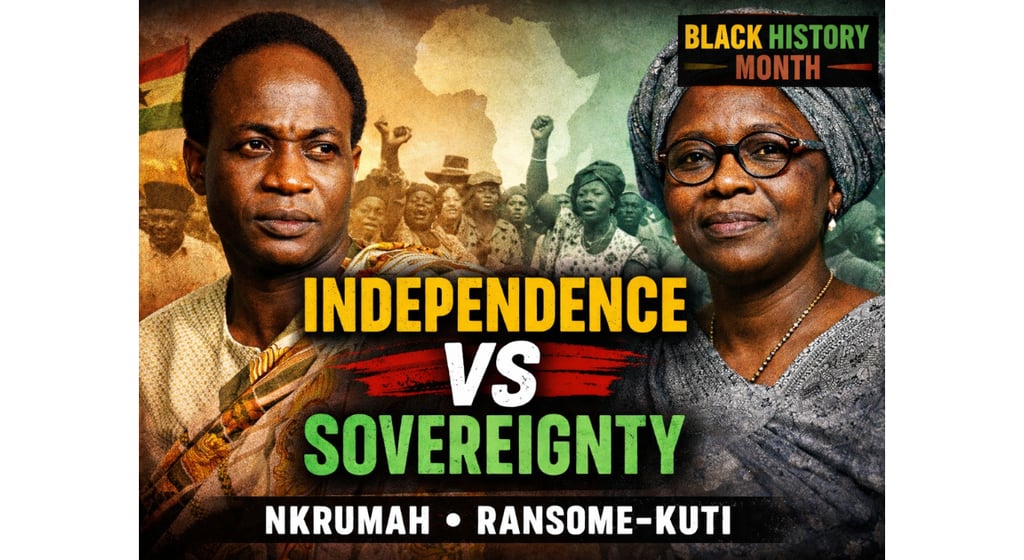
Independence vs Sovereignty | Kwame Nkrumah & Funmilayo Ransome-Kuti
POLITICAL, ECONOMIC, & JUSTICE SOVEREIGNTY | PAN AFRICAN HISTORY
The Black Metrics
2/9/20263 min read
Independence Is a Moment. Sovereignty Is a Practice.
Black History Month often celebrates independence as an endpoint. A flag is raised. A new anthem is sung. A leader gives a speech. But history tells a more complicated story.
Independence can arrive in a single moment. Sovereignty must be built, defended, and renewed over time.
The lives of Kwame Nkrumah and Funmilayo Ransome Kuti help us understand this distinction. Together, they reveal why many post colonial states struggle and why real freedom depends not only on leadership, but on organized people.
Kwame Nkrumah and the Dream of Political Power
Kwame Nkrumah was born in 1909 in the British colony known as the Gold Coast. Like many African leaders of his generation, he came of age in a world where political decisions affecting African lives were made elsewhere.
Through his education in Ghana, the United States, and the United Kingdom, Nkrumah encountered Pan African thought and global Black liberation movements. These experiences shaped his understanding of power.
For Nkrumah, colonialism was not simply foreign rule. It was the systematic removal of African control over political decision making, economic resources, and social direction.
When Ghana gained independence in 1957, Nkrumah believed political sovereignty meant more than symbolic self rule. It meant transforming the collective will of the people into organized, strategic power capable of resisting foreign influence and shaping national priorities.
This vision aligns directly with what The Black Metrics defines as Political Sovereignty. Transforming collective voice into organized, strategic power.
Nkrumah pursued this through strong central government, national development projects, and Pan African unity. He believed the state could act as a vehicle for liberation if it was strong enough to protect national interests and coordinated enough to pursue long term goals.
But this approach also revealed a critical tension. When political sovereignty becomes concentrated primarily within institutions, and ongoing popular participation weakens, power can drift away from the people it claims to serve.
Economic Control and the Limits of Independence
Nkrumah understood that political independence without economic control was unstable.
This insight speaks directly to Economic Sovereignty, defined by The Black Metrics as controlling the flow, ownership, and circulation of our own wealth.
Ghana remained deeply tied to global economic systems shaped by colonial extraction. Even with African leadership in place, external pressures and internal inequalities limited how fully economic sovereignty could be realized.
This pattern would repeat across much of the post colonial world. Independence changed who governed. It did not automatically change how power and resources were distributed.
Funmilayo Ransome Kuti and Sovereignty From Below
Funmilayo Ransome Kuti was born in 1900 in Abeokuta, Nigeria, also under British colonial rule. Her political awakening emerged not from elite institutions, but from everyday life.
As an educator and organizer, she recognized that women bore the heaviest burdens of colonial taxation, economic hardship, and political exclusion.
For Funmilayo, sovereignty did not begin with the state. It began with people understanding their rights, organizing collectively, and refusing to accept unjust authority.
Her work embodies Justice Sovereignty, which The Black Metrics defines as redefining safety, accountability, and restoration beyond punishment.
Through mass organizing, particularly among market women, she challenged colonial administrators and traditional rulers who enforced unjust policies. Her movements forced real concessions and demonstrated the power of collective accountability.
Women Led Movements and Political Stability
Funmilayo Ransome Kuti’s leadership also illustrates a recurring historical truth. Women led movements often serve as stabilizers of sovereignty.
They anchor political demands in daily survival. They maintain pressure when formal leadership shifts. And they ensure that freedom is not reduced to symbolism.
Her work activated Political Sovereignty at the grassroots level, turning communities into organized forces that power had to respond to.
Why Post Colonial States Struggle
Taken together, Nkrumah and Ransome Kuti reveal why independence alone is insufficient.
Political sovereignty without economic control remains vulnerable. Economic policy without justice reproduces inequality. Leadership without organized people becomes insulated.
This is why The Black Metrics frames sovereignty as a system, not a single achievement.
Economic Sovereignty ensures control over wealth. Political Sovereignty ensures collective power. Justice Sovereignty ensures accountability and restoration.
These pillars do not operate in isolation. They reinforce one another.
Sovereignty as an Ongoing Commitment
Independence is a moment in history. Sovereignty is a practice across generations.
A community that controls its economy, education, health, housing, environment, and political power controls its destiny.
Kwame Nkrumah reminds us that institutions matter. Funmilayo Ransome Kuti reminds us that people matter more.
The lesson is not to choose one over the other.
The lesson is that sovereignty requires both, sustained over time, through constant organization, accountability, and collective effort.
This is not only Black history. It is a blueprint.
THE BLUEPRINT
Building the future of the global African Diaspora through data-driven storytelling and the Eight Pillars of Sovereignty. From survival to ownership.
Contact
Subscribe To the NewsLETTER
hello@blackmetrics.space
Copyright © 2026 The Black Metrics. All Rights Reserved.
The BlaCK METRICS