Internalized Racism in the Black Community
This Strategic Briefing discusses the concept of internalized racism, particularly among Black individuals. It explores how this phenomenon manifests psychologically and socially, detailing its effects on mental health, family dynamics, and community cohesion. The author emphasizes the importance of acknowledging and addressing internalized racism as a means to heal individually and collectively.
HEALTHCARE SOVEREIGNTY | AFRICAN AMERICAN HEALTH
The Black Metrics
1/19/20264 min read
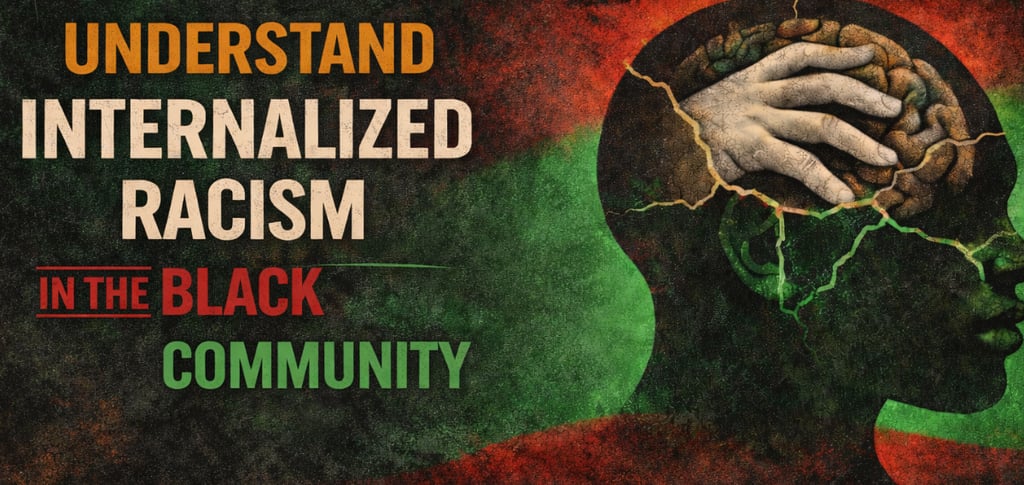
When Racism Turns Inward
Racism does not only operate through laws, policing, or economic systems. One of its most damaging forms lives inside the mind.
Internalized racism occurs when Black people absorb anti Black beliefs from society and turn them inward against themselves and one another. This process harms mental health, fractures families, and weakens collective power.
This is not a personal failure. It is a predictable psychological response to long term racial oppression.
And it is also something we can heal.
What Is Internalized Racism
Internalized racism is the acceptance of negative stereotypes, beliefs, and narratives about Black people and applying them to oneself or other Black people.
Psychologists define it as the internalization of racial oppression by the racially subordinated. It can be conscious or unconscious and often reflects a belief learned through media, institutions, and culture that whiteness is the standard and Blackness is inferior.
Common signs include the following.
Shame about being Black.
Wanting to change hair, skin tone, or speech to appear less Black.
Distancing from other Black people.
Colorism and texturism.
Respectability politics.“Not like other Black people” thinking.
Denying racism because acknowledging it feels overwhelming.
Because these ideas are normalized, many people do not recognize them as internalized racism at all.
Mental Health Effects of Internalized Racism
Research consistently links internalized racism to poorer mental health outcomes among Black populations.
Studies show associations with higher anxiety, depression, and chronic stress. They also show lower self esteem and self worth, increased helplessness and hopelessness, and emotional exhaustion from constant self monitoring and over performance.
In some research, internalized racism predicts psychological distress even more strongly than direct experiences of racism.
When a person internalizes the idea that Black people are less capable or less deserving, every struggle feels like personal failure rather than evidence of systemic barriers.
How Internalized Racism Harms Families and the Black Community
Internalized racism does not stay at the individual level.
In families, it shows up when children receive messages, direct or subtle, about which skin tones, hair textures, or behaviors are acceptable. Often these messages are framed as protection, but they still reinforce shame.
At the community level, internalized racism fuels colorism and internal hierarchy, respectability politics, “good Black” versus “bad Black” narratives, and policing one another instead of systems. Over time, this fragmentation weakens collective organizing and solidarity.
This creates a self perpetuating cycle that benefits systems of oppression by keeping communities divided and distracted.
Why Some Black Celebrities and Content Creators Degrade Blackness
A common and painful question is why some Black celebrities and Content Creators use their platforms to publicly degrade Black people or Black culture.
This behavior is not random. It often reflects a combination of internalized racism, structural incentives, and greed.
Proximity to Power Rewards Anti Black Narratives
Media industries, corporate sponsors, and political platforms frequently reward Black voices that distance themselves from the Black community, frame racism as a Black personal failure rather than a structural issue, or echo stereotypes in the language of accountability or realism.
For some individuals, criticizing Blackness becomes a pathway to wealth, visibility, and acceptance within predominantly white power structures.
Internalized Racism at a Larger Scale
Fame does not erase internalized racism. It can amplify it.
Celebrities often exist in environments where whiteness is treated as the norm and Blackness is tolerated only when it is profitable, entertaining, or non threatening. Over time, some begin to see themselves as exceptions rather than members of a collective.
This can lead to public shaming of Black people, respectability narratives framed as tough love, and dehumanizing language disguised as honesty.
Greed and the Love of Money
There is also an economic reality. Anti Blackness sells.
Outrage, controversy, and internal conflict generate clicks, contracts, and attention. Some public figures knowingly trade community harm for financial gain.
This does not excuse the behavior, but it explains why it persists. The damage is real. These messages reinforce internalized racism, validate external stereotypes, and deepen mistrust within the community.
Healing Starts With Naming the Problem
One of the most powerful steps in healing is naming internalized racism for what it is.
When you name it, you move the source of harm from your character to a system you were conditioned by.
Practice this exercise. Write down moments when you felt less than because you are Black. Next to each moment, write the following sentence.
This belief was taught to me by racism. It is not the truth about who I am.
Reclaiming Identity Through History and Counter Storytelling
Racism teaches a distorted story. Healing requires replacing it with a truthful one.
Identity affirmation involves reconnecting with Black history, Pan African civilizations and contributions, and histories of resistance, innovation, and governance, not only survival.
History provides context. Context restores dignity.
When people know where they come from, lies lose their power.
Evidence Based Healing Practices
Research on racial trauma highlights several effective approaches.
Self compassion reduces the mental health impact of internalized racism.
Cognitive approaches such as Cognitive Behavioral Therapy and Acceptance & Commitment Therapy help identify and challenge racism trained thoughts.
Mindfulness and racial stress focused practices reduce shame and restore nervous system safety.
Racial trauma informed therapy integrates identity, grief, anger, and empowerment.
When accessible, working with a therapist who understands racial trauma can be transformative.
Healing Must Also Be Collective
Internalized racism is learned socially and it heals socially.
Racial trauma research emphasizes within group sanctuary. These are spaces where Black people can speak freely without minimizing or explaining their experiences.
Community healing happens through Black led support and therapy groups, cultural and spiritual spaces, political education and organizing, mutual aid, and collective action.
When healing is shared, shame becomes agency.
What Is Coming From The Black Metrics
The Black Metrics exists because data tells us what is happening, but healing requires tools that help us unlearn, rebuild, and reconnect.
Coming soon, The Black Metrics will introduce a community centered tool designed to help people deconstruct internalized anti Black beliefs, reclaim identity and self worth, heal collectively rather than in isolation, and ground personal growth in historical truth.
During the month of February, The Black Metrics will also share Pan African history to support this work of reclamation.
Stay tuned.
Final Thought
Internalized racism is not who we are.
It is something that happened to us.
Healing is possible individually, collectively, and historically.
And together, we can build something better.
THE BLUEPRINT
Building the future of the global African Diaspora through data-driven storytelling and the Eight Pillars of Sovereignty. From survival to ownership.
Contact
Subscribe To the NewsLETTER
hello@blackmetrics.space
Copyright © 2026 The Black Metrics. All Rights Reserved.
The BlaCK METRICS