Internalized Racism in the Black Community: Causes, Effects, and the Path to Collective Healing
Internalized racism fractures Black mental health, families, and collective power. We break down how it works, why it persists, and how communities heal together.
HEALTHCARE & EDUCATIONAL SOVEREIGNTY
The Black Metrics
1/19/20269 min read
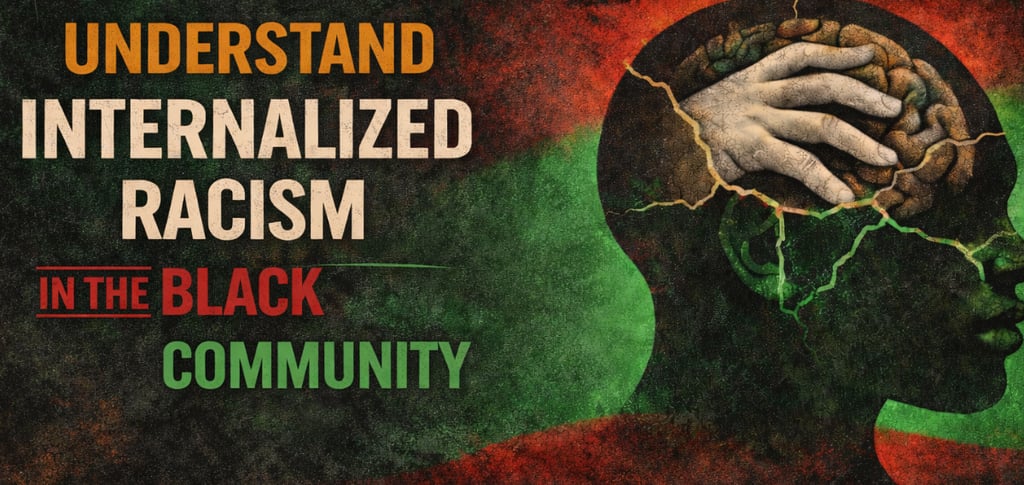
Internalized Racism in the Black Community: Causes, Effects, and the Path to Collective Healing
Racism does not only operate through laws, policing, or economic systems. One of its most damaging forms lives inside the mind.
Internalized racism occurs when Black people absorb anti-Black beliefs from society and turn them inward against themselves and one another. This process harms mental health, fractures families, and weakens the collective power we need to build sovereignty. It is one of the most effective and least discussed mechanisms through which systems of oppression sustain themselves without constant external enforcement.
This is not a personal failure. It is a predictable psychological response to long-term racial oppression. And it is something we can name, examine, and heal.
How Internalized Racism Is Installed
Before we discuss its effects, we need to be precise about its origins. Internalized racism does not develop spontaneously. It is installed through the same layered process that shapes all cultural identity: systemic influence, collective transmission, and individual absorption. The system creates the standard. The collective, shaped by survival in a hostile environment, sometimes reinforces that standard. The individual absorbs it before they have the language to name what is happening.
Media consistently associates Blackness with deficit, danger, or entertainment while associating whiteness with intelligence, authority, and desirability. Educational institutions teach a version of history that begins Black people in enslavement and frames their entire trajectory as one of overcoming deficiency rather than exercising continuous capacity. Legal systems treat Black bodies as inherently suspect. These are not subtle signals. They are relentless repetition at scale.
The weathering hypothesis, confirmed by the 2026 JAMA study, documents how this relentless repetition does not stay in the mind. It embeds biologically, elevating inflammation markers and accelerating cellular aging. Internalized racism is not just a psychological issue. It is a public health crisis with measurable physiological consequences. For the full clinical breakdown of that research, read The Silent Killer: New 2026 Study Proves Racism Is a Public Health Emergency.
Sylvia Wynter's framework explains the mechanism. When the definition of full humanity is built around a narrow European standard, everyone who falls outside that standard is positioned as inherently deficient. Internalized racism is what happens when the people who were excluded from that definition begin to apply it to themselves. The definition was never theirs to begin with. But it was repeated so consistently, across so many institutional channels, that it began to feel like truth. For the foundational analysis of how that definition was constructed and how reclaiming it is an act of sovereignty, read Who Decides What It Means to Be Human? Du Bois, Wynter, and the Foundation of Black Sovereignty.
What Internalized Racism Looks Like
Psychologists define internalized racism as the internalization of racial oppression by the racially subordinated. It can be conscious or unconscious and often reflects a belief, learned through media, institutions, and culture, that whiteness is the standard and Blackness is a deviation from it.
Common signs include shame about being Black, wanting to change hair, skin tone, or speech to appear less Black, distancing from other Black people, colorism and texturism within families and communities, respectability politics, the persistent belief that one is different from or better than other Black people, and denial of racism because acknowledging it feels overwhelming.
Because these patterns are so normalized, many people do not recognize them as internalized racism at all. They experience them as personal preferences, reasonable caution, or pragmatic strategy. The work of naming them is not about assigning blame. It is about identifying the source of the belief so you can evaluate it rather than simply enacting it.
Mental Health Effects
Research consistently links internalized racism to poorer mental health outcomes among Black populations. Studies document associations with higher rates of anxiety, depression, and chronic stress, lower self-esteem and self-worth, increased helplessness and hopelessness, and emotional exhaustion from the constant labor of self-monitoring and over-performance in environments that require you to prove your worth repeatedly.
In some research, internalized racism predicts psychological distress even more strongly than direct experiences of racism. This is one of the most significant findings in the field and one of the least discussed outside of clinical settings. The implication is that the system does not need to actively discriminate against you every day to produce harm. Once the belief is internalized, the individual reproduces the harm internally.
When a person has internalized the idea that Black people are less capable or less deserving, every struggle becomes confirmation of that belief rather than evidence of systemic barriers. Every setback becomes personal failure rather than the predictable outcome of operating in a system that was not built to support your success. This is the psychological mechanism that sustains inequality without constant external enforcement. The system installs the belief and then the belief does the work.
How Internalized Racism Harms Families
Internalized racism does not stay at the individual level. It travels through families, often carried by people who genuinely love their children and are trying to protect them.
It shows up when children receive messages, direct or subtle, about which skin tones, hair textures, or behaviors are acceptable. Often these messages are framed as preparation for a hostile world. Straighten your hair before the interview. Speak properly around white people. Do not be too loud or too aggressive or too Black in environments where that might cost you. These messages are not born from contempt. They are born from pain and from a real understanding of what the system punishes.
But even when the intent is protective, the message received is that something about Blackness requires management. That Blackness is a liability that must be minimized to access opportunity. Children absorb this early, before they have the capacity to contextualize it, and it shapes their relationship to their own identity in ways that take years to examine.
The cycle of internalized programming maps this process with clinical precision. Early household messages create the foundation. Institutional reinforcement follows. By the time a young person reaches adulthood, the belief feels like self-knowledge rather than conditioning. For the full structural analysis of how this programming installs and perpetuates itself, read The Cycle of Internalized Programming: How Beliefs Are Installed, Reinforced, and How to Break the Loop.
How Internalized Racism Harms Community
At the community level, internalized racism fuels division that serves systems of oppression precisely because it is self-enforcing. It shows up in colorism and internal hierarchy, in respectability politics that police community members rather than systems, in the persistent good Black versus bad Black narrative that frames certain Black people as deserving of protection while others are treated as liabilities.
It shows up in the fragmentation that makes collective organizing harder. When community members spend energy managing internal hierarchy and policing one another's Blackness, less energy is available for building the collective infrastructure sovereignty requires. This is not coincidence. Divide and fracture is one of the oldest tools in the suppression manual. Internalized racism performs that function from the inside.
This is why building sovereignty requires addressing internalized racism as infrastructure work, not as a side conversation. A community trying to build Economic Sovereignty while its members are unconsciously devaluing Black-owned products and services because the system trained them to associate quality with whiteness will undermine its own work at every step. A community building Political Sovereignty while its members are applying respectability politics to determine whose issues are worth organizing around will reproduce the exclusions of the system it is trying to replace. The internal work and the external work are the same work.
Why Some Black Celebrities and Content Creators Degrade Blackness
A common and painful question is why some Black public figures use their platforms to publicly degrade Black people or Black culture.
This behavior is not random. It is a predictable product of internalized racism operating at scale, combined with structural incentives that reward anti-Black narratives.
Media industries, corporate sponsors, and political platforms frequently reward Black voices that distance themselves from the Black community, frame racism as a Black personal failure rather than a structural issue, or echo stereotypes in the language of accountability or realism. For some individuals, criticizing Blackness becomes a pathway to wealth, visibility, and acceptance within predominantly white power structures. The reward is real. The cost is paid by the community, not the individual collecting the reward.
Fame does not erase internalized racism. In many cases it amplifies it. Celebrities often exist in environments where whiteness is treated as the professional norm and Blackness is tolerated only when it is profitable, entertaining, or non-threatening. Over time, some begin to see themselves as exceptions rather than members of a collective. This is exactly what the layered identity framework predicts: when systemic influence operates without counter-pressure from the collective and without individual examination, it produces alignment with systemic standards at the expense of community solidarity. For the full framework on how this dynamic operates across identity layers, read Understanding the Layers of Cultural Identity: A Strategic Breakdown of Influence and Control.
There is also a straightforward economic reality. Anti-Blackness sells. Outrage, internal conflict, and community degradation generate clicks, contracts, and attention in a media economy built on engagement regardless of harm. Some public figures knowingly trade community damage for financial gain. The damage is real. These messages reinforce internalized racism, validate external stereotypes, and deepen mistrust within communities that are trying to build the trust required for collective power.
Healing Starts With Naming the Problem
One of the most powerful steps in healing is naming internalized racism for what it is: a predictable psychological response to systematic, institutional, relentless messaging that told you and everyone around you that Blackness was a deficiency.
When you name it accurately, you move the source of harm from your character to a system you were conditioned by. That shift is not about removing accountability for your actions. It is about locating the correct origin of the belief so you can address it at the root rather than managing its symptoms indefinitely.
Practice this exercise. Write down moments when you felt less than because you are Black. Next to each moment, write: This belief was taught to me by racism. It is not the truth about who I am. Do this repeatedly. Not because the repetition will immediately change the feeling, but because naming the source is the beginning of the process through which the belief becomes a thing you examine rather than a thing you simply enact.
Reclaiming Identity Through History and Counter-Storytelling
Racism teaches a distorted story. Healing requires replacing it with a truthful one, not as inspiration but as accurate data.
Every post in The Black Metrics briefing series is a piece of that counter-narrative. Anna Julia Cooper was not exceptional by accident. She built from a tradition of intellectual sovereignty that predated her and continued after her. Claudia Jones built economic infrastructure under active suppression because she operated from a definition of Black capacity that did not require external validation. Funmilayo Ransome-Kuti organized tens of thousands of women without formal political power because she understood that sovereignty does not wait for permission. These are not stories of overcoming deficiency. They are records of capacity operating under hostile conditions.
When people know where they come from, lies lose their power. History provides context. Context restores dignity. And dignity is the foundation upon which every pillar of sovereignty is built.
Evidence-Based Healing Practices
Research on racial trauma highlights several effective approaches for healing internalized racism, both individually and collectively.
Self-compassion practices specifically designed to address racial shame reduce the mental health impact of internalized racism by separating the belief from the self. Cognitive approaches including Cognitive Behavioral Therapy and Acceptance and Commitment Therapy help identify and challenge racism-trained thoughts by bringing them into conscious examination rather than allowing them to operate below awareness.
Mindfulness practices adapted for racial stress contexts reduce shame and restore nervous system regulation, addressing the biological embedding that the JAMA study documented. Racial trauma-informed therapy integrates identity, grief, anger, and empowerment rather than treating them as separate clinical categories.
When accessible, working with a therapist who has specific training in racial trauma is one of the most effective individual interventions available. The qualifier matters. Standard therapeutic approaches that do not account for racial trauma can inadvertently reinforce internalized racism by treating its symptoms as individual pathology rather than systemic response.
Healing Must Also Be Collective
Internalized racism was learned socially and it heals socially. Individual work is necessary but insufficient. The racial trauma research is consistent on this point: within-group sanctuary, spaces where Black people can speak freely without minimizing, explaining, or defending their experiences, is one of the most effective healing environments documented.
Community healing happens through Black-led support and therapy groups, cultural and spiritual spaces that affirm rather than manage Black identity, political education and organizing that connects personal experience to structural analysis, mutual aid networks that demonstrate collective care in practice, and collective action that transforms individual pain into shared power.
The mutual aid model, which Stop Asking Start Building: The Blueprint for Black Community Economic Self-Determination documents in detail, is itself a healing intervention. When community members experience being caught by their own network rather than falling through a system that does not serve them, the belief that Black people cannot rely on each other begins to be replaced by documented evidence that they can. Trust rebuilt through consistent, transparent, documented action is one of the most powerful antidotes to internalized racism at the community level.
When healing is shared, shame becomes agency. And agency is the beginning of sovereignty.
The Bantaba: Discussion Questions
Name one belief you hold about Black people, including yourself, that you received rather than chose. Where did you receive it? Who benefited from its transmission?
Colorism is one of the most visible expressions of internalized racism in Black communities. How does it show up in your family or community, and what would addressing it directly require?
Respectability politics asks some members of the community to make themselves less Black to earn protection. Who is asked to perform that labor most often, and what does it cost them?
What would a within-group sanctuary space look like in your community? What conditions would need to exist for people to speak freely about racial shame without minimizing or defending?
How does internalized racism show up in economic behavior? In what ways do you or people around you devalue Black-owned products, services, or knowledge because the system trained you to associate quality with other standards?
Recommended Reading
Post-Traumatic Slave Syndrome by Dr. Joy DeGruy — The foundational clinical analysis of how racial trauma is transmitted across generations and what healing requires.
The Unapologetic Guide to Black Mental Health by Dr. Rheeda Walker — A practical guide specifically designed for Black readers navigating mental health in a racially hostile environment.
Caste by Isabel Wilkerson — Essential context for understanding the structural hierarchy that produces internalized ranking systems within marginalized communities.
My Grandmother's Hands by Resmaa Menakem — A somatic approach to racial trauma that addresses the biological embedding documented in the JAMA study.
This is the work of Healthcare and Educational Sovereignty. Volume Four, Reclaiming the Mind, drops May 2026. → Join the waitlist → Ebooks
THE BLUEPRINT
Contact
hello@blackmetrics.space
Copyright © 2026 The Black Metrics. All Rights Reserved.
The BlaCK METRICS
The Pillars
Strategic Stream Blog