Malcolm X & Queen Mother Moore: The Blueprint for Black Reparations and Sovereignty
Malcolm X took the fight to the UN. Queen Mother Moore built the reparations framework. Here is how their strategies apply to Black sovereignty in 2026.
POLITICAL, JUSTICE, EDUCATIONAL, & ECONOMIC SOVEREIGNTY
The Black Metrics
2/17/20267 min read
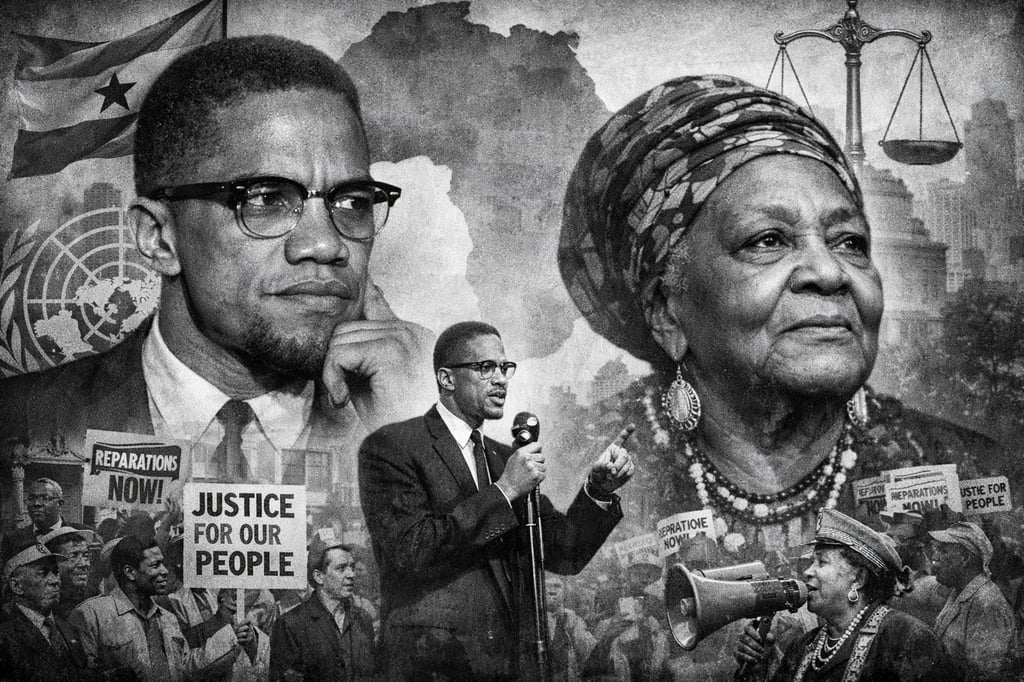
Malcolm X & Queen Mother Moore: Reparations and Black Sovereignty
What does liberation look like when the state itself is the problem?
This question disrupts the traditional civil rights narrative. It forces us beyond the language of reform and into the language of power. If the institutions that claim to deliver justice are structurally aligned against you, then appealing to them is not a solution. It is a stall tactic. Two leaders confronted this reality with cold, strategic precision: Malcolm X and Queen Mother Audley Moore. They did not simply demand a seat at the table. They interrogated who built the table and for what purpose.
Malcolm X: The Internationalization of the Struggle
Malcolm X was born El Hajj Malik El Shabazz in 1925 in Omaha, Nebraska. His early life was a case study in state-sanctioned hostility. His father, Earl Little, was an organizer for the Universal Negro Improvement Association, a movement that prioritized Black self-determination and global unity. To understand the organizational foundation Malcolm inherited, read Marcus Garvey: The Pan African Blueprint for Black Sovereignty. This political affiliation made the family a target for the Black Legion, a white supremacist splinter group.
After his father's suspicious death and his mother's institutionalization, Malcolm's trajectory through foster care and incarceration became a schooling in the failures of the American social contract. Prison, however, became a site of intellectual rearmament. He did not just find religion. He found a systemic critique of Western hegemony.
The 1964 Shift: Civil Rights vs. Human Rights
Initially, as the face of the Nation of Islam, Malcolm focused on moral reform and separation. However, after his 1964 pilgrimage to Mecca and subsequent travels through Africa, his strategy underwent a massive evolution. He met with leaders like Kwame Nkrumah of Ghana and Gamal Abdel Nasser of Egypt. He saw Black diplomats operating as sovereign equals on the world stage.
This experience led to his most potent strategic contribution: the reframing of the struggle from Civil Rights to Human Rights. This was not a semantic change. It was a jurisdictional one. Civil rights are internal matters handled by the domestic courts of a specific nation, which were the very courts Malcolm viewed as structurally biased. Human rights, however, fall under the jurisdiction of the United Nations. By moving the argument to the UN, Malcolm sought to put the United States on trial before the international community.
This move exemplifies Political Sovereignty within the Black Metrics framework. It is the transformation of collective grievance into organized, international leverage. He argued that if the United States wanted to lead the Free World, it could no longer hide its domestic oppression from global scrutiny.
The Organization of Afro-American Unity: From Rhetoric to Architecture
What is often overlooked in the popular memory of Malcolm X is what he was building in the final year of his life. After leaving the Nation of Islam, he founded the Organization of Afro-American Unity in 1964, modeled directly on the Organization of African Unity. This was not a symbolic gesture. It was an institutional attempt to formalize the connection between the African diaspora and the African continent at the level of political coordination.
The OAAU had a charter. It had defined committees. It outlined programs for education, economics, and political action. Malcolm was not just a speaker. He was an architect who understood that without a system behind the message, the message dies with the messenger. The UNIA taught him that. Amy Jacques Garvey's editorial discipline demonstrated it. For a deeper breakdown of how organizational systems sustain movements, read Amy Jacques Garvey: The Blueprint for Black Organizational Strategy and Sovereignty Systems.
His assassination in February 1965 cut that architecture short. But the blueprint survived. And it is our responsibility to build from it.
Queen Mother Audley Moore: The Mother of Reparations
While Malcolm expanded the arena of the struggle, Queen Mother Audley Moore built the legal and material architecture to sustain it. Born in 1898 in Louisiana, Moore's life bridged the gap between the immediate aftermath of enslavement and the height of the Black Power movement. Her grandparents had been enslaved, and she witnessed the brutal dismantling of Reconstruction firsthand. Like Malcolm, she was a Garveyite, but her focus was on the long-term institutional requirements for autonomy.
Institutionalizing the Demand
If Malcolm was the strategist of the argument, Moore was the strategist of the structure. She is widely regarded as the founder of the modern reparations movement in the United States. In the 1950s and 1960s, she began articulating reparations not as a plea for charity but as a formal requirement of international law. She founded the Committee for Reparations for Survivors of Revolutionary Ancestry and later the Universal Association of Ethiopian Women. Her logic was clear and uncompromising.
Economic Sovereignty first. Political freedom is a myth without a material base. Without land, capital, and restitution for stolen labor, liberation is just a change in vocabulary. For a deeper look at how economic infrastructure underpins every pillar of sovereignty, read Stop Asking Start Building: The Blueprint for Black Community Economic Self-Determination.
Justice Sovereignty second. She argued that the state cannot provide justice through the same courts that enforced Jim Crow. Justice must include restorative repair, the actual fixing of what was broken, not just the cessation of what was wrong.
Moore's work also centered heavily on Educational Sovereignty. She understood that the state-run education system was designed to produce compliant citizens, not liberated thinkers. She spent decades teaching history and law to younger activists, ensuring that political memory remained a living tool of resistance rather than a museum exhibit. Anna Julia Cooper made this same argument a generation earlier. To understand the educational foundation that both women built upon, read Anna Julia Cooper: The Blueprint for Black Educational Sovereignty and Intellectual Power.
The Intergenerational Transfer of Strategy
One of the most under examined aspects of Queen Mother Moore's legacy is her role as a bridge builder between generations. She did not hoard strategy. She transferred it. She mentored Stokely Carmichael, influenced the Black Power movement, and connected the civil rights generation to the reparations framework. She understood that sovereignty is not built in one lifetime. It is constructed across generations through intentional knowledge transfer.
This is the same principle that drives Employment & Business Sovereignty. A business that cannot outlast its founder is not sovereignty. A movement that cannot outlast its leader is not sovereignty. The measure of any system is whether it continues to function after the founders step back. For a full breakdown of building systems designed to transfer, read Black Employment Sovereignty: Why the Job Is Just the Starting Point to Real Wealth.
Beyond Reform: The Architecture of Autonomy
Together, Malcolm X and Queen Mother Moore move the conversation beyond inclusion and into jurisdiction. They compel us to ask uncomfortable questions. Who has ultimate authority over Black life? Who defines what safety looks like in a community? Who controls the resources necessary for a community to feed, clothe, and defend itself?
Liberation, in their analysis, is not a request for a better master. It is the organized power capable of negotiating, demanding, and sustaining autonomy. When the state itself is the problem, the answer cannot be an appeal to the state's conscience. It must be the construction of a new architecture.
Contextualizing the Leaders Within the Framework
Malcolm X operated primarily within Political and Justice Sovereignty. By attempting to take the United States to the United Nations, he was attempting to change the jurisdiction of the struggle entirely. He believed that as long as the struggle was local, the state held all the cards. By making it global, he introduced a new set of rules that domestic power structures could not as easily control.
Queen Mother Moore focused primarily on Economic and Educational Sovereignty. She argued that without a land base and a clear understanding of one's legal and historical status, any political gains would remain temporary. She saw reparations not as a check, but as the seed capital required to build a permanent, self-sustaining society. Capital without infrastructure is charity. Infrastructure without capital is aspiration. Reparations, in her framework, was the convergence of both.
The Modern Application: What This Looks Like in 2026
The strategies of Malcolm X and Queen Mother Moore are not historical artifacts. They are operational directives for the present.
Audit the institution. Look at a local school, court, or bank. Ask directly: does this institution serve our community, or does our community serve this institution? The answer will tell you where to build alternatives.
Define the jurisdiction. When a problem arises in your community, what is the first instinct? To call the state, or to activate an internal mechanism for resolution? Building those internal mechanisms is the work. It is unglamorous. It is essential.
Track the capital flow. How many times does a dollar circulate within the community before it exits to an outside corporation? The goal is not a single Black-owned transaction. The goal is a network where money moves through multiple Black hands before it leaves. That is a sovereign economy in motion.
Demand with documentation. Queen Mother Moore did not just call for reparations. She built the legal case for them. Whatever your community is demanding, document it. Frame it in the language of law and international precedent. Demands without documentation are grievances. Demands with documentation are claims.
The Bantaba: Discussion Questions
Malcolm X reframed the struggle from civil rights to human rights. What current community issues could be reframed from a local problem to an international human rights concern? What would that shift make possible?
Queen Mother Moore argued that reparations are a legal requirement, not a charitable gesture. How does changing the framing from request to requirement change the strategy?
Both leaders were Garveyites who evolved the original blueprint for their era. What aspects of their framework need to evolve again for 2026 conditions?
The OAAU had committees, a charter, and defined programs. What would a modern OAAU look like in your city? What departments would it need?
Moore spent decades transferring strategy to younger generations. Who are you transferring strategy to? What would it look like to formalize that transfer?
Recommended Reading
The Autobiography of Malcolm X as told to Alex Haley — The foundational text for understanding his strategic evolution from separation to internationalism.
Malcolm X Speaks edited by George Breitman — His speeches after the 1964 shift, where the Human Rights framework is articulated most clearly.
Reparations: The Cure for America's Black Problem — Queen Mother Moore's own articulation of the reparations framework.
The Condemnation of Blackness by Khalil Gibran Muhammad — Essential context for understanding how data and narrative were weaponized against Black communities, which is precisely what Malcolm and Moore were fighting.
This is the work of Black Sovereignty. The political architecture, jurisdictional strategy, and economic restitution framework are in Volume One. → Get your copy → Black Sovereignty
THE BLUEPRINT
Contact
hello@blackmetrics.space
Copyright © 2026 The Black Metrics. All Rights Reserved.
The BlaCK METRICS
The Pillars
Strategic Stream Blog