Marcus Garvey & Amy Ashwood Garvey: The Pan African Blueprint for Black Sovereignty
The UNIA wasn't a movement — it was a prototype state. We break down how the Garveys built the Pan African sovereignty blueprint still relevant in 2026.
ECONOMIC, EDUCATIONAL, & POLITICAL SOVEREIGNTY
The Black Metrics
2/23/202610 min read
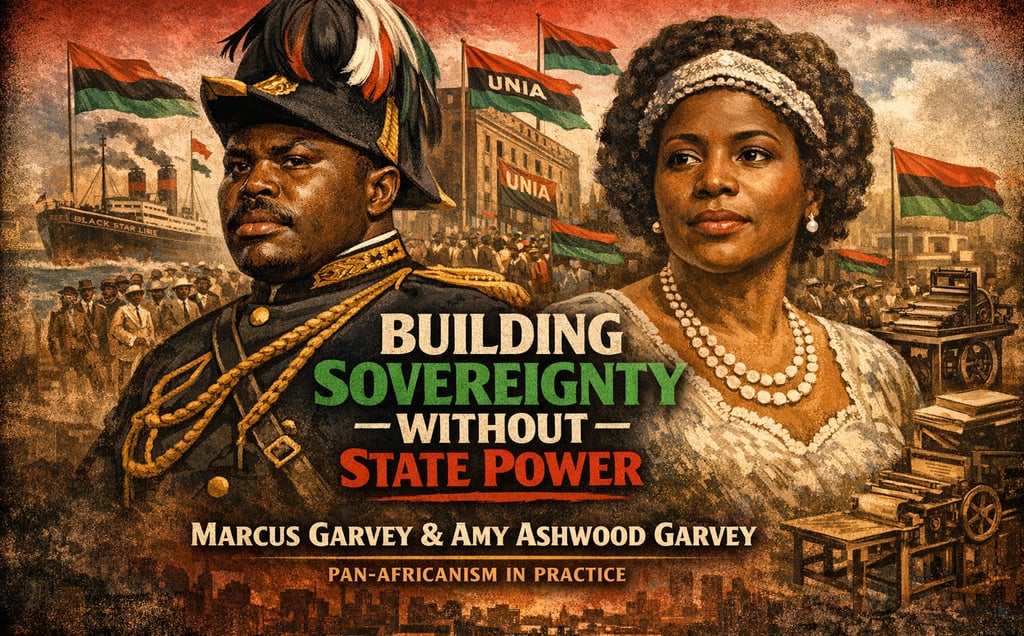
Marcus Garvey, Amy Ashwood Garvey, and the Architecture of Sovereignty
As Black History Month concludes, the question shifts.
Not what did we remember. But what did we learn.
Black history is not decoration. It is instruction. It is not a collection of heroic moments preserved in amber. It is a blueprint for capacity, a technical manual for building sovereignty under conditions designed to prevent it.
Before the Universal Negro Improvement Association became one of the largest mass movements of Black people in recorded history, Marcus Garvey and Amy Ashwood Garvey were young Jamaicans shaped by colonial rule. To understand what they built, we must first understand what built them. Architecture emerges from conditions. You cannot understand the structure without understanding the terrain it was designed to address.
Colonial Jamaica and the Making of Marcus Garvey
Marcus Garvey was born in 1887 in Saint Ann's Bay, Jamaica, under British colonial governance. Colonial hierarchy was not abstract in his childhood environment. It structured daily life with the precision of a formal legal system. Economic power and political authority rested in white hands. Black labor sustained the colonial economy, but Black leadership was systematically restricted through legal, social, and economic mechanisms designed to reproduce that arrangement indefinitely.
Garvey's father was a mason with a personal library. That detail carries enormous strategic weight. In a society where access to formal institutional power was blocked, access to books became access to intellectual sovereignty. The library was not a luxury. It was an alternative infrastructure for a mind that the colonial system was designed to contain. Young Garvey read widely. He absorbed history. He learned how narratives shape identity and how identity shapes the limits of what people believe they can build.
As a teenager, he became a printer. Printing was not simply a trade. It was a doorway into the infrastructure of communication. Printers controlled newspapers, pamphlets, and public messaging. They understood how ideas move, how influence is manufactured, and how narratives are distributed at scale. This technical knowledge would shape everything Garvey built. The Negro World, the UNIA's global newspaper, was not an accident of his career. It was the direct application of skills he developed as a young man working in Kingston print shops.
Travel then transformed his framework from local observation to global analysis. In Central America, he witnessed the harsh exploitation of Black laborers under foreign companies: the same racial hierarchy reproduced across national borders with different flags but identical economic logic. In London, he encountered global Black intellectual networks and the early Pan-African thought being developed by scholars and activists across the diaspora. He observed colonial systems operating at scale and saw the same pattern everywhere he looked.
These experiences produced a conclusion that would define the rest of his life: racial hierarchy was not a local problem with local solutions. It was a global system requiring a global response organized at equivalent scale.
Garvey did not simply develop anger. He developed a theory of power. Power required organization. Organization required structure. Structure required discipline. These were not inspirational abstractions. They were operational requirements.
The Early Formation of Amy Ashwood Garvey
Amy Ashwood Garvey grew up in the same colonial environment but developed her leadership instincts through distinct pathways that would prove essential to what they built together.
Educated within British-influenced institutions, she learned discipline, rhetorical precision, and institutional structure. At the same time, she developed a clear-eyed recognition of the racial ceilings embedded within those institutions. She understood early that assimilation into colonial systems did not produce authority. It produced a more sophisticated form of managed exclusion.
From a young age, she engaged in political discussions about racial uplift and collective self-determination. She was not simply inspired by Garvey when they met. She was intellectually engaged in the same foundational questions from her own independent trajectory. How do you build dignity in a system designed to withhold it? How do you cultivate leadership where there is no state power available to legitimate it?
Amy Ashwood Garvey's critical contribution was organization: the translation of abstract vision into coordinated action. Movements do not scale on inspiration alone. They scale on systems. She played a foundational role in the early formation of the UNIA by helping convert idea into institution through the specific work of organizing people, structuring meetings, mobilizing participation, and building the early infrastructure that made the UNIA more than a discussion group.
Energy without structure dissipates. Emotion without logistics fades. Amy Ashwood Garvey provided the organizational discipline that gave the vision its first operational form.
Founding the UNIA: A Strategic Decision
When Marcus Garvey and Amy Ashwood Garvey co-founded the Universal Negro Improvement Association in 1914 in Jamaica, it was not a spontaneous emotional reaction to injustice. It was the strategic output of two people who had observed colonial systems carefully and concluded that waiting for inclusion was not a viable path to sovereignty.
They built instead.
When Garvey relocated to Harlem in 1916, the movement expanded at a pace that surprised everyone outside it and confirmed what the founders had always understood: there was a global Black population hungry for an organizing framework that began from dignity rather than accommodation.
From Harlem, the UNIA developed chapters across North America, the Caribbean, Central America, and Africa. It hosted international conventions that attracted thousands of delegates. It launched the Black Star Line, a shipping company intended to facilitate trade, create employment, and establish the symbolic and practical reality of Black-owned international commerce. It published the Negro World newspaper, distributing sovereign ideas across continents. At its peak, the UNIA was the largest Black mass organization in history.
This was not symbolic nationalism performing sovereignty for psychological comfort. This was institutional experimentation, a serious attempt to build, under hostile conditions, the actual infrastructure of a self-determined Black world.
One God, One Aim, One Destiny: The Coordination Mechanism
The UNIA was anchored by a unifying doctrine: One God. One Aim. One Destiny. This was not simply a slogan. It was a coordination mechanism operating at civilizational scale.
In any organization spanning multiple countries, cultures, and languages, the most dangerous failure mode is fragmentation. Different chapters developing different interpretations of the mission. Different leaders prioritizing different objectives. Different communities operating on different understandings of what the organization exists to do. The doctrine was the answer to that fragmentation problem. It aligned identity, purpose, and direction across a global population before the digital tools that would later make such alignment easier even existed.
Within this system, communication infrastructure was critical. The Negro World newspaper became the central organ of ideological distribution. It connected chapters across continents, reinforced shared identity, and educated the membership on history, strategy, and current events through a Black lens at a time when no mainstream publication would do so. It reached an estimated 200,000 readers weekly at its peak.
Leadership of the Negro World was consequently one of the most strategically significant positions in the UNIA. Amy Jacques Garvey, who later became editor of the paper, ensured that the message remained disciplined, consistent, and aligned with the movement's sovereign mission even as the movement faced its most severe external pressures. Editorial control was organizational power. For the full analysis of how she exercised that power, read Amy Jacques Garvey: The Blueprint for Black Organizational Strategy and Sovereignty Systems.
The UNIA as Prototype State
To understand the UNIA properly, we must move beyond personality and into architecture.
The organization functioned as a prototype state. Not a state in the formal international legal sense, but a state in the functional sense: an institution that practices governance, develops systems of accountability, produces collective identity, manages economic enterprises, and builds the capacity for a people to coordinate their affairs without depending on external authority for any of those functions.
It had ranks, titles, and ceremonial leadership that created a sense of institutional gravity and collective dignity. It developed internal accountability systems. It built communication networks that spanned continents. It organized parades, conventions, and community programs that made membership a lived experience rather than a theoretical affiliation. It produced Black identity at scale, which is not a trivial achievement.
Collective identity determines whether people move as individuals reacting to separate circumstances or as a coordinated body with shared objectives and shared infrastructure. The UNIA's capacity to make hundreds of thousands of people across dozens of countries feel their connection to each other and to a shared project was itself a form of power that no hostile government could simply legislate away.
Marcus Garvey provided the vision and the voice. He articulated global Black unity and self-determination with a clarity and force that had never been deployed at that scale. Amy Ashwood Garvey provided the early organizational discipline that converted that vision into operational infrastructure. Amy Jacques Garvey provided the editorial control that maintained message consistency under sustained pressure. Together, they demonstrate that sovereignty is not a solo act. It is a collaborative architecture built by people with complementary capacities operating with aligned purpose.
The Three Pillars Activated
The Garvey model directly activates three pillars of sovereignty in ways that provide specific operational guidance for 2026.
Economic Sovereignty was activated through the emphasis on Black-owned enterprise, internal circulation of wealth, and independent trade. The Black Star Line represented an attempt to build international economic infrastructure at scale. It failed for specific documented reasons: inexperienced management, deliberate federal sabotage, and the inherent difficulty of capitalization without access to the banking systems that funded comparable white enterprises. But the strategic principle it embodied, that Black economic power requires Black-owned logistics infrastructure, not just Black-owned retail, remains as valid today as it was in 1919. For the community-scale activation of this principle, read Stop Asking Start Building: The Blueprint for Black Community Economic Self-Determination.
Educational Sovereignty was activated through the Negro World and the mass conventions. The UNIA conducted political education at scale, teaching history, cultivating collective identity, and reframing what it meant to be Black in a world designed to define Blackness as a deficit. This was counter-programming at the institutional socialization level, using the same mechanism that the dominant system used to install limiting beliefs to install sovereign ones instead. For the full analysis of how educational counter-programming works at the individual and community level, read The Cycle of Internalized Programming: How Beliefs Are Installed, Reinforced, and How to Break the Loop.
Political Sovereignty was activated through the practice of parallel governance. The UNIA did not wait for assimilation into existing power structures. It rehearsed authority internally, creating its own systems of leadership, accountability, and decision-making that did not require external validation. This is the key lesson that connects the UNIA model to every sovereignty project that has come before and after it. Sovereignty can begin before formal state control. It begins with capacity. You practice governance in the space you control until you have built the capacity to govern in a larger space.
The UNIA in the Digital Age
The question now is not whether the UNIA model worked perfectly. No system built under that level of sustained external pressure operates without flaws. The question is how its architecture translates to present conditions.
Today, the tools are different. Communication infrastructure is no longer limited to print. Economic coordination can happen across borders in real time. Organization can scale faster than it ever has before. But the same challenges remain: fragmentation, lack of coordination, overreliance on external platforms and systems, and the psychological programming that tells Black communities they cannot sustain collective institutions at scale.
Modern leaders who have understood the Garveyite framework have extended it for their era. Malcolm X built the Organization of Afro-American Unity on the explicit model of the UNIA's global coordination strategy. He took the jurisdictional logic of Pan-Africanism and applied it to the international human rights framework at the United Nations. The tools changed. The architecture did not. For the full analysis of Malcolm X's extension of the Garvey model, read Malcolm X & Queen Mother Moore: The Blueprint for Black Reparations and Sovereignty.
The African Continental Free Trade Area now represents the largest free trade zone in the world by participating countries. The infrastructure for the economic coordination that the Black Star Line was attempting to build at the beginning of the twentieth century is now available at a scale Garvey could only envision. The diaspora that positions itself intentionally within that infrastructure now, as investors, entrepreneurs, and economic bridge builders, will be the early architects of the Black economic sovereignty that the UNIA pointed toward. For the full breakdown of how to position in that transition, read Black Employment Sovereignty: Why the Job Is Just the Starting Point to Real Wealth.
The Deeper Instruction for Today
The Garvey story is often reduced to imagery, slogans, and the drama of federal persecution. When we study the architecture instead of the drama, the instruction becomes precise.
Mass movements can build sovereignty without state power, but only if they build systems that endure beyond inspiration, only if they train leadership that can function without the founder, only if they coordinate logistics with the same discipline as the vision, and only if they create institutions that outlive personalities and transfer capacity to the next generation.
Black history must move beyond celebration into examination. Marcus Garvey's global observation of racial hierarchy produced vision. Amy Ashwood Garvey's organizing discipline helped operationalize that vision. Amy Jacques Garvey's editorial control ensured message discipline and continuity across the most difficult years of the movement's operation.
Together, they demonstrate that sovereignty is not merely declared. It is constructed. And construction requires coordination across multiple domains simultaneously: communication, economics, governance, and identity, all running together, all reinforcing each other, all designed to function when any single component faces disruption.
The Strategic Question
The question they leave is not whether they succeeded perfectly. The question is whether we are building with the same level of seriousness.
Are we organizing at scale? Are we developing institutional capacity? Are we controlling our communication infrastructure? Are we coordinating economically beyond individual gain? Are we building systems that can survive disruption?
Because that is the standard. Not visibility. Not influence. Capacity.
Black history is architectural guidance. And the Garveys remind us that waiting for permission has never been the strategy of the sovereign.
The Bantaba: Discussion Questions
The UNIA functioned as a prototype state, practicing governance without formal state power. What aspects of governance, accountability, and institutional function does your current community organization practice? What is missing?
The doctrine "One God, One Aim, One Destiny" was a coordination mechanism designed to prevent fragmentation across a global network. What is the equivalent unifying framework in your current organization? How consistently is it applied?
The Black Star Line failed partly due to deliberate federal sabotage and partly due to internal management challenges. Which of those two failure types is more relevant to the sovereignty projects you are currently building?
Amy Ashwood Garvey's contribution was converting vision into operational infrastructure. Who in your current network performs this function? If no one does, what is the cost of that gap?
The UNIA's educational work through the Negro World was counter-programming at the institutional scale. What counter-programming infrastructure is your community currently building at that scale?
Recommended Reading
The Philosophy and Opinions of Marcus Garvey edited by Amy Jacques Garvey — The primary strategic document of the UNIA. Read it as an operational manual.
Garvey and Garveyism by Amy Jacques Garvey — The insider account of how the movement's economic and political pillars functioned under sustained pressure.
The Veiled Garvey by Ula Yvette Taylor — The definitive modern biography of Amy Jacques Garvey's specific strategic role.
Race First by Tony Martin — The comprehensive scholarly analysis of Garvey's political and economic ideology as a coherent sovereignty framework.
This is the work of Black Sovereignty. The full blueprint, the architecture of Pan African power, economic independence, and institutional capacity, is in Volume One.
→ Get your copy → Black Sovereignty
THE BLUEPRINT
Contact
hello@blackmetrics.space
Copyright © 2026 The Black Metrics. All Rights Reserved.
The BlaCK METRICS
The Pillars
Strategic Stream Blog