Pan Africanism in Practice: Marcus Garvey, Amy Ashwood Garvey, and the Blueprint of Sovereignty
This Strategic Briefing explores, "Marcus Garvey, Amy Ashwood Garvey, and the Architecture of Sovereignty," reframes Black history from a collection of heroic moments into a strategic blueprint for institutional power. By examining the colonial upbringing and global observations of both Marcus and Amy Ashwood Garvey, the post explores how the Universal Negro Improvement Association (UNIA) functioned not just as a movement, but as a "prototype state." It highlights the critical intersection of Marcus Garvey’s vision with Amy Ashwood Garvey’s organizational discipline, emphasizing that true sovereignty is built through economic, educational, and political infrastructure rather than mere inspiration. It serves as a call to move beyond celebration and toward the serious work of building enduring systems of capacity.
ECONOMIC, EDUCATIONAL, & POLITICAL SOVEREIGNTY | PAN-AFRICAN HISTORY
The Black Metrics
2/23/20264 min read
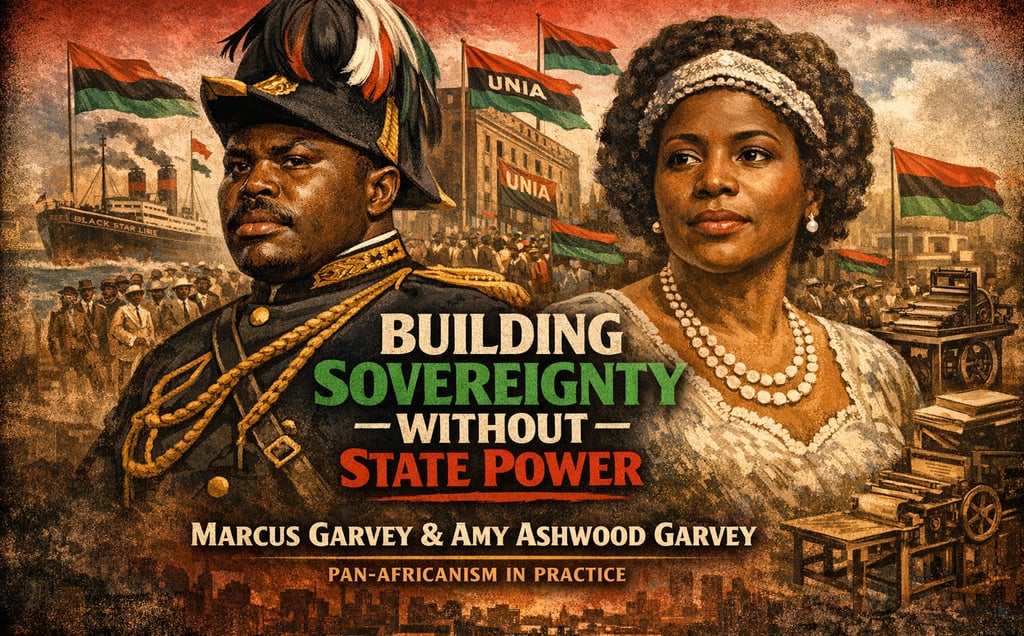
Marcus Garvey, Amy Ashwood Garvey, and the Architecture of Sovereignty
As Black History Month concludes, the question shifts.
Not what did we remember.
But what did we learn.
Black history is not decoration. It is instruction. It is not a collection of heroic moments. It is a blueprint for capacity.
Before the Universal Negro Improvement Association became one of the largest mass movements of Black people in history, Marcus Garvey and Amy Ashwood Garvey were young Jamaicans shaped by colonial rule.
To understand what they built, we must first understand what built them.
Colonial Jamaica and the Making of Marcus Garvey
Marcus Garvey was born in 1887 in Jamaica under British colonial governance. Colonial hierarchy was not abstract. It structured daily life. Economic power and political authority rested largely in white hands. Black labor sustained the economy, but Black leadership was restricted.
Garvey’s father was a mason with a personal library. That detail matters. In a society where access to formal power was limited, access to books became access to intellectual sovereignty. Young Garvey read widely. He absorbed history. He learned how narratives shape identity.
As a teenager, he became a printer. Printing was not just a trade. It was a doorway into communication infrastructure. Printers controlled newspapers, pamphlets, and public messaging. Garvey learned how ideas move.
Travel transformed him.
In Central America, he witnessed the harsh exploitation of Black laborers working under foreign companies. He saw racial hierarchy reproduced across borders. In London, he encountered global Black intellectual networks and early Pan African thought. He observed colonial systems operating at scale.
These experiences clarified something fundamental.
Racial hierarchy was not local.
It was global.
And if the problem was global, the solution had to be organized at scale.
Garvey did not simply develop anger. He developed a theory of power. Power required organization. Organization required structure.
The Early Formation of Amy Ashwood Garvey
Amy Ashwood Garvey grew up in the same colonial environment but developed her leadership instincts in distinct ways.
Educated within British influenced schooling, she learned discipline, rhetoric, and institutional structure. At the same time, she recognized the racial ceilings embedded in colonial systems. She understood that assimilation did not equal authority.
From a young age, she engaged in political discussions about racial uplift and collective self determination. She was not simply inspired by Garvey. She was intellectually engaged in the same questions.
How do you build dignity in a system designed to withhold it?
How do you cultivate leadership where there is no state power?
Amy Ashwood Garvey’s strength was not just passion. It was organization. It was mobilization. It was infrastructure.
That distinction becomes critical.
Movements do not scale on inspiration alone. They scale on systems.
Founding the UNIA: A Strategic Decision
When Marcus Garvey and Amy Ashwood Garvey co founded the Universal Negro Improvement Association in 1914 in Jamaica, it was not a spontaneous emotional reaction to injustice.
It was strategic.
They had observed colonial governance. They had observed economic exclusion. They had observed global racial hierarchy. They concluded that waiting for inclusion would not produce sovereignty.
So they built.
When Garvey relocated to Harlem in 1916, the movement expanded dramatically. Harlem was not just a neighborhood. It was a nerve center of Black intellectual and cultural life. From there, the UNIA developed chapters across North America, the Caribbean, Central America, and Africa.
The organization hosted international conventions that attracted thousands. It launched the Black Star Line, a shipping company intended to facilitate trade and symbolic global connection. It published the Negro World newspaper, distributing ideas across continents.
This was not symbolic nationalism.
It was institutional experimentation.
The UNIA as Prototype State
To understand the UNIA properly, we must move beyond personality and into architecture.
The organization functioned as a prototype state.
It practiced governance within its internal structure. It developed ranks, titles, and ceremonial leadership. It cultivated economic initiatives. It created systems of accountability and discipline. It built communication networks. It organized parades, conventions, and community programs.
It produced identity at scale.
Identity is not trivial. Collective identity determines whether people move as individuals or as a coordinated body.
Marcus Garvey provided the vision. He articulated global Black unity and self determination. He framed dignity as non negotiable.
Amy Ashwood Garvey played a critical role in organizing, mobilizing, and sustaining infrastructure. She was deeply involved in early organizing efforts and understood that without coordination, movements collapse.
Energy without structure dissipates.
Emotion without logistics fades.
The UNIA endured because it attempted to institutionalize vision.
The Three Pillars Activated
The Garvey model connects directly to three core pillars of sovereignty.
Economic Sovereignty
The emphasis on Black owned enterprise, internal circulation of wealth, and independent trade reflected a clear understanding that political demands without economic leverage are fragile.
Educational Sovereignty
Through the Negro World and mass conventions, the UNIA conducted political education at scale. It taught history. It cultivated pride. It reframed identity. Education was not left to colonial institutions.
Political Sovereignty
The organization practiced forms of parallel governance. It did not wait for assimilation into existing power structures. It rehearsed authority internally.
This is the key lesson.
Sovereignty can begin before formal state control.
It begins with capacity.
The Deeper Instruction for Today
The Garvey story is often simplified into imagery and slogans. But if we study the architecture, the lesson becomes sharper.
Mass movements can build sovereignty without state power.
But only if they build systems that endure beyond inspiration.
Only if they train leadership.
Only if they coordinate logistics.
Only if they create institutions that outlive personalities.
Black history, especially during Black History Month, must move beyond celebration into examination.
Marcus Garvey’s global observation of racial hierarchy produced vision.
Amy Ashwood Garvey’s organizing discipline helped operationalize that vision.
Together, they demonstrate that sovereignty is not merely declared.
It is constructed.
And the question they leave us with is not whether they succeeded perfectly.
The question is whether we are building with the same seriousness.
Are we organizing at scale?
Are we developing institutional capacity?
Are we moving from aspiration to architecture?
Black history is not static memory.
It is architectural guidance.
And the Garveys remind us that waiting for permission has never been the strategy of the sovereign.
THE BLUEPRINT
Building the future of the global African Diaspora through data-driven storytelling and the Eight Pillars of Sovereignty. From survival to ownership.
Contact
Subscribe To the NewsLETTER
hello@blackmetrics.space
Copyright © 2026 The Black Metrics. All Rights Reserved.
The BlaCK METRICS