Social Democracy and Black America: How Structural Reform Can Close the Wealth and Opportunity Gap
Explore how a shift toward social democracy in the United States could transform life for Black communities through universal healthcare, stronger worker rights, fairer taxation, and real political power. A strategic breakdown through the Eight Pillars framework.
POLITICAL SOVEREIGNTY | AFRICAN AMERICAN EDUCATION
The Black Metrics
11/29/202519 min read
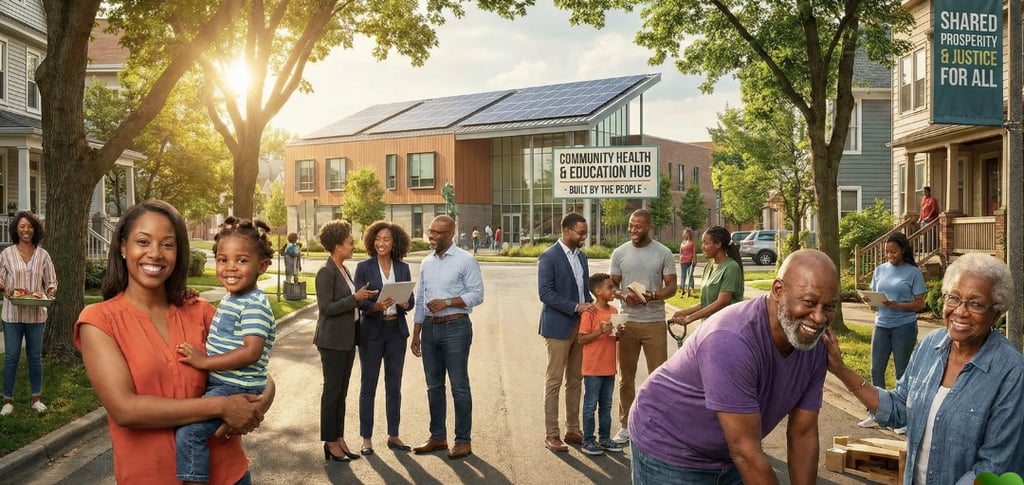
Social Democracy in America: Rebuilding a System That Works for Everyone, Especially Black Communities
America has always reinvented itself. Every generation has faced the same fundamental question: how do we build a society where prosperity is shared, justice is real, and opportunity is not reserved for a privileged few? Today, that question feels more urgent than ever. Millions of people are working harder than their parents yet falling further behind. Inequality widens. Wages stall. Healthcare, childcare, and education are increasingly treated as luxuries instead of basic rights.
More people are beginning to wonder whether the United States can evolve into a model that centers human well-being instead of treating it as an afterthought. That model already exists. It is called social democracy, a system that preserves markets and innovation while ensuring dignity, fairness, and real opportunity for all.
For African Americans, who have historically carried the heaviest burdens of inequality, the possibilities are especially transformative. But before we go any further, something needs to be said clearly: social democracy is not the plan. Sovereignty is the plan. Social democracy is the environment in which we build it. That distinction matters, and we will return to it.
What Social Democracy Actually Means
Social democracy is not the end of capitalism. It is the end of allowing capitalism to operate without responsible rules.
In today's version of liberal capitalism, the United States experiences weak social protections, strong corporate influence, limited worker power, and public goods tied directly to income or employment. It is a system built on the philosophy that markets should decide almost everything, including whether people have access to healthcare or affordable education.
A shift away from liberal capitalism does not dismantle the country. It simply adjusts the priorities. A social democracy centers equity, universal access to basic needs, shared prosperity, and strong public investment. Markets still operate. Businesses still innovate. People simply gain protections that prevent them from falling through the cracks.
What often gets lost in political debate is how moderate these changes actually are. Countries across Scandinavia, Western Europe, and Canada have operated under social democratic frameworks for decades. Their economies remain competitive. Their businesses remain profitable. The difference is that their citizens do not go bankrupt from medical bills, their workers receive paid family leave as a baseline, and their children are not priced out of higher education. These are not radical outcomes. They are practical ones. And they are achievable here.
These changes are reforms that can be implemented through democratic processes already in place.
How a Social Democracy Could Be Built in the United States
A stronger, people-centered system can emerge through legislation, policy changes, and constitutional tools already available.
Universal Healthcare
A social democracy replaces employer-dependent insurance with publicly supported healthcare that covers everyone. This can be done by expanding Medicare, creating a national public insurance plan, or allowing states to launch regional models. The result is universal coverage, lower costs, and protection from medical debt.
The United States already spends more per capita on healthcare than any other nation and yet covers fewer people with worse average outcomes. The issue is not resources. The issue is where those resources flow. A publicly supported system redirects spending toward patient care rather than administrative overhead and shareholder returns.
Universal College, Trade School, and Childcare
Education and childcare become rights instead of privileges tied to income. Partnerships across federal and state levels can make community colleges tuition free, expand trade and technical programs, and provide accessible childcare centers in every district. Families gain stability, and economic mobility becomes real.
For too long, higher education has functioned as a debt trap rather than a pathway. Young people graduate with five and six-figure loan balances before their careers have even started. Trade and technical programs, which offer direct routes to stable employment, remain underfunded and undersold. A social democratic approach invests in both, recognizing that a skilled and educated population is not a cost. It is the foundation of a competitive economy.
Stronger Worker Rights
Workers gain a fair balance of power with corporations. Union rights expand, paid leave becomes standard, anti-discrimination measures strengthen, and workplace protections improve. Wages rise, and people gain the stability needed to build secure lives.
The decline of union membership in the United States over the past fifty years tracks directly with the decline in middle-class wages and economic security. That is not a coincidence. When workers have collective power, they negotiate better outcomes. When they negotiate better outcomes, communities stabilize and consumer spending strengthens the broader economy. Worker rights are not just a labor issue. They are an economic infrastructure issue.
Wealth and Corporate Tax Reform
The goal is not punishment. It is modernization. Closing loopholes, updating capital gains taxes, and creating public investment funds ensures revenue returns to communities that need it most.
The tax code in its current form contains decades of carve-outs, exemptions, and structures that consistently benefit wealth over work. A family earning fifty thousand dollars a year pays a higher effective tax rate than many hedge fund managers. Modernizing that system does not require radical redistribution. It requires closing the gap between what the tax code says and what wealthy individuals and corporations actually pay.
Public Options in Key Sectors
Public options offer reliable alternatives when private markets fail. Broadband, utilities, housing development, and banking services become more accessible, more affordable, and more accountable.
In rural and low-income communities across the country, private markets have consistently failed to deliver basic services at reasonable prices. Internet access remains unavailable or unaffordable in large portions of the country. Predatory payday lenders operate in communities underserved by traditional banks. Public options do not eliminate private providers. They create competition that forces private markets to serve people better or lose them.
Democratic Reforms
A stronger democracy supports a stronger social democracy. Automatic voter registration, ranked choice voting, independent redistricting, and campaign finance reform help ensure that political power reflects the public more accurately.
Policy cannot serve people if people are locked out of the political process. Voter suppression, gerrymandering, and the influence of large donors distort representation and protect the status quo. Democratic reform is not a partisan issue. It is the operating system that allows every other reform to function.
What a Social Democracy Would Look Like in the United States
Imagine an America where healthcare is guaranteed, childcare is affordable, and higher education is accessible without lifelong debt. Picture workers earning wages that support a decent life, communities receiving sustained investment, and inequality beginning to shrink rather than expand.
It remains the same America, but it becomes a country that values collective well-being alongside economic freedom. Small businesses thrive because their employees have healthcare independent of payroll. Entrepreneurs take more risks because a failed venture does not mean losing health coverage. Parents stay in the workforce because childcare is accessible. Students choose careers based on interest and talent rather than which field pays enough to service a loan.
The social democratic model does not produce a nation of dependents. It produces a nation of people with the stability to take the kinds of risks that actually drive innovation, community investment, and long-term growth.
How Social Democracy Would Transform Life for African Americans
Because African Americans sit at the intersection of economic and racial inequality, a social democracy brings especially deep benefits. These changes are not charity. They are structural repair.
Universal Healthcare Creates Better Health Outcomes
Black communities face higher rates of chronic illness, maternal mortality, and medical debt. Guaranteed healthcare, preventive care, maternal health initiatives, and protection from financial ruin all close these gaps and strengthen future generations. Black women in America die from pregnancy-related complications at a rate nearly three times higher than white women. That is not biology. That is a policy failure. A system built around universal access and equitable care addresses this directly.
Stronger Worker Rights Lead to Higher Wages and Safer Jobs
Black workers are overrepresented in low-wage and high-risk industries. Expanded worker protections, stronger unions, and reinforced anti-discrimination laws improve pay, workplace safety, and long-term financial stability. When the floor rises, those who have been kept closest to the floor rise the most.
Universal Childcare and Education Expand Mobility
Black families often face higher childcare expenses and heavier student debt. Universal childcare, free community colleges, expanded trade programs, and investment in underfunded schools provide real mobility and generational uplift. Education has always been the clearest pathway to economic mobility in America, and it has always been the resource most aggressively denied to Black communities throughout history. Investing in it universally is both economic strategy and moral accounting.
Fair Taxation and Public Investment Strengthen Communities
Fairer taxation supports investment in schools, transportation, housing, and infrastructure. Communities that have been historically underfunded gain the resources needed for long-term growth. The neighborhoods that were redlined, defunded, and bypassed by highway construction did not fall behind by accident. Intentional disinvestment requires intentional reinvestment to correct.
Public Options Reduce Predatory Barriers
Predatory lending, unfair utilities, and exploitative financial systems have long targeted Black communities. Public options provide safer, more affordable alternatives and reduce systemic harm. When a community lacks access to a traditional bank, it is not a personal failure. It is a market gap that has been deliberately left open for exploitation.
A Fairer Democracy Strengthens Black Political Power
Removing voter suppression, creating fair districts, and reforming campaign finance elevates Black political influence and makes government more accountable. Black political power has historically been suppressed through legal and extralegal means whenever it grew strong enough to threaten existing power arrangements. Fair democratic systems do not give Black communities an advantage. They simply remove the disadvantage that has been deliberately constructed.
Lower Inequality Narrows Wealth Gaps
When inequality falls, the communities hit hardest by it experience the greatest gains. Wealth gaps begin to close, and opportunities expand. The racial wealth gap in America is not the result of different work ethics or different values. It is the compound result of centuries of exclusion, extraction, and blocked accumulation. Policies that reduce inequality structurally produce disproportionate benefits for those who have been most structurally excluded.
Stability Creates Space for Wealth Building
When healthcare, childcare, education, and wages stabilize, families gain the freedom to save, invest, buy homes, build businesses, and create generational wealth. Wealth is not just accumulated money. It is accumulated security. It is the margin that allows a family to survive a setback without losing everything. Social democracy expands that margin for the people who have had the least of it.
Why Black America Gains the Most From a Social Democracy
Inequality has harmed Black communities the most, so the solutions designed to reduce inequality naturally produce the strongest improvements where the need is greatest. Social democracy is not dependency. It is empowerment. It is measurable progress rooted in fairness and shared opportunity.
It reflects the values America has always claimed to uphold: dignity, equality, and opportunity for all.
This Is Not a New Idea. It Is an Overdue One.
Social democracy is not a foreign concept imported from Europe. Its roots run deep in American soil. The New Deal, the Civil Rights Movement, the Great Society programs, and the labor movements of the 20th century were all expressions of the same core belief: that a government of the people has a responsibility to protect the people.
What changed was not the idea. What changed was who gained power and what they chose to prioritize.
The last several decades have produced a steady erosion of public investment, worker power, and social protections while corporate profits and executive wealth have reached historic highs. The result is an economy that works brilliantly for a narrow class of people and leaves tens of millions, disproportionately Black Americans, managing survival instead of building futures.
It is worth noting that many of the New Deal programs that built the American middle class were deliberately structured to exclude Black workers. Social security initially excluded domestic workers and agricultural laborers, two of the largest employment categories for Black Americans at the time. The GI Bill, which created generational wealth for millions of white families through homeownership and education benefits, was administered in ways that systematically denied those same benefits to Black veterans. The social democratic tradition in America has a complicated racial history. Acknowledging that history does not discredit the model. It clarifies what a fully realized version of it must look like.
Social democracy does not ask America to become something it has never been. It asks America to fulfill what it has always promised, this time without the asterisk.
The Eight Pillars and the Case for Structural Change
At Black Metrics, we analyze progress through the Eight Pillars, a framework for evaluating Black community health and sovereignty across education, economics, health, political power, employment, land, environment, and justice. Social democracy, implemented fully, moves the needle across every single pillar.
Education
Education has historically been the most weaponized pillar against Black communities. From laws criminalizing Black literacy during slavery to the deliberate underfunding of majority Black schools today, the denial of education has been a consistent tool of suppression. Social democracy directly counters this by making education a public good rather than a product priced by zip code.
Universal pre-K and subsidized childcare give Black children equitable starting points. Fully funded public schools eliminate the property tax funding model that channels resources toward wealthy neighborhoods and starves communities that need investment the most. Tuition-free community colleges and expanded trade programs remove debt as a barrier to skilled careers. When education is treated as infrastructure rather than a privilege, Black students gain access to the full pipeline of opportunity that has too long been available only to those who could afford it.
But here is the deeper point. An educated Black community does not just participate in the broader economy. It builds its own. Sovereign institutions, independent schools, community-controlled curricula, and intergenerational knowledge transfer all depend on a population with the tools to think critically, lead strategically, and pass wisdom forward. Social democracy creates the floor. Sovereignty builds the house.
Economics
The racial wealth gap is not a gap in ambition or effort. It is the compounded result of legal exclusion from wealth-building systems across generations. Black families were locked out of the GI Bill, redlined out of homeownership, excluded from labor protections, and targeted by predatory financial products. Social democracy addresses the structural roots of this gap rather than its symptoms.
Progressive taxation that closes loopholes and updates capital gains rules generates revenue for public investment in underserved communities. Public banking options provide affordable financial services where predatory lenders currently operate without competition. Community investment funds begin to rebuild the asset base that was systematically denied. When the economic floor rises and public investment flows into historically excluded communities, the racial wealth gap begins to narrow not through charity but through structural correction.
That correction, however, is not the destination. It is the runway. The goal is not simply to close a gap within a system that has never fully included us. The goal is to build economic infrastructure that Black communities own, control, and direct. Social democracy gives us more resources to work with. Sovereignty determines what we build with them.
Health
Black communities carry a disproportionate burden of chronic illness, preventable death, and healthcare debt. These are not biological inevitabilities. They are the direct outcomes of a healthcare system that has historically underserved, mistreated, and financially punished Black patients.
Universal healthcare eliminates the barrier of cost that causes Black Americans to delay or avoid care until conditions become critical. Guaranteed preventive care catches chronic illness early rather than treating it expensively late. Targeted maternal health investments address the crisis of Black maternal mortality, which persists across income and education levels. Mental health services, long underfunded in Black communities, become part of standard coverage. When health is treated as a right, the outcomes gap between Black and white Americans begins to close because the system stops failing the people it has most consistently failed.
And a healthy community is a sovereign community. You cannot build, organize, lead, or sustain generational work from a position of chronic illness and medical debt. Better public health outcomes are not just quality of life improvements. They are capacity investments in the people doing the work of sovereignty every day.
But improved access to the existing healthcare system is only part of the work. The deeper mandate is to heal our people through culturally grounded care, local pharmaceutical production, and community-led wellness systems built outside of dependency. That means investing in traditional botanical research, supporting Black practitioners who center the whole person rather than just the symptom, and building independent medical networks that serve our communities on our own terms. A social democracy reduces the financial and structural barriers that have kept Black people from receiving adequate care. Sovereignty builds the parallel infrastructure that ensures our healing is never entirely contingent on whether the state chooses to provide it.
The measure of progress here is not just insurance coverage rates. It is health outcomes across Black communities, the expansion of independent medical networks, and the growth of traditional botanical research infrastructure that reconnects our people to knowledge systems that predate and outlast any government program.
Social democracy opens the door to better care. Sovereignty builds the healing institutions that belong to us permanently.
Political Power
Black political power has been suppressed, diluted, and dismantled at every point in American history when it grew strong enough to threaten existing power arrangements. From Reconstruction-era disenfranchisement to modern voter ID laws and gerrymandering, the tools change but the goal remains consistent.
Social democracy includes democratic reform as a core structural component. Automatic voter registration removes bureaucratic barriers that disproportionately affect Black voters. Independent redistricting commissions end the practice of drawing districts to dilute Black voting power. Campaign finance reform reduces the influence of large donors and raises the relative weight of ordinary voters. Ranked choice voting creates more competitive elections and reduces the effectiveness of spoiler candidates used to split progressive coalitions. When democracy works more fairly, Black political power grows stronger and government becomes more accountable to the communities it has historically ignored.
But political power within the state is not the same as sovereignty. Representation is a tool, not a destination. The goal is not simply to have Black faces in the rooms where decisions are made about our communities. The goal is to build the independent institutions, economic bases, and governing capacity that reduce how many of those rooms we have to petition in the first place.
Employment
Black workers have always faced a dual disadvantage in the American labor market, higher unemployment rates during economic downturns and overrepresentation in low-wage, high-risk industries during periods of growth. Anti-discrimination protections exist on paper but enforcement has remained inconsistent and slow.
Social democracy strengthens the labor floor for everyone and enforces it more aggressively where the need is greatest. Expanded union rights give Black workers collective bargaining power in industries where individual negotiation leaves them vulnerable. Minimum wage increases tied to cost of living raise wages in the sectors where Black workers are most concentrated. Paid family leave and workplace safety protections provide stability and security that low-wage workers have long been denied. Strengthened anti-discrimination enforcement in hiring, promotion, and pay closes gaps that legal protection alone has failed to close. When work pays fairly and the rules are enforced, Black workers gain the economic ground that has been repeatedly taken from them.
The larger vision, though, is a Black community that is not solely dependent on employment within systems it does not own. Worker protections matter enormously for the generations of Black people currently employed in those systems. And simultaneously, the goal is to expand Black-owned enterprises, cooperative models, and community-controlled economic institutions so that sovereignty is not waiting on someone else to enforce a rule. It is built into the structure of how we work and who benefits from that work.
Land
Land ownership is one of the most direct expressions of economic sovereignty, and Black communities have one of the most documented histories of land loss in American history. From the broken promise of forty acres after emancipation to the use of zoning laws, eminent domain, and tax manipulation to remove Black landowners from valuable property throughout the 20th century, land has been taken more often than it has been allowed to accumulate.
Social democracy creates the conditions for land ownership to return and stabilize in Black communities. Affordable housing programs reduce the displacement that pushes Black residents out of gentrifying neighborhoods. Community land trusts funded through public investment allow collective ownership models that resist speculative pricing. Predatory lending reforms protect Black homeowners from the financial instruments that stripped billions in equity from Black families during the 2008 mortgage crisis. Investment in rural Black land preservation supports the communities in the South where Black land ownership has been quietly disappearing for decades.
Land is not just an asset. It is the physical foundation of sovereignty. Every Black institution, every community garden, every school, every cooperative, every cultural space requires land. Social democratic policy helps Black communities hold what they have. Sovereignty strategy drives the work of acquiring, protecting, and passing it forward.
Environment
Environmental racism is the pattern by which industrial facilities, waste sites, and pollution sources are disproportionately located in and near Black communities. It is not accidental. It is the result of political decisions made in rooms where black communities had no representation and corporate calculations that treated Black neighborhoods as acceptable sacrifice zones.
Social democracy addresses environmental inequality as a matter of policy rather than afterthought. Green infrastructure investment prioritizes the communities that have been most harmed by environmental neglect, bringing clean energy, clean water, and improved public health simultaneously. Stronger environmental enforcement holds corporations accountable for the pollution they have long been permitted to concentrate in low-income Black neighborhoods. Public transit investment reduces car dependency in communities that have been systematically separated from economic centers by highway placement and transit disinvestment. When the environment is treated as a shared public good rather than a cost to be externalized onto vulnerable communities, Black neighborhoods stop absorbing the pollution that the broader economy has been allowed to produce without consequence.
A sovereign community also takes direct responsibility for its environment. Community-controlled green energy projects, urban agriculture, cooperative food systems, and local environmental stewardship are not just responses to what the state fails to provide. They are expressions of a community that refuses to outsource its survival and builds its relationship with the land on its own terms.
Justice
The American justice system has never operated equitably for Black communities. From the Black Codes following emancipation to mass incarceration today, the legal system has been used as a tool of economic extraction and social control as much as a mechanism of genuine public safety.
Social democracy does not simply reform policing. It addresses the conditions that have caused policing to expand into spaces where it does not belong. When mental health services exist, mental health crises do not default to armed response. When housing is stable, survival crimes decrease. When employment is accessible and fair, economic desperation does not funnel people into criminal exposure. When public defenders are properly resourced, poor Black defendants receive real legal representation rather than a system designed to process them quickly. Ending cash bail, investing in reentry programs, expunging nonviolent records, and reforming sentencing all restore the ability of Black individuals to participate fully in economic and civic life after contact with the system.
Justice, in the social democratic framework, is about creating the conditions where harm is less likely to occur and where those who have been harmed by the system can rebuild. And in the sovereignty framework, justice goes further. It means building community-based accountability systems, restorative practices, and the kind of internal cohesion that reduces dependence on a legal system that was never designed to protect us.
Why the Pillars Work Together
The Eight Pillars framework is useful here because it resists the temptation to treat any single policy as the solution. Healthcare reform alone does not build sovereignty. Worker protections alone do not close the wealth gap. But a system that addresses all eight dimensions simultaneously creates the conditions where each pillar can strengthen the others.
A child who receives quality education is more likely to gain stable employment. A worker with stable employment can invest in land ownership. A homeowner with land equity has more political and economic leverage. A community with political power can demand environmental protection. A neighborhood with a clean environment produces better health outcomes. A person who is healthy and educated and employed and housed is far less likely to become entangled in the justice system.
That is the compounding power of structural change as opposed to isolated programs. Each pillar, when strengthened, reinforces the others. And each pillar, when neglected, undermines the rest.
No single policy solves everything. But social democracy as a system creates the conditions where progress across all eight pillars becomes possible, measurable, and sustainable.
Sovereignty Is Plan A. Social Democracy Is the Terrain.
Here is what history has taught us plainly and repeatedly: what the state gives, the state can take away.
The Freedman's Bureau was dismantled. Black Wall Street was destroyed. The gains of Reconstruction were rolled back through violence and law. The programs of the Great Society were defunded and gutted. Affirmative action has been systematically dismantled in court. Every time Black communities have relied solely on state-granted rights, state-funded programs, or state-protected access, those gains have proven vulnerable the moment political winds shifted and the will to protect them disappeared.
This is not cynicism. It is pattern recognition. And the pattern demands a strategic response.
Sovereignty means building what we own, controlling what we build, and protecting what we control regardless of who occupies political office. It means Black-owned financial institutions, cooperative enterprises, community land trusts, independent schools, cultural institutions, and governance structures that do not require permission from outside to function. It means investing in internal capacity so that a hostile administration cannot simply defund our progress out of existence.
Social democracy and sovereignty are not competing visions. They operate on different levels and serve complementary purposes.
Social democracy improves the quality of the terrain we are building on. It means fewer of our people are in medical debt while trying to build. Fewer are trapped in predatory financial systems while trying to save. Fewer are locked out of education while trying to lead. It reduces the friction and the extraction that drain Black communities of the energy and resources needed for long-term sovereign institution building.
But social democracy is not the builder. We are the builders.
The goal is not to arrive at a well-funded, fairly structured version of dependency. The goal is to use every improvement in our material conditions as fuel for the deeper work of building institutions, accumulating land, developing leadership, and creating the kind of durable independent power that cannot be undone by a single election or a hostile court decision.
Social democracy at its best gives us better conditions to work in. Sovereignty gives us something worth working toward that belongs to us permanently.
Both matter. Neither replaces the other. And the work requires holding both with clarity at the same time.
What Stands in the Way
The obstacles are real and they should be named plainly.
Corporate lobbying distorts policy in favor of those who can afford to pay for influence. Racial resentment has been used for generations to turn working-class white voters against policies that would benefit them alongside Black communities. Misinformation frames universal programs as radical when they are standard practice in dozens of democracies. And a political system designed with significant structural barriers makes large-scale reform difficult even when public support exists.
There is also the obstacle of political imagination. Many people cannot picture what a different system looks like because they have lived their entire lives inside this one. When universal healthcare is described, the immediate instinct for many is to ask how it gets paid for rather than to ask why the current system costs more and delivers less. Shifting that instinct requires sustained public education, clear communication, and visible examples of the policy working in practice.
None of these obstacles are permanent. They are political, and political conditions change. Public opinion on healthcare, student debt, worker rights, and corporate accountability has shifted significantly over the past decade, particularly among younger Americans. The constituency for structural reform exists and is growing.
Progress has always come when organized people demanded it, sustained it, and refused to accept a system that served only the powerful. That work continues today.
The Path Forward
Social democracy does not arrive all at once. It is built through policy by policy, election by election, and coalition by coalition. It requires voters who understand what is at stake, organizers who build durable power, and thinkers who can translate complex systems into clear vision.
It also requires a willingness to hold two things at once: the urgency of immediate relief for communities under real pressure right now, and the long strategic commitment to systemic change that outlasts any single election cycle. Both are necessary. Short-term wins create momentum and demonstrate that change is possible. Long-term strategy ensures those wins are protected and expanded.
And running alongside all of it, not waiting for it to be finished but being built in parallel, is the sovereign infrastructure that belongs to us regardless of what the state decides. The community institutions. The independent economic networks. The cultural memory. The land. The schools. The next generation of leaders who understand both how the system works and why building beyond it is not optional.
That is part of what The Strategic Stream exists to do.
Every post in this series is a tool. Use it to understand, to organize, and to build. The goal is not just commentary. The goal is capacity. The goal is a community that understands its situation clearly enough to change it strategically and permanently.
Read. Watch. And get to work.
References:
Economic Policy Institute for data on racial wage gaps and worker rights
The Century Foundation for research on universal healthcare and racial health disparities
Brookings Institution specifically their race and economic opportunity research
National Bureau of Economic Research for studies on inequality and social investment
Demos for policy research on democracy reform and racial equity
Color of Change for political power and structural reform framing
Urban Institute for housing, childcare, and education equity research
Movement for Black Lives Policy Platform for connecting structural policy to Black liberation framework
THE BLUEPRINT
Contact
hello@blackmetrics.space
Copyright © 2026 The Black Metrics. All Rights Reserved.
The BlaCK METRICS
The Pillars
Strategic Stream Blog