Stop Asking, Start Building: Reclaiming Our Collective Economic Power
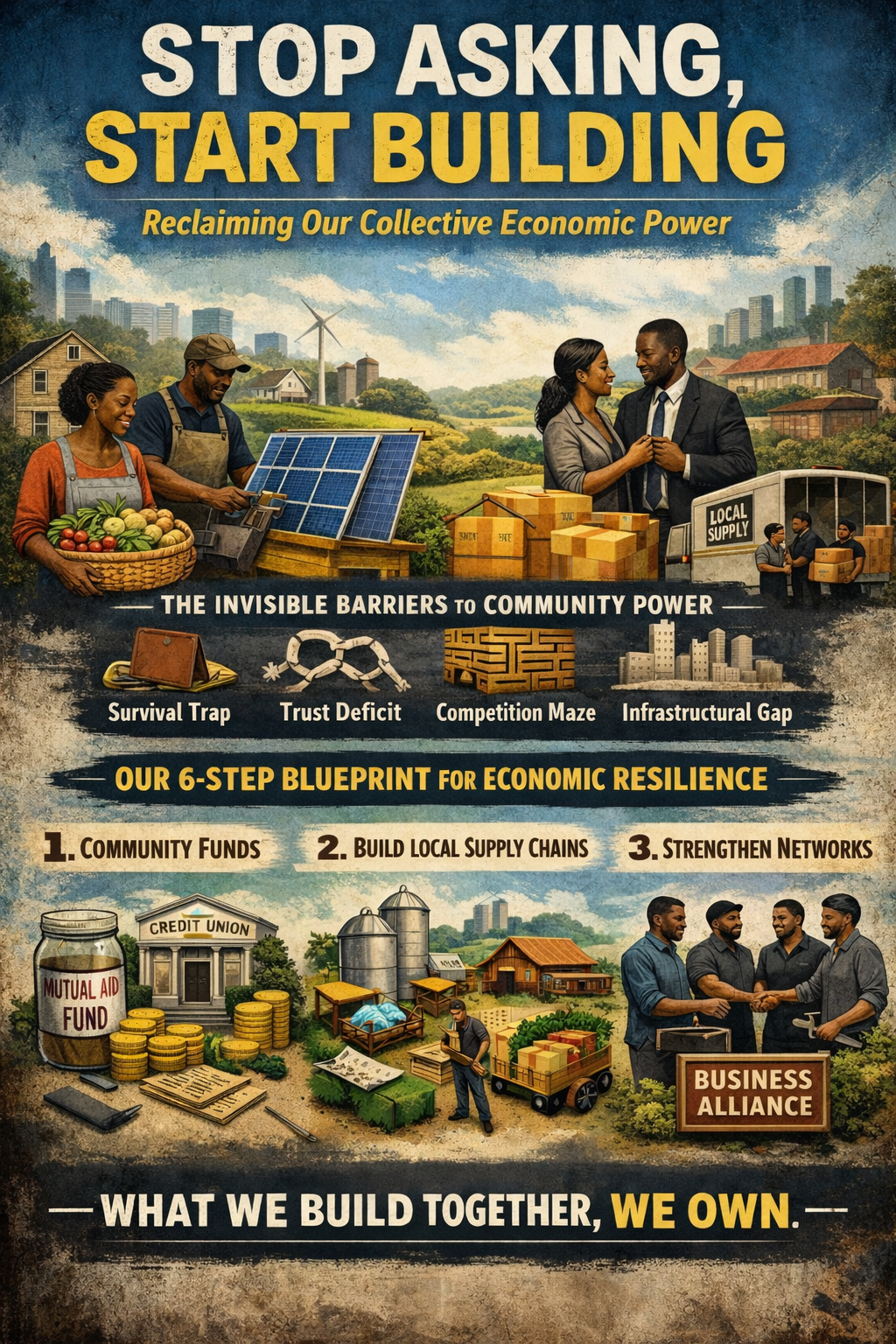
This Strategic Briefing, titled "Stop Asking, Start Building," is a direct response to a viewer’s question regarding community self-reliance and economic independence. It serves as both a strategic analysis and a practical roadmap for moving beyond political activism into tangible community building. The post is structured into three main parts: The Problem: It validates the frustration of relying on external systems that are often cut or dismantled, arguing that true freedom requires economic self-determination. The Barriers: It identifies four psychological and structural hurdles—the Survival Trap, the Trust Deficit, the Competition Maze, and the Infrastructural Gap—that prevent communities from unifying. The Solution: It provides a 6-step "Activation Blueprint" divided into three phases: establishing mutual aid funds, redirecting capital to local credit unions, and formalizing bartering networks and business alliances. Overall, the post is designed to shift the reader's mindset from a passive consumer waiting for outside help to an active builder of a "Circular Community Economy."
The Black Metrics
3/22/20263 min read
Stop Asking, Start Building: Reclaiming Our Collective Economic Power
We’ve all seen the news, felt the shifting political winds, and watched programs or civil rights we fought for slowly erode. The response is almost always a call to action: complain louder, vote smarter, and then wait for things to change.
Recently, a viewer reached out with a profound frustration, questioning why we, as a community, aren’t doing more to save ourselves. They asked:
"Voting is important, but we also need to build, work, and actively take part in systems that reduce our dependence on others for basic needs. Many communities succeed by consistently supporting their own businesses, services, and networks, creating stability and long term resilience. When support systems are cut, too many of us are left waiting and asking for help instead of having something sustainable already in place. Why aren’t we doing more to come together, support each other economically, and build systems that keep us strong regardless of outside decisions?"
It’s a question that cuts through the noise and targets the one thing every community truly needs: Self Determination.
True freedom is not just about who holds office; it’s about who holds your mortgage, who grows your food, and who manages your collective resources. If our economic foundation depends entirely on systems outside our control, our political power remains fragile.
To move forward, we must be honest about why we haven't already reached this goal.
The Four Invisible Barriers to Community Power
The Survival Trap: We cannot think long-term when we are struggling to exist. For many, finding the cheapest deal from a multinational corporation isn't a lack of loyalty; it’s a survival tactic. We must design solutions that bridge this immediate resource gap.
The Trust Deficit: Social capital is our greatest currency, but historical trauma has damaged it. Many communities have seen their successful economic systems systematically targeted or dismantled. Building a shared safety net requires us to actively re-learn how to trust and rely on one another.
The Competition Maze: Modern economies demand that we compete rather than collaborate. We must rewire our leadership style to favor collectivism over individualism. This means breaking out of silos, sharing resources, and prioritizing the long-term collective good over short-term ego wins.
The Infrastructural Gap: We aren't just competing against the price of a loaf of bread; we are competing against a global supply chain. To thrive independently, we need to build the entire vertical stack: our own banks, our own insurance pools, and our own supply lines.
Activation: Our 6-Step Blueprint for Economic Resilience
Recognizing these barriers is the starting point. We can no longer afford to wait. It’s time to activate the Circular Community Economy. Here is a non-negotiable guide for those ready to transition from a consumer mindset to a builder mindset.
Phase 1: Establish Your Community Funds
Do not rely on national insurance companies or government loans as your only resort in a crisis.
Start the Mutual Aid Fund: A small group commits to saving a set amount monthly in a shared fund. Over time, this becomes a resilience pool for emergency rent assistance, medical bills, or small business disasters.
Formalize Local Investment: Instead of only investing in the general stock market, direct capital into established local community-development loan funds or credit unions. This activates your money to build local systems.
Phase 2: Redirect and Verticalize Your Capital
Economic independence is about redirection, not necessarily new spending.
Move Your Account to a Credit Union: This is a powerful move. Unlike national banks that export capital, local credit unions recycle money back into the community through home and business loans. Your money works for your neighborhood.
Build a Vertical Supply Chain: Supporting a local business is a start, but we must also support the businesses that supply them. By strengthening local millers, farmers, and distributors, we create a closed loop of wealth.
Phase 3: Formalize Your Network
Move from handshake deals to reliable community infrastructure.
Standardize Bartering Networks: Formalize a system where skills like plumbing, accounting, or childcare can be traded. This reduces cash flow dependency and turns community talent into community wealth.
Join a Local Business Alliance: Create or join a collaborative structure where local entrepreneurs pool resources for buying power, collective marketing, and business training. This replaces "me" with "us."
The viewer who asked this question is right. Programs may change and rights may be challenged, but the only thing that remains sustainable is what we build together.
THE BLUEPRINT
Building the future of the global African Diaspora through data-driven storytelling and the Eight Pillars of Sovereignty. From survival to ownership.
Contact
Subscribe To the NewsLETTER
hello@blackmetrics.space
Copyright © 2026 The Black Metrics. All Rights Reserved.
The BlaCK METRICS