Stop Asking Start Building: The Blueprint for Black Community Economic Self-Determination
We break down the four barriers blocking Black economic power and lay out a 6-step Activation Blueprint for building a Circular Community Economy that lasts.
ECONOMIC, EMPLOYMENT, & BUSINESS SOVEREIGNTY
The Black Metrics
3/22/20269 min read
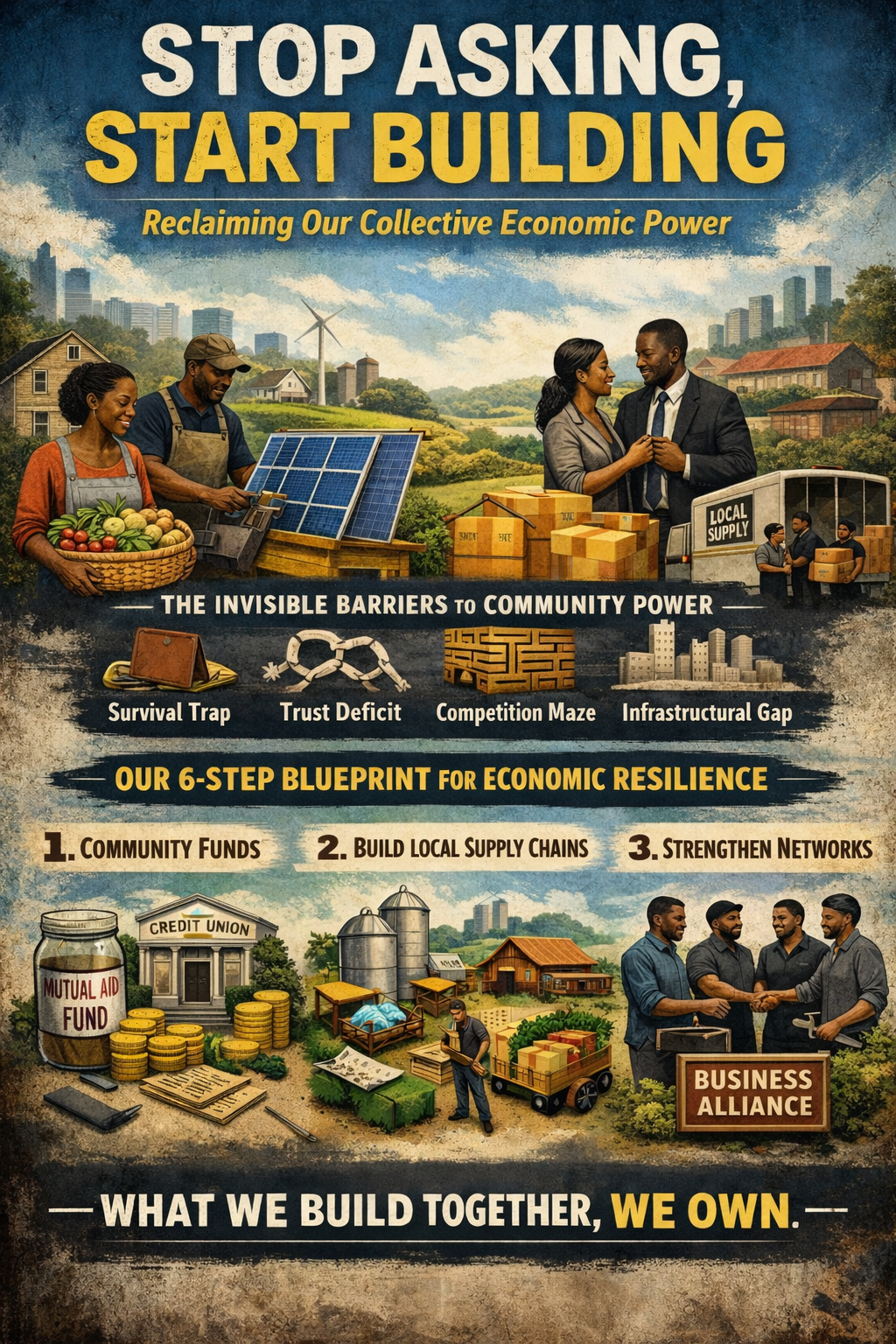
Stop Asking, Start Building: Reclaiming Our Collective Economic Power
We have all seen the news, felt the shifting political winds, and watched programs or civil rights we fought for slowly erode. The response is almost always a call to action: complain louder, vote smarter, and then wait for things to change.
Recently, a viewer reached out with a profound frustration, questioning why we as a community are not doing more to save ourselves. They asked:
"Voting is important, but we also need to build, work, and actively take part in systems that reduce our dependence on others for basic needs. Many communities succeed by consistently supporting their own businesses, services, and networks, creating stability and long-term resilience. When support systems are cut, too many of us are left waiting and asking for help instead of having something sustainable already in place. Why aren't we doing more to come together, support each other economically, and build systems that keep us strong regardless of outside decisions?"
It is a question that cuts through the noise and targets the one thing every community truly needs: self-determination.
True freedom is not just about who holds office. It is about who holds your mortgage, who grows your food, and who manages your collective resources. If our economic foundation depends entirely on systems outside our control, our political power remains fragile regardless of who we elect.
The Historical Precedent We Cannot Ignore
This is not a new problem and it is not a new observation. In 1921, the Greenwood District of Tulsa, known as Black Wall Street, represented one of the most prosperous Black communities in American history. It had its own hospitals, law firms, banks, newspapers, and schools. The dollar circulated within the community multiple times before it left. It was an operational model of Economic Sovereignty functioning at community scale.
It was destroyed in 36 hours by a coordinated mob attack aided by local government including aerial bombardment of a civilian community. The lesson is not that building is pointless. The lesson is that building without protection and without redundancy is the vulnerability. We must build smarter, deeper, and more connected than before.
Black Wall Street was not destroyed because it was weak. It was destroyed because it was strong. Economic autonomy in a Black community was treated as a threat that required violent elimination. Understanding that history is not pessimism. It is strategic intelligence. Every piece of infrastructure we build today must be designed with that intelligence built in. For the full analysis of how systems of suppression target economic sovereignty and what it means for how we build, read When the Declaration Became Conditional: Black Sovereignty and America's Broken Promise.
The Garvey movement understood this as well. The UNIA built economic infrastructure at global scale while simultaneously building the political organization to protect it. The two pillars were inseparable by design. Building without organizing the protective infrastructure around the building is the gap that has consistently been exploited. For the full organizational blueprint, read Marcus Garvey and the UNIA: How the Largest Black Movement in History Built the Blueprint for Global Black Sovereignty.
The Four Invisible Barriers to Community Power
Recognizing the opportunity is not enough. We also need to be honest about why we have not already closed the gap. Four structural barriers appear consistently across communities and across data sets.
Barrier One: The Survival Trap
We cannot think long-term when we are struggling to exist. For many, finding the cheapest deal from a multinational corporation is not a lack of loyalty. It is a survival tactic. We must design solutions that bridge this immediate resource gap rather than demanding sacrifice from people who are already stretched.
This is why the entry point to community economics cannot require financial sacrifice from those who are already at the margin. The mutual aid model works precisely because it starts small. Ten dollars a month from twenty people is two hundred dollars immediately available for whoever needs it most. Five committed people putting in twenty-five dollars each per month produces fifteen hundred dollars by the end of the year. That is someone's security deposit. That is a business filing fee. That is a medical co-pay that does not become a debt spiral. Scale from there.
The Survival Trap is also a psychological pattern with biological roots. The 2026 JAMA study confirmed that chronic survival stress elevates inflammation markers and shortens lives. The chronic financial precarity that traps communities in short-term thinking is not just an economic issue. It is a healthcare crisis. The economic work and the health work are the same work. For the full clinical analysis of how survival stress embeds biologically, read The Silent Killer: New 2026 Study Proves Racism Is a Public Health Emergency.
For a deeper breakdown of how mutual aid evolves into structured economic power, read Claudia Jones: The Blueprint for Black Economic Internationalism and Pan-African Sovereignty.
Barrier Two: The Trust Deficit
Social capital is our greatest currency, but historical trauma has damaged it. Many communities have seen their successful economic systems systematically targeted or dismantled: Black Wall Street, the Reconstruction-era Black banks and land holdings, the UNIA's economic enterprises. The pattern of building and having it destroyed has left a legitimate scar on collective trust.
Trust is not rebuilt through speeches. It is rebuilt through consistent, documented, transparent action over time. When community members see that the mutual aid fund actually paid someone's rent, when they see the credit union actually approved a local business loan that a traditional bank denied, the trust compounds. Proof of function is the antidote to historical betrayal. Every small act of delivered promise is a brick in the foundation that the next generation will build on.
The internalized racism research documents how this historical trauma transmits across generations through the collective layer of socialization. Children who grow up in communities where the story of Black economic cooperation ends in betrayal and destruction absorb that story as a warning rather than as a call to rebuild with better systems. Naming that transmission and interrupting it is part of the economic work. For the full analysis of how internalized programming affects collective economic behavior, read The Cycle of Internalized Programming: How Beliefs Are Installed, Reinforced, and How to Break the Loop.
Barrier Three: The Competition Maze
Modern economies demand that we compete rather than collaborate. We are marketed to as individuals. Our metrics for success, personal income, personal property, personal brand, are all singular. The entire architecture of the consumer economy is built to route our spending toward large corporations and away from each other.
Individual success without collective infrastructure is a nicer cell. It provides comfort but not sovereignty. The Competition Maze is also enforced culturally through respectability politics that pit community members against each other for access to external validation. Sovereignty requires adding a second set of metrics alongside the personal ones: how many in my community did I pull up this year? How much capital stayed in our network? How many local businesses did I refer and support?
Barrier Four: The Infrastructural Gap
We are not just competing against the price of a loaf of bread. We are competing against a global supply chain with vertical integration, economies of scale, and decades of infrastructure investment. To thrive independently, we need to build the entire vertical stack: our own banks, our own insurance pools, our own supply lines, our own distribution networks.
The infrastructural gap is not closed by spending at one Black-owned restaurant on a Saturday. It is closed by building the systems that supply that restaurant: the local distributors, the community-backed lenders, the cooperative buying groups, the shared commercial kitchen infrastructure. Visibility is not infrastructure. Ownership is.
Activation: The Six-Step Blueprint for Economic Resilience
Recognizing these barriers is the starting point. Here is the non-negotiable guide for those ready to transition from a consumer mindset to a builder mindset.
Phase One: Establish Your Community Funds
Start the Mutual Aid Fund. A small group commits to saving a set amount monthly in a shared fund. Over time, this becomes a resilience pool for emergency rent assistance, medical bills, or small business disasters. Start with five people. Five committed people with twenty-five dollars each per month is fifteen hundred dollars by the end of the year. That is someone's security deposit. That is a business filing fee. Scale from there.
Formalize Local Investment. Instead of only investing in the general stock market, direct capital into established local community-development loan funds or credit unions. Your retirement cannot be the only thing you are investing in. Invest in the community around you and that community becomes part of your long-term security.
Phase Two: Redirect and Verticalize Your Capital
Move Your Account to a Credit Union. Unlike national banks that export capital to shareholders, local credit unions recycle money back into the community through home and business loans. Your money works for your neighborhood. Most people never switch because they assume it is complicated. It is not. It takes one afternoon and one decision. The question is not whether you can do it. The question is whether you are willing to prioritize community capital circulation over banking convenience.
Build a Vertical Supply Chain. Supporting a local business is a start, but we must also support the businesses that supply them. Ask the Black-owned restaurant where they buy their produce. Ask the Black-owned boutique where they source their inventory. Then support those suppliers. The goal is not to be a customer. It is to understand and strengthen the entire chain. Every link in the chain you can replace with a Black-owned alternative is a link in the circuit of community wealth.
Phase Three: Formalize Your Network
Standardize Bartering Networks. Formalize a system where skills like plumbing, accounting, childcare, or legal counsel can be traded. This reduces cash flow dependency and turns community talent into community wealth. A barter network is not informal charity. It is a structured agreement with clear terms. Document it. Honor it. Treat it like a contract, because it is one.
Join or Create a Local Business Alliance. Create or join a collaborative structure where local entrepreneurs pool resources for buying power, collective marketing, and business training. The business alliance is also your intelligence network. When one member learns about a grant, everyone knows. When one member faces a regulatory challenge, the group responds. Individual businesses fail in isolation. Alliances adapt and survive.
The Longer View: What We Are Actually Building
The six steps above are not a fix. They are a foundation. What we are actually building beneath the mutual aid funds and the credit unions and the barter networks is a parallel economy: a system that does not disappear when a program is cut, when an election goes wrong, or when a platform changes its algorithm.
The communities around the world that have achieved the most durable form of sovereignty are not the ones that lobbied hardest. They are the ones that built the most redundant infrastructure. When one pathway was closed, they had three others. When one institution was attacked, two more were already operational. That is the model. Not dependence on any single system, leader, or institution. Distributed. Documented. Durable.
For a deeper strategic breakdown of how employment income becomes the seed capital for this parallel economy, read Black Employment Sovereignty: Why the Job Is Just the Starting Point to Real Wealth.
Every step you take inside the Circular Community Economy is a node in a sovereign network. Your mutual aid fund connects to your credit union, which finances the local business, which hires from the community, which fills the mutual aid fund. That is not charity. That is a sovereign economy in motion.
The viewer who asked the original question is right. Programs may change and rights may be challenged, but the only thing that remains sustainable is what we build together. Kwame Nkrumah learned this when political independence without economic control proved insufficient. Funmilayo Ransome-Kuti demonstrated it when organized communities produced real concessions that petitions alone could not. The lesson is consistent across every sovereignty framework ever built. For the full analysis of that lesson at the national and continental scale, read Kwame Nkrumah & Funmilayo Ransome-Kuti: Independence vs Black Sovereignty.
The Bantaba: Discussion Questions
The Survival Trap makes long-term thinking difficult for communities under financial pressure. What is one economic structure your community could build that would reduce the immediate financial pressure on its most vulnerable members?
Trust is rebuilt through consistent, documented, transparent action. What is one example of a community economic institution in your area that has built trust through proof of function? What made it work?
The Competition Maze routes Black spending away from Black communities through individualized marketing and pricing. What specific spending decision could you change this week that would redirect capital into your community network?
The infrastructural gap requires building the supply chain, not just the storefront. What is one supply chain that currently serves Black-owned businesses in your community that could itself be Black-owned?
The Circular Community Economy connects mutual aid to credit unions to local businesses to community employment. Which link in that chain is weakest in your community and what would strengthening it require?
Recommended Reading
The Cooperative Commonwealth — On the history and economics of cooperative enterprise as a sovereignty model.
Collective Courage: A History of African American Cooperative Economic Thought and Practice by Jessica Gordon Nembhard — The definitive history of Black cooperative economics in America.
The Working World — On community-development finance and alternative capital models.
Our Black Year by Maggie Anderson — A practical case study of what redirecting Black consumer spending into Black-owned businesses produces at community scale.
This is the work of Economic and Employment & Business Sovereignty. The full blueprint is in Volume 2 and Volume 3.
→ Get Volume 2: Economic Sovereignty Bundle
→ Get Volume 3: Employment & Business Sovereignty
THE BLUEPRINT
Contact
hello@blackmetrics.space
Copyright © 2026 The Black Metrics. All Rights Reserved.
The BlaCK METRICS
The Pillars
Strategic Stream Blog