The Biology of Oppression: Why You Cannot Meditate Your Way Out
The Biology of Oppression: A 2026 JAMA study found racism shortens Black lives in the bloodstream. Healthcare Sovereignty, Vol 5, explains why the cure cannot be individual.
HEALTHCARE SOVEREIGNTY
The Black Metrics
6/8/20266 min read

The Sovereignty Series • Volume 5
The Biology of Oppression: Why You Cannot Meditate Your Way Out
For most of modern medical history, Black communities carried a claim that the establishment refused to measure. They said the daily weight of discrimination was making them sick and shortening their lives. They were told it was attitude, imagination, anything but a verifiable injury. In January 2026, that excuse collapsed.
A study published in JAMA Network Open, led by Isaiah Spears at Washington University in St. Louis, drew on the St. Louis Personality and Aging Network and followed more than 1,500 Black and White adults for roughly two decades. It found that the higher mortality among Black participants was explained, in part, by two forces acting together: greater cumulative stress across the lifespan and elevated inflammation in the blood, measured through markers such as C-reactive protein and interleukin-6.
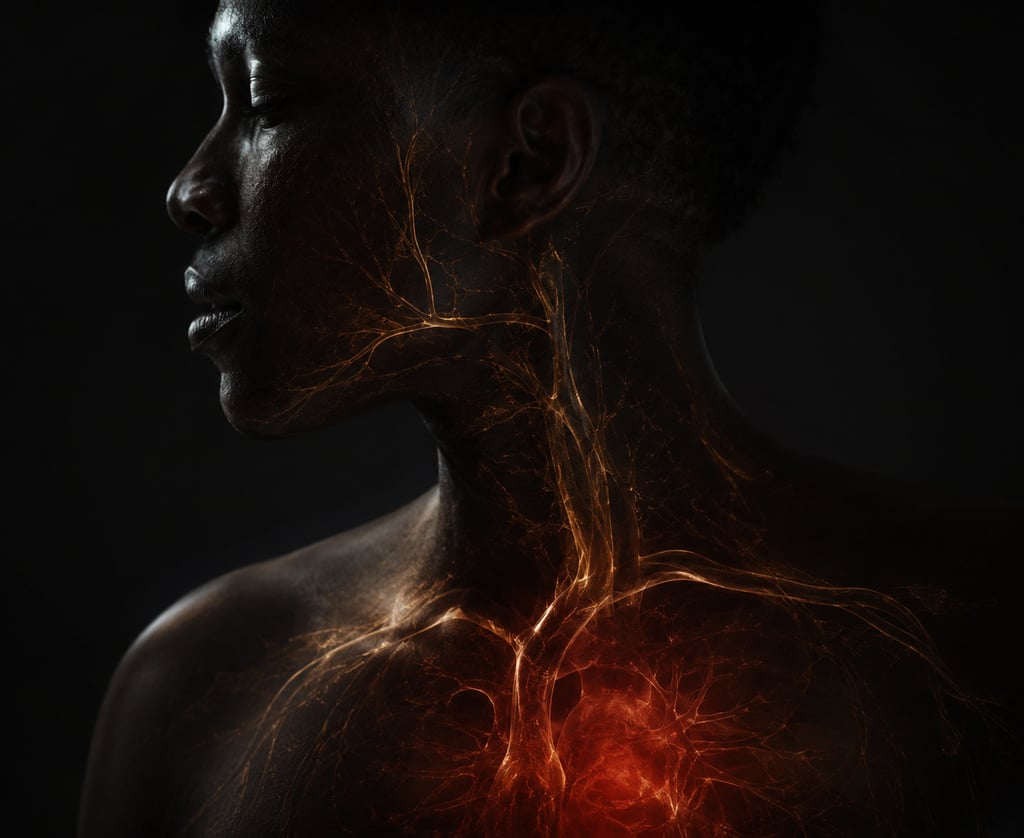
In plain terms, the body keeps the record. Racism is not only a moral injury. It is a physical one, and it can now be tracked in the bloodstream. This is the foundation of Healthcare Sovereignty, Volume 5 of The Sovereignty Series, and it rewrites the entire argument about Black health.
Racism is not only a moral injury. It is a physical one, and the body keeps the record.
The Cumulative Burden
The stress that the study measured was not a single bad week. It included childhood adversity, lifetime trauma, major experiences of discrimination, and socioeconomic disadvantage reaching back to a participant's parents. This is the rigorous confirmation of a long held idea called weathering, the theory that constant exposure to inequality wears the body down like erosion, producing earlier disease and premature death.
The stakes are not abstract. An estimated 1.63 million excess Black deaths occurred between 1999 and 2020. Black life expectancy stood at roughly 74 years in 2023, among the shortest in the country. These are not figures about distant strangers. They are parents who never met their grandchildren and friends buried a decade too soon.
What makes the finding conservative, and therefore more damning, is that even after accounting for cumulative stress and inflammation, more than half of the mortality gap between Black and White participants remained unexplained. The authors noted that everyday stressors such as constant vigilance and routine discrimination are difficult to capture in any survey. What has been measured is already devastating. What has not yet been measured is almost certainly worse.
The Survival Trap
The mechanism is the message. Chronic stress is not merely a feeling. It is a biological process that keeps the body's alarm system switched on, drives inflammation, and accelerates the conditions that appear on death certificates as heart disease and cancer.
The difference between a single traumatic event and structural racism is that structural racism does not end. There is no recovery period and no return to baseline. The body stays alert because the danger is still present, and sustained alertness is what accelerates death.
This is the trap. A community forced into permanent survival mode cannot think in generations, because it is consumed by getting through the day. Survival mode itself, the very state that has kept us alive, becomes the instrument that wears us down. The wisdom that helped Black families endure for centuries was never the problem. The problem is being made to live inside an emergency that never ends.
You cannot meditate your way out of a system engineered to keep your alarm switched on.
Why the Usual Prescription Is a Deflection
For decades the advice handed to Black communities was personal. Manage your stress. Fix your diet. Be resilient. The science now exposes that advice as a deflection. You cannot calm your way out of a system engineered to keep your alarm switched on, and no amount of discipline lowers an inflammation level that the conditions of your life keep raising.
A people cannot heal inside the machine that is making it sick. The only intervention that reaches the bloodstream is the one that changes the conditions, and changing the conditions means owning them. This is why sovereignty is not idealism. It is treatment. Every cooperative that steadies a family's income, every land trust that removes the threat of displacement, every school that lifts the weight of mis-education, lowers the biological load this study measured. Health is not a standalone concern. It is the outcome of all the others, and that is why it cannot wait for them.
The Anatomy of the Gap
If the harm is real and structural, the next question is how large it is. The disparities are not vague impressions. They are specific, measurable, and consistent across nearly every category of health, and read carefully they reveal a pattern of design rather than random misfortune.
Maternal mortality. Black women in the United States die from pregnancy related causes at three to four times the rate of White women, and the gap holds across income and education. A college degree and a high salary do not erase it, which means the cause is not individual circumstance.
Cancer. According to the American Cancer Society, death rates run roughly twice as high in Black people for myeloma and for cancers of the stomach, prostate, and uterine corpus. Black women are 38 to 41 percent more likely to die of breast cancer despite similar or lower diagnosis rates, and Black men carry the highest prostate cancer death rate of any group in the country.
Chronic conditions. Black communities carry heavier burdens of hypertension, diabetes, and stroke, and live, on average, fewer years. These are the conditions through which the cumulative stress described above ultimately expresses itself.
The Funding Signal
The clearest measure of how a system values a group of people is the money it spends to keep them alive. By that measure the verdict is written in the budgets.
Research funding is supposed to follow disease burden. In practice it follows something else. Sickle cell disease, which predominantly affects people of African descent, is the most common inherited blood disorder in the country and roughly three times more prevalent than cystic fibrosis, which predominantly affects White people. Yet sickle cell has historically received a fraction of the funding per patient. The result is visible in survival. Cystic fibrosis now has new therapies and a near normal life expectancy, while sickle cell advances lagged for decades. The same neglect repeats with lupus, which affects mostly Black and Latina women, and with uterine fibroids, which reach nearly 80 percent of Black women by age 50 and remain understudied and underfunded.
Case Study: The Sickle Cell Funding Gap
A comparison published in JAMA Network Open examined research funding and outputs for sickle cell disease and cystic fibrosis over a decade. It found that government and foundation funding ran far higher per person for cystic fibrosis, and that the gap tracked with measurably less research output and fewer new treatments for sickle cell. The lesson is structural, not sentimental. When a disease that primarily affects Black people is funded at a fraction of one that primarily affects White people, the disparity in outcomes that follows is not an accident of biology. It is the downstream result of an allocation decision, and funding is a statement about whose life is worth saving.
From Measurement to Ownership
Here is the shift the science demands. The disparities have been measured, published, and mourned for fifty years, and fifty years of measurement has not closed a single gap, because measurement was never the missing piece. What is missing is control of the clinics, the research budgets, the data, and the institutions that decide which diseases get solved and which are left to kill quietly.
A community that does not own those levers can document its own decline in exquisite detail and still bleed out. Awareness is not a strategy, and a seat at someone else's table is not a solution. The biology proves the harm is structural. The numbers prove its scale. Both point to the same conclusion. The gap is not an information problem. It is an ownership problem, and ownership is the only thing that closes it. That is the work, and it begins with refusing the lie that this was ever your personal failure to manage.
The Bantaba: Questions for the Circle
If the harm of racism is now measurable in the blood, how should that change the way your family talks about health and personal responsibility?
Where in your own life is the alarm always switched on, and what conditions keep it there?
The study found more than half the mortality gap still unexplained. What everyday stressors do you carry that no survey would ever capture?
Funding reveals whose life a system values. Which diseases in your community feel ignored, and who decides?
What is one condition in your life that a cooperative, a land trust, or a school could change, and therefore one piece of your biology it could heal?
Recommended Reading
The weathering hypothesis, the research tradition pioneered by Arline Geronimus that the 2026 JAMA Network Open study now confirms in the blood.
Medical Apartheid by Harriet A. Washington, the definitive history of experimentation on Black Americans.
Just Medicine by Dayna Bowen Matthew, on bias and the law in health care.
Healthcare Sovereignty: The Sovereign Body, Volume 5 of The Sovereignty Series by The Black Metrics, Chapters 1 and 2.
The Diagnosis Is Only Chapter One
This article covers the opening of the book. The full framework, from the biology of oppression to the blueprint for owned care, lives in Healthcare Sovereignty: The Sovereign Body, Volume 5 of The Sovereignty Series. Twelve chapters, each closing with a documented case study, plus a Strategic Assessment Checklist your organization can use to measure its own progress.
→ Get Healthcare Sovereignty, Vol. 5
Next week: They Already Built the Blueprint. From the Panther clinics to Mound Bayou, the proof that owned care works.
→ Watch the companion video on YouTube
The June Series: Healthcare Sovereignty
June 1 Surviving Sickness Is Not Sovereignty • June 8 The Biology of Oppression (You Are Here) • June 15 They Already Built the Blueprint • June 22 The Trillion Dollar Body • June 29 Whose Data Is Your Body
THE BLUEPRINT
Contact
hello@blackmetrics.space
Copyright © 2026 The Black Metrics. All Rights Reserved.
The BlaCK METRICS
The Pillars
Strategic Stream Blog