The Cycle of Internalized Programming: How Beliefs Are Installed, Reinforced, and How to Break the Loop
From family to institutions to media, we break down how internalized programming shapes Black identity and how to disrupt the cycle with intention, not repetition.
HEALTHCARE & EDUCATIONAL SOVEREIGNTY
The Black Metrics
1/19/202612 min read
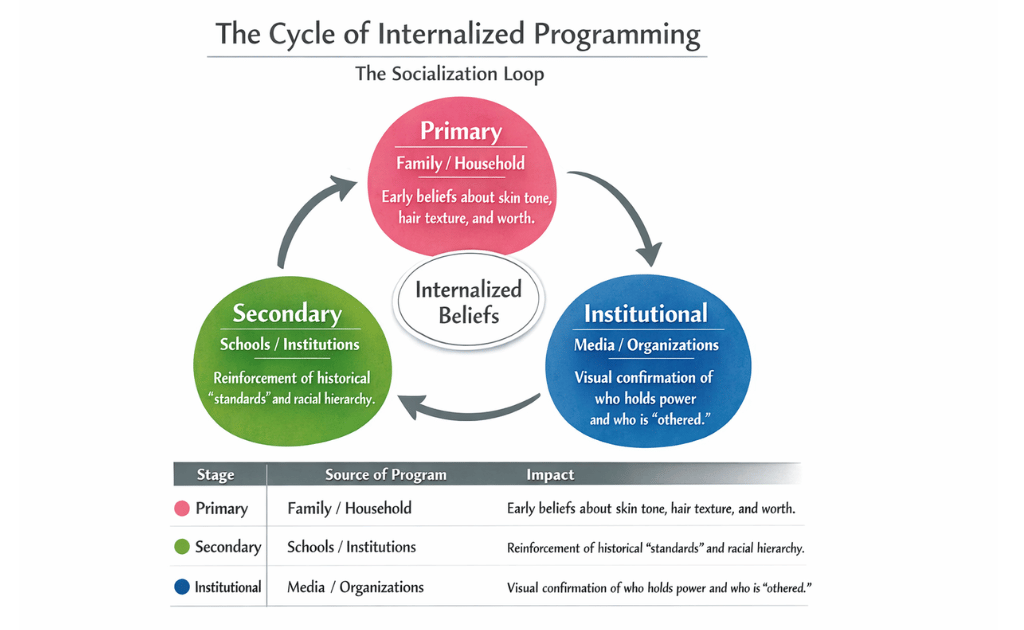
The Cycle of Internalized Programming: How Beliefs Are Installed, Reinforced, and Reproduced
Every system begins with a set of assumptions.
Not written policies. Not formal rules. Assumptions about who has value, who has authority, and who belongs in positions of power.
Those assumptions do not appear fully formed in adulthood. They are introduced early, reinforced over time, and eventually absorbed as truth. The cycle described in this post breaks down the mechanism through which beliefs about identity, hierarchy, and worth are programmed into individuals and then reproduced across generations without requiring constant external enforcement.
This is not random. It is structured. And structure can be understood, interrupted, and rebuilt.
Why Understanding the Mechanism Matters
Most conversations about systemic racism focus on what the system does to communities from the outside. Fewer conversations examine how the system sustains itself from the inside through the beliefs it installs in the people it targets.
The 2026 JAMA study documented that nearly half of the mortality gap between Black and White Americans was explained by cumulative stress and elevated inflammation. That stress is not only produced by external discrimination. It is also produced by the internal labor of navigating a world whose standards, absorbed through this programming cycle, do not affirm your full humanity. The biological cost of operating under an installed belief system that positions you as deficient is measurable and lethal. For the full clinical breakdown, read The Silent Killer: New 2026 Study Proves Racism Is a Public Health Emergency.
The companion post on internalized racism documents the psychological effects of this programming. This post goes one level deeper to map the structural mechanism: the specific stages through which programming is installed, the way each stage reinforces the previous one, and the points at which intentional intervention becomes possible. For the full psychological and community analysis, read Internalized Racism in the Black Community: Causes, Effects, and the Path to Collective Healing.
Understanding the cycle does not excuse individual behavior. It locates its origin with precision. And precision is the foundation of effective intervention.
The Foundation: Internalized Beliefs
At the center of the cycle are internalized beliefs.
These are not surface-level opinions. They are deeply embedded frameworks that shape perception, behavior, and decision-making before conscious analysis takes place. They influence what feels normal, what feels desirable, and what feels possible. They determine which risks seem worth taking and which seem naive. They shape which people seem trustworthy and which seem threatening. They define the boundaries of what feels achievable without you ever consciously drawing those boundaries.
Internalized beliefs operate largely below conscious awareness. They guide reactions before analysis takes place. By the time a person evaluates a situation logically, the underlying assumptions have already framed the interpretation and narrowed the range of responses that feel available.
This is what makes them powerful and what makes them dangerous when they were installed by a system that did not have your sovereignty as its objective. They do not feel learned. They feel inherent. And things that feel inherent are not examined. They are enacted.
Sylvia Wynter's work on the construction of the modern definition of humanity explains how this operates at the civilizational level. When a particular definition of who is fully human gets embedded into every institution of a society, that definition begins to feel like a natural observation rather than a political decision. For the full philosophical framework, read Who Decides What It Means to Be Human? Du Bois, Wynter, and the Foundation of Black Sovereignty.
Stage One: Primary Socialization
The cycle begins in the primary environment, the family and household.
This stage introduces the earliest signals about identity and value through the people a child trusts most completely. These signals are not always explicit. They are often communicated through tone, repetition, and the texture of everyday interaction.
Children observe what is praised and what is criticized. They notice how adults describe themselves and others. They absorb which traits are associated with attractiveness, intelligence, or success. Comments about skin tone, reactions to different hair textures, preferences expressed casually within the home, the way family members speak about their own Blackness and about other Black people, all of these contribute to early belief formation. Even when these messages are subtle, their consistency gives them the weight of fact.
At this stage there is no filter. Information is absorbed directly. The child has no framework for evaluating whether what they are absorbing is true or whether it is a transmission of someone else's pain. By the time they begin to question these patterns, those patterns have already been established as the baseline from which all future experience will be measured.
It is important to hold both truths simultaneously here. Families transmit this programming and families also transmit the counter-programming. Grandparents who told children about Black excellence, parents who built walls of Black books and images, communities that celebrated Black achievement deliberately and consistently, all of this was also primary socialization. The question is which input was louder, more consistent, and more reinforced at the subsequent stages.
The intergenerational transfer of strategy that The Black Metrics documents throughout the briefing series was the deliberate counter-programming that ancestors understood was necessary. Anna Julia Cooper did not just teach Latin and Greek to her students at M Street. She was installing a different belief at the primary level of their intellectual identity. For the full strategic framework, read Anna Julia Cooper: The Blueprint for Black Educational Sovereignty and Intellectual Power.
Stage Two: Secondary Socialization
The second stage expands beyond the household into schools and formal institutions.
Here, early beliefs encounter broader systems that carry the historical hierarchies of the society that built them. Educational content, authority structures, peer dynamics, and disciplinary practices all contribute to reinforcing or challenging what was learned at home.
Curriculum choices determine which histories are emphasized and which are minimized. When Black children learn a version of history that begins in enslavement and frames their entire collective narrative as one of victimization and overcoming, the implicit message is that Blackness is defined by what was done to it rather than by what it has built. That is not education. That is the installation of a specific belief about Black capacity under the cover of history class.
Representation among teachers and leadership influences perceptions of competence and authority. When every position of authority a child encounters in their formative years is occupied by people who do not look like them, the institutional message is consistent: authority has a face, and it is not yours.
Disciplinary practices signal whose behavior is acceptable and whose is treated as a threat. The documented racial disparities in school discipline, where Black students are suspended and expelled at significantly higher rates than White students for equivalent behavior, communicate a belief about Black children before those children have the language to name what is being communicated to them.
When these institutional patterns align with early household messaging, they strengthen the belief system through cross-environment confirmation. What was once a possibility in the mind of a child becomes a confirmed reality when the same message appears from multiple trusted sources. The belief hardens from perception into fact.
This is the precise environment that Claudia Jones, Amy Jacques Garvey, and every educator in The Black Metrics briefing series was working to counter. The West Indian Gazette was secondary socialization counter-programming at community scale. The UNIA's mass conventions were secondary socialization for adults who had passed through an entire educational system designed to install the opposite belief. For the full analysis of how media functions as counter-programming infrastructure, read Claudia Jones: The Blueprint for Black Economic Internationalism and Pan-African Sovereignty.
Stage Three: Institutional Socialization
The third stage operates through media and large-scale organizations. This is where belief systems are normalized through constant, unavoidable exposure.
Television, film, advertising, and digital platforms present repeated images of who holds power, who is valued, and who is marginalized. These images are not neutral observations. They are constructions that reflect the beliefs of the people and systems producing them, and they reproduce those beliefs at the scale of entire populations.
The impact is cumulative. When the same visual hierarchy appears across multiple channels simultaneously, it becomes familiar. Familiarity creates acceptance. Over time, acceptance becomes expectation. And once a hierarchy becomes expected, it stops being questioned. It becomes the natural order.
Institutional socialization does not require direct interaction to produce its effect. Its influence comes from volume and repetition. It reaches individuals regardless of their personal environment and reinforces patterns already introduced in earlier stages. A child who received strong counter-programming at home and in community still navigates a media environment that can erode that counter-programming through sheer repetition and scale if it is not continuously reinforced.
This is why Claudia Jones building the West Indian Gazette was a strategic act. It was not supplemental media. It was counter-institutional socialization at the only scale she had access to. This is why The Bantaba, The Black Metrics, and every Black-owned media platform is doing the same work in 2026 with more powerful tools. For the full strategic breakdown of why owning the platform is a sovereignty requirement, read Marcus Garvey and the UNIA: How the Largest Black Movement in History Built the Blueprint for Global Black Sovereignty.
The Loop: How Programming Sustains Itself
The strength of the cycle lies in its continuity and in the way each stage feeds back into the next.
Primary socialization introduces early beliefs. Secondary socialization reinforces them through structured institutional environments. Institutional socialization normalizes them at scale. These inputs converge to form internalized beliefs at the center. Once internalized, those beliefs shape behavior. They influence preferences, expectations, and decisions. Individuals then communicate these beliefs, often unconsciously, through their own actions and interactions with the next generation.
This restarts the cycle.
The system does not need constant external enforcement because it has successfully transferred the enforcement function inward. Once the belief is installed, individuals reproduce it in their families, communities, and institutional behaviors without requiring direct pressure from the system. The cycle becomes self-sustaining.
This is the insight that Understanding the Layers of Cultural Identity addresses from the perspective of individual navigation. The cycle is the mechanism. The layers are the experience of living inside it. Together they form a complete map of how external power becomes internal constraint. For the full strategic framework on navigating these layers with intention, read Understanding the Layers of Cultural Identity: A Strategic Breakdown of Influence and Control.
Behavior and the Illusion of Choice
One of the key outcomes of this cycle is the alignment between internalized beliefs and personal behavior in ways that feel like free choice.
Preferences begin to mirror repeated exposure. Choices about appearance, relationships, professional direction, and community alignment often reflect the patterns presented across family, institutions, and media. These choices feel independent. They are experienced as personal decisions made freely. They feel like self-knowledge.
However, when similar preferences appear consistently across large groups of people who have been exposed to the same programming cycle, it becomes statistically clear that these behaviors are not entirely self-generated. They are influenced by shared conditioning operating at every stage of development.
This does not eliminate individual agency. It contextualizes it. Agency is not the absence of influence. It is the capacity to examine influence and make decisions based on that examination rather than simply enacting patterns without awareness of where they came from. The difference between default and intention is not the absence of conditioning. It is the conscious engagement with it.
The Impact on Self-Perception and Collective Capacity
The most significant effect of internalized programming is its influence on what people believe is possible, both for themselves and for their communities.
Beliefs about hierarchy and worth shape how individuals see themselves in relation to others and in relation to systems. They affect confidence, ambition, and perceived opportunity in ways that are not always visible as the effects of programming because they feel like realistic self-assessment. A person who has internalized the belief that Black-owned businesses are less reliable will underinvest in them. A person who has internalized the belief that Black communities cannot coordinate successfully will not build the organizational infrastructure sovereignty requires. These are not personality traits. They are the behavioral output of an installed belief system.
At the collective level, this means internalized programming is one of the most effective barriers to sovereignty building because it operates inside the community doing the building. It is why Marcus Garvey understood that mass psychological re-education was not separate from institution building. It was a prerequisite for it. The UNIA was not just building economic and political infrastructure. It was running counter-programming at every stage of the cycle simultaneously. For the full analysis of how that model worked, read Marcus Garvey and the UNIA: How the Largest Black Movement in History Built the Blueprint for Global Black Sovereignty.
Why the Cycle Persists
The cycle persists because it is reinforced at multiple levels simultaneously and because it presents itself as reality rather than as programming.
A single contradictory message cannot disrupt a pattern that is supported by family, institutions, and media simultaneously. Consistency across environments creates stability in the belief system. This is why individual inspiration, a single powerful book or speech or teacher, while meaningful, is rarely sufficient to produce lasting change in deeply installed beliefs. The environment outside the moment of inspiration continues to run the original programming.
Additionally, the cycle operates quietly. It does not announce itself as conditioning. It presents as observation, common sense, or personal preference. Without deliberate examination, there is little incentive to question it because it does not feel like a choice. It feels like a perception of reality.
This is precisely why The Black Metrics frames sovereignty as a structural project rather than an individual achievement. Individual awareness is necessary. It is not sufficient. The cycle requires structural counter-pressure at every stage where it operates.
Points of Intervention
Disrupting the cycle requires intentional intervention at each stage, not just at the individual level.
Within the primary environment, intentional counter-programming reshapes early beliefs. Deliberate exposure to Black excellence, Pan-African history, community sovereignty models, and affirmations that begin from wholeness rather than deficiency create a different foundation. Families that name racism explicitly and give children frameworks for understanding it rather than simply absorbing it are performing primary socialization counter-programming. This is why the historical briefings in The Black Metrics series are designed to be read and discussed in community, not consumed individually.
Within secondary institutions, the counter-intervention requires curriculum changes, representation in authority, and disciplinary equity. It also requires the building of independent educational institutions when existing ones cannot be transformed. Anna Julia Cooper's defense of classical education at M Street was a secondary socialization intervention. The independent schools built by Pan-African communities across the diaspora are the same intervention operating at community scale.
At the institutional level, media and organizations that center Black humanity, history, and capacity as the default rather than the exception perform counter-institutional socialization. Every post in this series. Every episode of Pan-Africanism in Practice. Every Volume in the Sovereignty Series. These are all institutional socialization counter-programming delivered at the scale currently accessible to us, with the explicit intent to expand that scale.
Repetition and Reprogramming
The same mechanism that installs beliefs can be used to replace them. Repetition remains the key factor at every stage.
New narratives, representations, and standards must be introduced consistently and across multiple environments simultaneously. A child who encounters counter-programming at home, in their school, and in the media they consume is receiving the same cross-environment reinforcement that installed the original programming. Over time, these inputs compete with existing beliefs and gradually displace them.
This process is not immediate. It requires sustained, coordinated exposure and reinforcement. It is the reason that The Black Metrics Eight Pillars of Sovereignty framework addresses all eight domains simultaneously rather than focusing on a single area. You cannot reprogram at the economic level while the educational and healthcare and political levels continue running the original code. The whole system requires simultaneous counter-pressure.
This is also the reason that the ancestor briefings matter strategically. Knowing that Claudia Jones built a newspaper and a carnival under active government suppression is counter-programming. Knowing that Anna Julia Cooper earned a PhD at 67 after a lifetime of institutional resistance is counter-programming. Knowing that Funmilayo Ransome-Kuti organized tens of thousands of women without formal political authority is counter-programming. These are not inspiration stories. They are evidence. And evidence, repeated consistently across multiple environments, is how installed beliefs are replaced with more accurate ones.
The Broader Implication for Sovereignty
The cycle of internalized programming demonstrates that belief systems are not purely individual constructs. They are shaped by interconnected environments operating in coordination. Understanding this cycle provides a framework for analyzing why certain patterns persist in communities even when conditions change, why individual effort without structural support produces limited results, and why sovereignty building requires intervention at multiple levels simultaneously rather than focusing all energy on individual transformation.
The Eight Pillars are not eight separate projects. They are eight domains of the same counter-programming project. Economic Sovereignty counter-programs the belief that Black communities cannot build durable wealth. Educational Sovereignty counter-programs the belief that Black intelligence must be validated by external standards. Healthcare Sovereignty counter-programs the belief that Black bodies are inherently more resilient or less deserving of care. Every pillar is, at its foundation, a structural interruption of a specific stage in this cycle.
Understanding the system is the first step toward changing it. Changing it requires building the counter-system at every level where the original programming operates. That is the work. That is sovereignty in practice.
The Bantaba: Discussion Questions
Identify one belief you hold that can be traced back to primary socialization. When was it first communicated to you? How was it reinforced at the secondary and institutional stages?
What counter-programming did you receive at each stage of your development? What was its source and how consistent was it compared to the original programming it was countering?
The cycle sustains itself because it presents as reality rather than as programming. What beliefs in your community are treated as common sense that might actually be installed patterns requiring examination?
Effective disruption requires intervention at every stage simultaneously. Which stage of the cycle does your current work address? Which stages are not being addressed and what would it take to address them?
What would a community counter-programming project look like that operated at all three stages: within families, within institutions, and at the media and organizational level simultaneously?
Recommended Reading
The Mis-Education of the Negro by Carter G. Woodson — The original analysis of how educational institutions install limiting beliefs and what educational sovereignty requires as the corrective.
Post-Traumatic Slave Syndrome by Dr. Joy DeGruy — Documents how programming is transmitted across generations through the primary socialization stage and what interrupting that transmission requires.
Pedagogy of the Oppressed by Paulo Freire — The theoretical framework for understanding education as either domestication or liberation and what counter-programming education looks like structurally.
The Body Keeps the Score by Bessel van der Kolk — Essential for understanding how programming embeds biologically, connecting the psychological cycle to the physiological consequences documented in the JAMA study.
This is the work of Educational and Healthcare Sovereignty. Volume Four, Reclaiming the Mind, drops May 2026. → Join the waitlist → Ebook
THE BLUEPRINT
Contact
hello@blackmetrics.space
Copyright © 2026 The Black Metrics. All Rights Reserved.
The BlaCK METRICS
The Pillars
Strategic Stream Blog