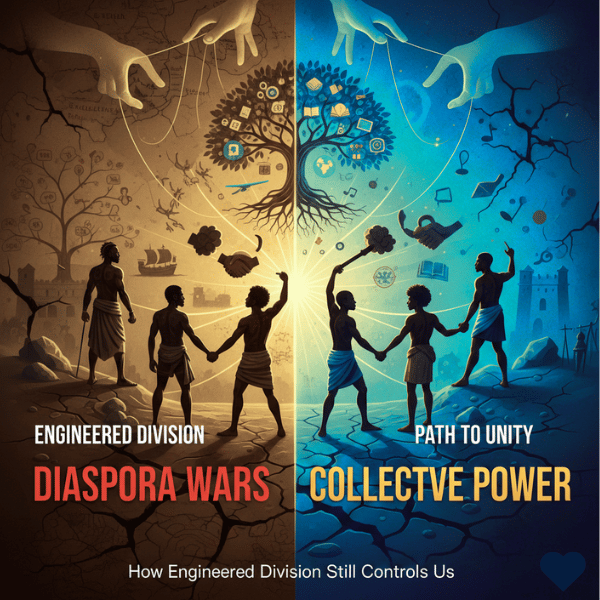
The Diaspora Wars: How Colonial Division Was Engineered — And the Definitive Roadmap to Collective Black Power
The conflicts dividing African Americans, Caribbeans, continental Africans, and Afro-Latinos are not accidents. They are the inherited output of documented psychological warfare. Here is the full historical record — and the roadmap to ending it.
EDUCATION SOVEREIGNTY | DIASPORA EDUCATION
The Black Metrics
12/5/202512 min read
The Diaspora Wars: How Colonial Division Was Engineered — And the Definitive Roadmap to Collective Black Power
Open any comment section on a video about Pan-African history and you will find it within minutes. African Americans dismissing continental Africans as complicit in the slave trade. Caribbeans accusing African Americans of cultural arrogance. Continental Africans viewing the diaspora as Westernized and disconnected from authentic African identity. Afro-Latinos navigating challenges to their Blackness from multiple directions simultaneously. Black people across Europe caught between African and Caribbean and American frameworks that each insist on their own primacy.
These conflicts have a name: diaspora wars. And they are consuming enormous quantities of political energy, intellectual capacity, and potential coalition power at precisely the moment in history when the global African diaspora has the tools, the capital, and the technological infrastructure to accomplish what the ancestors spent their lives building toward.
This is not coincidence. And it is not natural.
The argument of this essay is a specific and historically grounded one: the divisions that manifest as diaspora wars are not primarily the product of genuine cultural incompatibility or legitimate historical grievance about which community suffered more or contributed more. They are the inherited residue of deliberate, systematic strategies of psychological and social engineering deployed by slave-holding and colonial powers that understood, with precise clarity, that a unified African diaspora was an existential threat to their systems.
Understanding this history does not make the conflicts disappear. But it changes the frame — and changing the frame is the first step toward changing the outcome.
Part One: The Historical Receipts — How Disunity Was Engineered
The foundational premise of both the Atlantic slave system and European colonialism was the same: African people, if they ever truly united across the lines of nation, language, and culture that separated them, represented a threat that force alone could not contain. The systems of oppression that governed Black life across the globe were built on the labor of the very people they oppressed — and those people vastly outnumbered their oppressors in almost every context. The arithmetic of resistance was always in favor of the African.
The systems of oppression survived not by solving this arithmetic problem but by preventing it from being organized. If Black people never coordinated their shared interests across the divisions that separated them, the numbers never mattered. The engineering of disunity was not a side effect of slavery and colonialism. It was a load-bearing structural element.
The Plantation System's Psychological Architecture
The most granular and devastating expression of this engineering happened on the plantations of the Americas. Enslavers understood that the psychological conditions under which enslaved people lived were as important as the physical ones. A people who had been stripped of their sense of shared identity, who were in competition with each other rather than cooperation, who were organized into internal hierarchies that reproduced the logic of their oppression within the community of the oppressed — such a people were far easier to control than people who maintained their solidarity.
The system of colorism — the preferential treatment of lighter-skinned enslaved people, frequently the children of sexual assault by enslavers — was not a byproduct of these conditions. It was a deliberate policy. Lighter-skinned enslaved people were more frequently given positions in the house rather than the field, better food, less physically brutal work, and sometimes access to limited education. The intent was not to improve the conditions of lighter-skinned people out of any concern for their welfare. The intent was to create a hierarchy within the enslaved community that made solidarity across that hierarchy psychologically and materially difficult to maintain.
A person working in the field who had slightly better conditions than their neighbor was more likely to protect those conditions than to risk them by organizing collective resistance. A person in the house whose marginally better position depended on the continuation of the system had a material interest, however small and however conscripted, in the continuation of that system. The enslavers did not need enslaved people to love their bondage. They needed them to distrust each other enough that coordination was difficult.
The effects of this engineering did not end with emancipation. The color hierarchies it created survived formal slavery and reproduced themselves across generations, eventually becoming the global colorism that continues to shape Black communities' internal relationships today. When descendants of enslaved people in the United States, the Caribbean, and Latin America reproduce color-based hierarchies that associate lighter skin with greater beauty, status, or respectability, they are enacting a psychological script that was written by enslavers and has never been formally uninstalled.
The deliberate breaking of family bonds served a parallel purpose. By separating parents from children, siblings from siblings, and extended kin networks from each other, enslavers destroyed the social structures through which emotional solidarity and collective identity are normally transmitted. The language prohibition accomplished something similar at the cultural level: by forcing communication exclusively in the enslaver's language, the colonial powers severed enslaved people from the ancestral knowledge, the oral traditions, and the shared cultural frameworks that made collective identity possible.
The ethnic mixing strategy — the deliberate dispersal of people from the same linguistic and cultural communities across different plantations and different territories — was perhaps the most systematically preventive of all these tactics. When an Igbo speaker was separated from other Igbo speakers and placed among Yoruba, Akan, and Fon speakers who shared neither language nor cultural reference points, the immediate possibility of organized resistance based on shared background was eliminated. The forced creation of a new, creolized identity was not simply a cultural phenomenon. It was a security measure.
The Colonial Divide and Rule
When the exploitation model shifted from plantations to territorial colonialism across the African continent, the divide-and-rule strategy was refined and systematized at a larger scale. European colonial administrations spent enormous energy studying the demographic, linguistic, and cultural divisions within African societies — and then deliberately deepening, weaponizing, and institutionalizing those divisions in service of colonial governance.
The Belgian administration of Rwanda offers one of the most documented examples of this process. The distinction between Hutu and Tutsi, which before colonial intervention had been a relatively fluid social category relating primarily to cattle ownership and occupational identity, was transformed by Belgian colonial administrators into a rigidly racialized hierarchy. The Belgians introduced identity cards that formally assigned Rwandans to one category or the other, placed Tutsis in administrative roles governing the Hutu majority, and constructed an elaborate pseudo-scientific racial theory claiming that Tutsis were a superior race — the "Hamitic hypothesis" — to justify this arrangement.
The consequences of this colonial engineering played out across generations, eventually contributing to the conditions that produced the 1994 genocide. The Belgians were long gone by then. The division they had manufactured had long since taken on a life of its own.
Similar processes occurred across the continent. Colonial census-takers created rigid "tribal" categories where identities had previously been fluid and context-dependent. Access to mission schools and administrative positions was deliberately rationed to force competition among African communities for scarce resources, ensuring that their energies were directed horizontally — against each other — rather than vertically, against the colonial power. Ethnic groups that had historically competed were armed against each other. Groups that had historically cooperated were divided by arbitrary colonial borders.
The structures left behind by colonial administration at independence were not neutral. They were designed to be difficult to govern, prone to internal conflict, and economically dependent on the former colonial powers. The fragmentation was built into the architecture.
Part Two: The Contemporary Framework — How the Echo Continues
The engineering is historical. Its echoes are present and immediate.
Every manifestation of diaspora warfare that appears on social media, in cultural spaces, or in political organizing is, in one form or another, an expression of the divisions that colonial and slave systems built. This is not to say that every grievance within the diaspora is imaginary or that every conflict is equally manufactured. It is to say that the framework of competition through which these grievances are most commonly expressed — the competition over authenticity, over suffering, over cultural ownership, over who belongs more fully to the Black experience — is itself a colonial inheritance.
The Oppression Olympics
The most pervasive form of diaspora warfare is the competition over comparative suffering — the argument about which Black community experienced the worst, which community's suffering is most legitimate, whose historical trauma deserves the most contemporary recognition and remedy.
This competition is a trap, and it is a precisely calibrated one. Consider what it actually accomplishes: it takes the shared fact of African people's exploitation at the hands of Atlantic slavery and European colonialism and converts it from a source of common grievance and common cause into a source of division and mutual delegitimization. The source of the suffering — the same system, operating across different geographies and with local variations — becomes invisible in the competition between its victims over whose victimization was more authentic.
The people who built those systems of exploitation have been dead for generations. Their descendants continue to benefit from the wealth those systems accumulated. Meanwhile, the descendants of the exploited compete with each other about the details of the exploitation, achieving nothing except the continued fragmentation of the potential coalition that could actually challenge the ongoing consequences.
Refusing to play this game is not the same as denying that different Black communities experienced different things, or that those differences matter and deserve to be understood. It is the recognition that the competition framework serves no one in the diaspora and everyone who benefits from the diaspora's division.
The Authenticity Trap
The argument over who is "really" African, who is "really" Black, whose cultural practice is authentic, and whose is diluted or corrupted is a close cousin of the Oppression Olympics. It directs enormous intellectual and emotional energy toward policing the boundaries of identity rather than building the infrastructure of collective power.
The ancestors who built Pan-Africanism never made this argument. Williams convened a conference that included Africans from the continent, Caribbeans, African Americans, and Black Europeans — not because all of these communities shared an identical identity, but because they shared a common condition and a common cause. Garvey's UNIA organized across national and cultural lines. Nkrumah's Pan-Africanism explicitly embraced the diaspora as part of the African family regardless of generational distance from the continent. Malcolm X made his appeal to the Organization of African Unity on behalf of African Americans as part of the global African community.
None of them required that you prove your authenticity before you could participate in the project. They required that you understand the analysis and commit to the work.
The authenticity trap is particularly damaging because it often functions as an internalization of the colonial project of defining who counts as fully human — or in this context, who counts as fully African. When Black people gatekeep identity based on geography, language, cultural practice, or phenotype, they are operating with a definition of Blackness that was constructed by the same systems that exploited them. The colonial census-taker who hardened fluid identities into rigid categories is the intellectual ancestor of the social media commenter who decides who is Black enough to speak on Black issues.
Internalized Anti-Blackness and Colorism's Continuation
The plantation system's construction of color hierarchy did not require a single generation to take root. It required a consistent material reality in which lighter-skinned people received marginally better treatment, which over generations created associations between lighter skin and safety, value, and proximity to power that persisted long after the explicit material differential disappeared.
Contemporary colorism in Black communities across the diaspora — the preference for lighter skin, the association of darker skin with negative attributes, the different social experiences of darker and lighter-skinned Black people within the same community — is not a cultural preference that emerged from within Black culture. It is a wound inflicted from outside that was deep enough and systematic enough to produce what look like cultural preferences.
Addressing colorism is not simply an issue of interpersonal awareness. It is a Pan-African political issue. A liberation movement that reproduces colonial hierarchies internally is not finished with its work.
Part Three: The Framework for Healing and Unity
Unity is not sentiment. It is strategy. And like any strategy, it requires a framework, a methodology, and a willingness to do difficult work over sustained time.
The path from where the diaspora currently is — fragmented, competing, consuming itself in identity disputes — to where the ancestors' blueprint points — coordinated, sovereign, capable of acting as a global force — runs through five interconnected areas of work.
Historical Literacy as the Foundation
The prerequisite for diaspora healing is an accurate understanding of history — not the version of history that produces competition and grievance, but the version that produces context and analysis. This means understanding that the differences between how slavery operated in the American South, in the Caribbean under French or British or Spanish colonialism, and in Brazil were real differences with real consequences for how communities developed, what traumas they carry, and what political strategies they have historically pursued. It does not mean that those differences rank the suffering or establish hierarchies of legitimacy.
Historical literacy means knowing that Henry Sylvester Williams, a Trinidadian, built the first Pan-African institution in London — and understanding why that matters for how Caribbean intellectual and political leadership is positioned within the broader story. It means knowing that Delany's vision of Black sovereignty was developed in dialogue with African leaders in Nigeria — and understanding what that means for the relationship between the diaspora and the continent. It means knowing that Du Bois, Nkrumah, and Malcolm X were all, in their different ways, building on foundations laid by people who preceded them and that the tradition is continuous, not fragmented.
Historical literacy replaces the competition over whose suffering was greatest with a shared understanding of where the suffering came from and what it was designed to accomplish. Once you understand that the divisions were engineered, you can stop treating them as natural.
Economic Interdependence as Practice
The full vision of Black sovereignty has always had an economic center. Political rights without economic power are fragile. Cultural pride without economic infrastructure is aesthetically valuable and materially insufficient. The ancestors knew this, which is why Delany's earliest arguments were about economic independence, why Garvey built businesses alongside a political movement, why Nkrumah's Pan-African vision was as much about economic integration as political unity.
The practical expression of economic interdependence in the current moment means building relationships across diaspora lines that the economic imagination has not yet fully explored. It means a Black-owned business in Atlanta thinking about supply chain relationships with producers in Ghana or Jamaica or Brazil. It means diaspora capital — the savings and investments of Black people in wealthy countries — being directed toward building capacity in Black communities across the globe rather than simply flowing into the mainstream financial system. It means the tech sector, the creative industries, the professional networks that African-descended people have built in major global cities being understood as Pan-African infrastructure rather than simply individual career achievement.
None of this happens automatically. It requires the deliberate choice to build across diaspora lines rather than within national or cultural boundaries that colonial systems drew.
Cultural Exchange Over Gatekeeping
The cultural richness of the African diaspora is one of the most extraordinary facts of the last five centuries. From the music — jazz, blues, reggae, samba, Afrobeats, hip-hop, and every hybrid and descendant of these forms — to the literature, the visual arts, the culinary traditions, the spiritual practices, and the political philosophies, the creative output of African-descended people across the Americas, Africa, and Europe represents a global cultural inheritance of enormous power and beauty.
The gatekeeping instinct — the impulse to determine which of these cultural expressions is most authentic, most African, most legitimate — impoverishes everyone who participates in it. It converts a source of connection and mutual recognition into a source of competition and exclusion.
The alternative is genuine cultural exchange: the willingness to engage with, learn from, and celebrate cultural expressions from across the diaspora without using that engagement as an occasion for ranking or policing. Learning some Swahili, some Haitian Creole, some Portuguese. Understanding what Afrobeats music reveals about contemporary West African life. Understanding what hip-hop reveals about the specific conditions of Black life in American cities. Understanding what reggae reveals about the Caribbean experience of colonialism and resistance.
These are not trivial acts of cultural appreciation. They are practices of solidarity — ways of building the common consciousness that collective action requires.
Political Cohesion Around Shared Structural Issues
The diaspora is not politically homogeneous and it does not need to be. Black communities in different parts of the world face different immediate political challenges, operate in different governance systems, and have developed different political cultures and strategies. This diversity is not a problem to be solved. It is a reality to be organized around.
What the Pan-African tradition consistently identified as the foundation for cross-diaspora political solidarity was not ideological uniformity but shared structural analysis: the recognition that the conditions facing Black people in different parts of the world, while locally specific, have common roots and common solutions. The relationship between poverty and racial exclusion. The disproportionate exposure of Black communities to environmental destruction. The global patterns of police and state violence against Black people. The mechanisms of economic extraction that continue to flow wealth out of Black communities and into systems that were built, and continue to operate, on Black exclusion.
These are the issues that the sovereignty framework addresses at a structural level. Organizing around them does not require that African Americans and Caribbeans and continental Africans and Afro-Latinos agree on everything. It requires that they recognize what they have in common and build the political infrastructure to act on that recognition together.
Confronting the Internal Work
The most difficult part of ending the diaspora wars is not the external analysis. It is the internal reckoning — the honest acknowledgment that the divisions are not only between communities but within them, and that the healing is not only political but personal.
Colorism has to be actively challenged, not managed. The misogyny that the plantation system embedded in Black gender relations has to be consciously worked against, not accepted as cultural tradition. The class hierarchies that have developed within diaspora communities — the ways that educational and economic access reproduce internal inequality — have to be recognized as structural problems, not natural outcomes.
None of this is comfortable work. All of it is necessary work. The ancestors who built Pan-Africanism were not building a movement for comfortable people. They were building a movement for liberated ones.
What the Ancestors Are Still Saying
Read the record carefully. Williams in 1900 building the first Pan-African institution. Crummell in 1897 building the American Negro Academy. Delany in 1852 articulating the nation-within-a-nation analysis. Garvey in the 1920s building the largest Black political organization in history. Nkrumah in the 1960s warning that political independence without economic independence is fictional. Malcolm X in 1964 taking the Black struggle to the United Nations.
The message is consistent across 150 years and every political context: the divisions are the enemy's greatest weapon and our greatest weakness. The coordination is the path forward and the only one that leads where we are trying to go.
The diaspora wars are not a debate worth having. They are a trap worth escaping.
The blueprint exists. The ancestors left it. The question is whether we are disciplined enough, honest enough with ourselves about what is actually happening and why, and committed enough to the work to follow it.
Complete the series:
What Our Pan-African Ancestors Were Trying to Tell Us: Unity, Sovereignty, and the Blueprint Diaspora Wars Are Destroying
Martin Robison Delany: The Blueprint for Black Economic Self-Determination
THE BLUEPRINT
Contact
hello@blackmetrics.space
Copyright © 2026 The Black Metrics. All Rights Reserved.
The BlaCK METRICS
The Pillars
Strategic Stream Blog