The Diaspora Wars: How Engineered Division Still Controls Us
This Strategic Briefing argues that so called “Diaspora Wars” are not random cultural conflicts, but the long term result of deliberate divide and rule strategies developed during slavery and colonialism. It traces how tactics such as color hierarchies, forced ethnic separation, language suppression, and colonial favoritism were intentionally designed to prevent global Black unity and protect systems of exploitation. The briefing then connects those historical strategies to modern online conflicts, including authenticity debates, oppression comparisons, and internalized anti Blackness, showing how these patterns mirror the original psychological blueprint of fragmentation. Rather than stopping at critique, the briefing outlines a practical framework for healing and collective power built on historical literacy, economic interdependence, cultural exchange, confronting internalized division, and political cohesion. At its core, the message is clear. Division sustains oppression. Unity is strategy. And reclaiming coordinated global power requires consciously rejecting inherited fragmentation and building together across the diaspora.
EDUCATION SOVEREIGNTY | DIASPORA EDUCATION
The Black Metrics
12/5/20254 min read
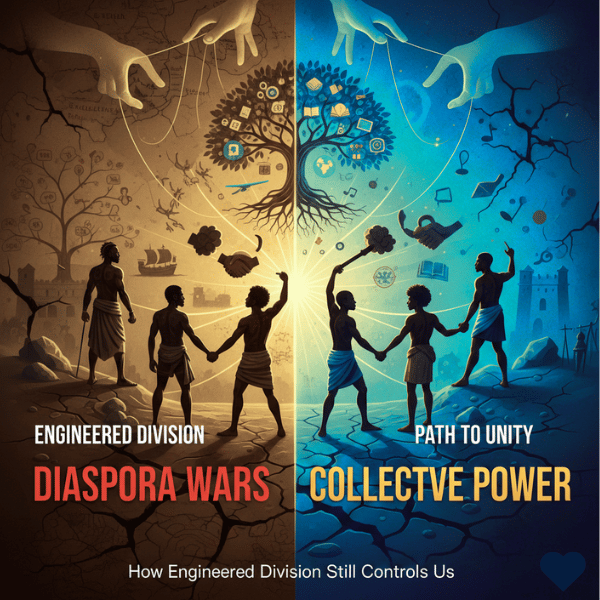
The Diaspora Wars: How Engineered Division Still Controls Us—And The Definitive Roadmap To Collective Power
The online arguments are endless: Africans versus African Americans. Caribbeans versus the Continent. Who is "authentic?" Who works harder? We call them the Diaspora Wars. But what if I told you these conflicts are not accidental? That they are the active echo of a documented campaign of psychological warfare waged against Black people for centuries.
These divisions were deliberately built into our history. When we understand the root, we can stop playing the game and finally build toward collective power.
1. Part I: The Historical Receipts—How Disunity Was Engineered
The systems of slavery and colonialism shared one foundational belief: If Black people ever truly united, their oppression would collapse. Our disunity was their security plan.
A. The Atlantic System's Psychological Warfare
Enslavers did not rely on whips alone; they used cunning psychological tactics rooted in separation and hierarchy to ensure enslaved people never formed a cohesive fighting force.
Manufacturing Colorism and the House/Field Divide: This was the most effective tactic for generating internal resentment. Lighter-skinned enslaved individuals (often the result of sexual assault by enslavers) were frequently given privileges—easier work, better food, access to the house. This was not a kindness; it was a wedge. This stratification instantly created distrust, envy, and competition, making solidarity between the "privileged" and the "field hands" nearly impossible.
Historical Receipt: Records show that this division was meticulously maintained, creating generations of trauma where skin tone was directly linked to proximity to power, a trauma that fully manifests as colorism today.
Targeting Lineage and Language: Breaking family bonds was crucial. Enslavers aggressively broke up nuclear families to prevent emotional centers of resistance. They banned African languages, forcing communication in the enslaver's tongue, which isolated individuals and severed ties to ancestral wisdom and collective memory.
Strategic Ethnic Mixing (The Babel Strategy): When ships arrived, people from the same linguistic and cultural groups (like Igbo, Yoruba, or Akan) were intentionally scattered and mixed with those from different groups across the Americas. This forced language barrier and cultural shock ensured that coordinated rebellion based on shared background was exceptionally difficult to organize.
B. The Colonial Strategy of "Divide and Rule"
When the focus shifted from plantations to African territories, European powers perfected the "divide and rule" strategy across the continent, directly influencing post-independence conflicts.
Weaponizing Ethnicity for Administration: Colonial administrations deliberately favored specific ethnic groups—sometimes the minority—for crucial roles in the police, military, and civil service. For example, in Rwanda, the Belgians used the Tutsis to govern the Hutu majority, deepening a historical rift that was less defined before colonial manipulation.
Resource and Education Scarcity: Access to mission schools and administrative jobs was strategically limited. By forcing communities to compete viciously for these scarce resources, the colonial powers ensured that African populations were focused on horizontal conflict (against each other) rather than vertical conflict (against the colonizer).
Inventing "Tribes": Colonial census takers and anthropologists often created rigid, artificial "tribal" categories where none existed before or where identities were fluid. By hardening these categories and linking them to land rights and political power, they solidified divisions that persist as ethnic conflicts today.
The damage didn’t end with independence; it left behind political, social, and economic structures designed to sustain mistrust.
2. Part II: The Contemporary Framework—How The Echo Continues
Today, the old strategies show up on new platforms. Every time a member of the diaspora posts a stereotype, minimizes another Black group’s suffering, or engages in a blame game, they are repeating the exact pattern that was engineered centuries ago.
The Modern Manifestations:
The Oppression Olympics: This is the core framework of contemporary disunity. When we argue over who "suffered more" (e.g., comparing chattel slavery in the US to Caribbean slavery or African colonialism), we miss the unifying fact: the source of the suffering was the same. This competition fulfills the original colonizer's goal by diverting energy from collective action to internal critique.
The Authenticity Trap: Arguments over who is "authentic," who works harder, or who has a better "culture." This is the psychological result of generations of being told we are not fully human. We gatekeep identity because we are seeking validation, but only by unifying our diverse identities can we find true validation.
Internalized Anti-Blackness: The continuation of Colorism and the perpetuation of toxic gender narratives (framing Black men as threats or Black women as hypersexual/subservient) are direct legacies of plantation mindsets designed to keep families fragile and trust low. The enemy is now internal, requiring an internal fight to break the pattern.
Whenever we stereotype, compete, or minimize each other, we repeat patterns created by systems that feared our unity. Recognizing this is our greatest power.
3. Part III: The Framework for Healing and Unity
Unity is not a feel-good emotion; it is an economic, cultural, and political strategy. Reclaiming that power begins with deliberate, conscious steps to reverse the engineer's blueprint.
The Five Pillars of Diaspora Healing:
Historical Literacy: Replace Competition with Context. Seek out specific historical narratives (e.g., read histories of Haiti, Ghana's independence, Brazil's quilombos). Understand that different histories led to different trauma responses, not different levels of suffering.
Economic Interdependence: Unity Through the Dollar. Commit to Horizontal Support: Intentionally invest in, buy from, and promote Black-owned businesses outside your specific diaspora group (Afro-Latino art, African textiles, Caribbean technology).
Cultural Exchange: Challenge Gatekeeping. Engage and Learn: Consume media, music, and food from the entire diaspora. Learn simple phrases from other Black languages (e.g., Spanish, French Creole, Swahili). Use these moments to build bridges, not draw lines.
Confronting Internal Conflict: Heal the Inner Wound. Actively Reject Colorism and Misogyny: Challenge microaggressions against darker-skinned people and actively call out toxic narratives about Black men and women, both online and in person. Healing begins at home.
Political Cohesion: Find Common Ground for Power. Focus on Shared Global Issues: Organize around issues that affect the entire diaspora: wealth inequality, climate injustice, police accountability. A unified Black political voice is the only way to challenge global systems of oppression.
Unity is the greatest threat to white supremacy, neo-colonialism, and every lingering system of oppression.
Our divisions are not accidental flaws; they are deliberate tools designed to keep the system running. The moment we recognize that, and choose to rebuild what they tried to divide, is the moment we become unstoppable.
Let’s stop fighting each other and start building together.
THE BLUEPRINT
Building the future of the global African Diaspora through data-driven storytelling and the Eight Pillars of Sovereignty. From survival to ownership.
Contact
Subscribe To the NewsLETTER
hello@blackmetrics.space
Copyright © 2026 The Black Metrics. All Rights Reserved.
The BlaCK METRICS