The Global Classroom: How the African Diaspora Builds a Pan-African Education Network
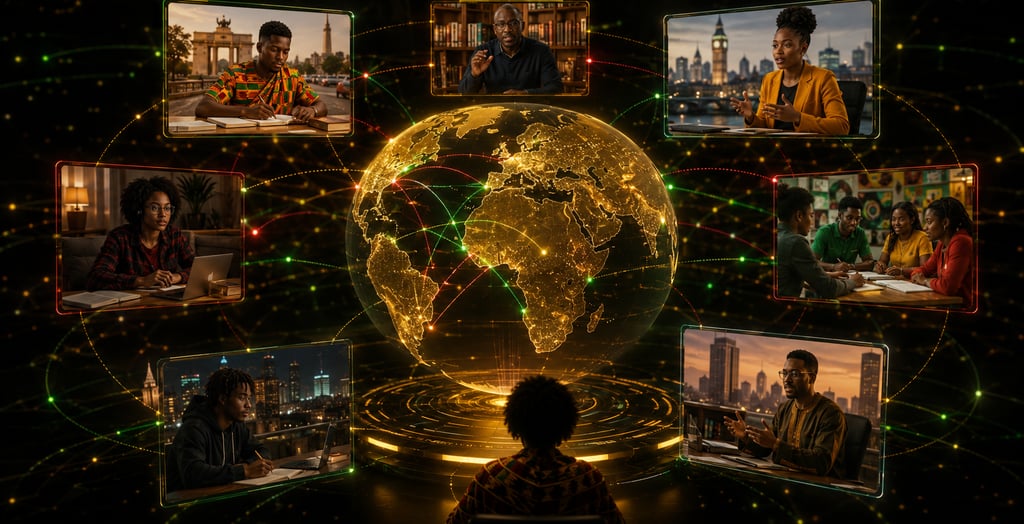
A curriculum developed in London should be accessible in Lagos. A teaching method proven in Accra should spread to Atlanta. The African diaspora spans continents, but its educational infrastructure remains fragmented. This post explores what a connected, global Pan-African learning network looks like and what it takes to build one.
EDUCATIONAL SOVEREIGNTY
The Black Metrics
5/25/20267 min read
The Global Classroom: How the African Diaspora Builds a Pan-African Education Network
The Black diaspora spans continents, cultures, and histories. That global presence is not a consequence to be managed. It is a strategic asset to be organized into the most powerful learning network in the world.
Peace and blessings, family. This is the final briefing of Educational Sovereignty month and the closing chapter of our strategic argument for Volume Four of the Sovereignty Series. Over the past three weeks we have established that education has always been contested ground, that independent learning ecosystems must be deliberately built from existing fragments, and that sovereignty requires collective systems rather than individual exceptions. This week we scale the argument to its full geographic scope.
Educational sovereignty cannot be fully achieved at the local or national level alone. The forces that have historically constrained Black educational development have operated globally. The response must operate at the same scale.
The Diaspora as a Strategic Asset
The Black diaspora is not confined to one geography. It spans continents, cultures, and histories. From the Caribbean to North America, from Europe to South America, from West Africa to East Africa and beyond, there are communities of African descent navigating different political systems, different economic realities, and different educational landscapes while sharing a common history of dispossession and a common aspiration for sovereignty.
This global presence is not a limitation. It is an advantage. A diaspora that is connected across its geographic diversity possesses a network of relationships, a breadth of knowledge, and a range of access to different systems that no single geographically concentrated community can match. The educator in London who has developed an effective method for teaching Pan-African economic history has something that the educator in Lagos needs. The technology developer in Atlanta who has built a digital learning platform has something that the community school in Kingston needs. The scholar in Accra whose research has documented the governance systems of precolonial African kingdoms has something that the curriculum designer in Toronto needs.
These connections exist culturally. They manifest in shared music, shared religious traditions, shared historical references, and shared experiences of racial identity. They have not yet been structured educationally into the kind of coordinated network that would allow knowledge, resources, and talent to flow across the diaspora in support of shared sovereignty goals. Building that structure is the global dimension of educational sovereignty.
What W.E.B. Du Bois Understood That We Must Act On
W.E.B. Du Bois spent the better part of six decades trying to build exactly this kind of coordinated global Black network. His organization of and participation in the Pan-African Congresses from 1919 through 1945 represented one of the most ambitious attempts at cross-continental Black coordination in history. The First Pan-African Congress in Paris in 1919 was deliberately timed to coincide with the Versailles Peace Conference so that African and diaspora interests could be inserted into the post-World War One global settlement. The subsequent congresses in London, Brussels, Lisbon, and New York built the network of relationships and shared analysis that influenced the independence movements of the mid-twentieth century.
Du Bois understood that if oppression was globally coordinated, resistance had to be globally coordinated as well. A movement that focused only on conditions in one country or one diaspora community was fighting a local battle against a global system. It could win tactical victories but could not win the structural transformation that genuine liberation required. His final act, moving to Ghana at the age of 93 to work on the Encyclopaedia Africana, was a deliberate statement that the documentation and distribution of African intellectual heritage across the diaspora was worth the full commitment of the most distinguished Black scholar of the twentieth century.
The same logic applies to educational sovereignty. Local educational institutions can produce excellent graduates. Only a globally coordinated network can produce the scale of institutional builders that Pan-African sovereignty requires. Du Bois spent his career building the organizational infrastructure for that coordination. We have tools he never had access to. The question is whether we are using them with the same strategic intention.
As we documented in our analysis of Anna Julia Cooper, who attended the 1900 Pan-African Congress and helped write the Address to the Nations of the World, educational sovereignty has always had a global dimension. Cooper understood that the same definitional hierarchy that underfunded Black schools in Washington D.C. was extracting resources from colonized nations in Africa. The response had to be coordinated at the scale of the problem.
The African School of Excellence Model
The African School of Excellence network, established in South Africa and expanding across the continent, represents one of the most significant contemporary examples of independent Black educational infrastructure building at scale. The network operates high-quality secondary schools in underserved communities with a curriculum that integrates academic rigor with African identity, leadership development, and community service.
Students who attend African School of Excellence institutions perform at high levels on standardized assessments while developing a strong sense of Pan-African identity and responsibility. The network's expansion model trains local educators and community leaders to maintain schools with shared curriculum standards and organizational support. This provides a practical blueprint for how educational sovereignty infrastructure can scale across diverse contexts without requiring the centralized resources that typically constrain institutional growth.
The African School of Excellence model is exactly the kind of infrastructure that a Pan-African educational network needs as its continental anchor. Connected to Historically Black College and University networks in the United States, to independent schools in the Caribbean, and to digital academies serving diaspora communities in Europe, this model represents the beginning of the global classroom that educational sovereignty at scale requires.
The diaspora is not a demographic. It is a distributed educational system waiting to be connected.
Building the Technical Infrastructure
The practical challenge of building a Pan-African educational network is not primarily a financial one, though resources matter. It is primarily a technical and organizational one. Three specific infrastructure components are required for a functional global educational network.
The first is shared digital platforms that are accessible across the diverse technological environments of the diaspora, from high-bandwidth urban settings in London and Atlanta to lower-connectivity environments in rural West Africa and the Caribbean. Building platforms that function effectively across this range of conditions is a solvable engineering problem that requires intentional design rather than simply deploying existing commercial platforms that were built for high-bandwidth contexts. A Pan-African educational platform must be designed from the beginning to serve the full geographic range of the diaspora, not retrofitted to do so after the fact.
The second is translation and cultural adaptation capacity. A curriculum developed in English for students in Atlanta cannot simply be translated into French for students in Martinique or into Yoruba for students in Lagos. It requires cultural adaptation that preserves the sovereign orientation while making the content genuinely relevant to students in each context. Building that adaptation capacity across the diaspora requires investing in educators who are fluent in multiple cultural frameworks, not just multiple languages. The knowledge must be translated at the level of framework, not only at the level of language.
The third is governance structures for shared educational institutions that can navigate the different regulatory environments of multiple countries without sacrificing their sovereign orientation. This is perhaps the most complex challenge. The African Union's educational initiatives, the Caribbean Community's regional education frameworks, and the various Historically Black College and University partnership programs with African universities all represent partial solutions that a unified Pan-African educational network must build on and integrate into a coherent governance architecture.
The Closing Mandate
This month we have moved from the historical argument to the global blueprint. We began with the battlefield and ended with the global classroom. The distance between those two images is the distance between where we are and where educational sovereignty requires us to go.
The work is clear. Build institutions that reflect truth and purpose. Develop curricula that produce thinkers and creators. Invest in systems that ensure access and continuity. Connect efforts across regions to scale impact. These are not abstract aspirations. They are engineering problems with known solutions that require only the collective will to implement them.
Before economies can be transformed, before systems can be rebuilt, before power can be reclaimed, one thing must happen first. The mind must be free. The full blueprint for freeing it is in Volume Four. The full economic framework for building the institutions that will sustain that freedom is in Volume Three. The complete sovereignty architecture across all eight pillars begins in Volume One.
From Data to Destiny. The work begins now.
The Bantaba: Discussion Questions
Du Bois argued that if oppression is globally coordinated, resistance must be globally coordinated as well. What existing Pan-African educational connections does your community have, and what connections are missing?
The African School of Excellence model scales by training local educators with shared curriculum standards rather than replicating a central institution. What elements of this model could be applied to building educational infrastructure in your community?
The diaspora possesses knowledge that flows across geographic borders culturally but not yet educationally in a coordinated way. What specific knowledge exists in one part of the diaspora that your community needs and currently lacks access to?
Building a Pan-African educational network requires shared digital platforms, cultural adaptation capacity, and cross-border governance structures. Which of these three is the highest-priority investment for the organizations you are connected to?
This month's four briefings have moved from the battlefield to the global classroom. What is the single most important action you will take in the next 30 days as a result of engaging with this series?
Recommended Reading
The Souls of Black Folk by W.E.B. Du Bois. His analysis of double consciousness as a strategic asset rather than only a wound is the foundational argument for why diaspora identity is an educational resource. Read our full analysis at W.E.B. Du Bois: The Framework That Pan-Africanism Still Runs On.
Pan-Africanism or Communism by George Padmore. The most rigorous historical analysis of Pan-African organizational attempts and their lessons for contemporary network building.
Martin Robison Delany's blueprint for Black sovereignty, written more than 150 years ago, anticipated every argument made in this series. Read our analysis at Martin Robison Delany: The Architect of Black Sovereignty.
Educational Sovereignty: Reclaiming the Mind, Volume Four of The Sovereignty Series. The complete framework including the global dimension, the Assessment Checklist, and the full strategic blueprint for building the Pan-African educational network.
Educational Sovereignty Series — May 2026
Week 1: Education as a BattlefieldWeek 2: Building Independent Black Learning EcosystemsWeek 3: From Individual Achievement to Collective SystemsWeek 4: The Global Classroom (You Are Here)
The complete blueprint is in Volume Four.
Ten chapters. Historical diagnosis. Curriculum frameworks. Independent learning ecosystem models. Cooperative funding strategies. Global diaspora education networks. And the Educational Sovereignty Strategic Assessment Checklist with 25 indicators you can apply to your institution today.
→ Get Educational Sovereignty, Vol. 4
Next month: Healthcare Sovereignty — The Sovereign Body. Vol. 5 drops June 2026. The body is the next frontier of sovereignty.
THE BLUEPRINT
Contact
hello@blackmetrics.space
Copyright © 2026 The Black Metrics. All Rights Reserved.
The BlaCK METRICS
The Pillars
Strategic Stream Blog