The Silent Killer: New 2026 Study Proves Racism Is a Public Health Emergency
A 2026 JAMA study confirms racism kills. We break down how lifelong discrimination embeds itself in the body and what Healthcare Sovereignty demands we build.
HEALTHCARE, JUSTICE, & ENVIRONMENTAL SOVEREIGNTY
The Black Metrics
1/26/20267 min read
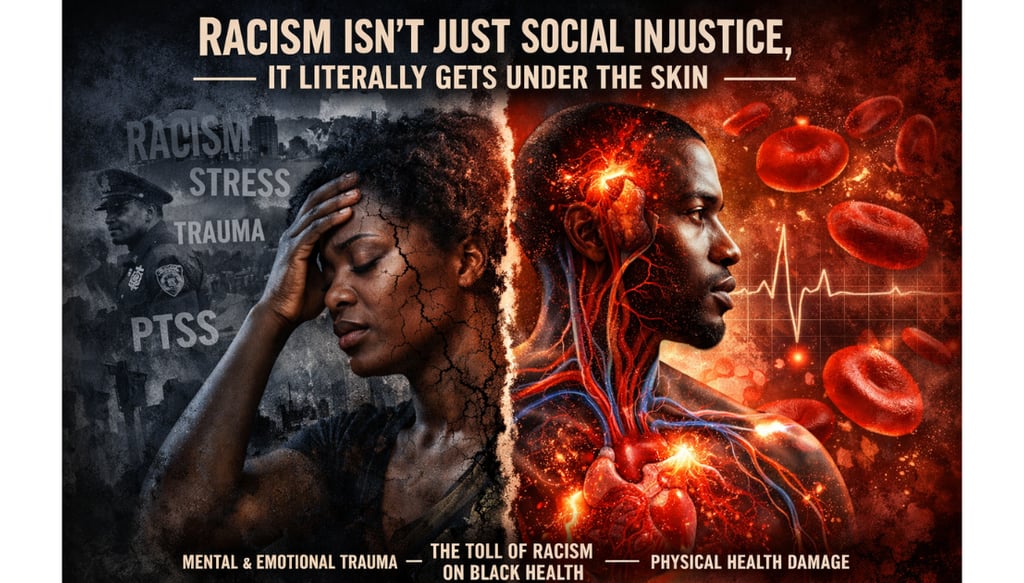
The Silent Killer: Why Discrimination Is a Public Health Emergency
For generations, African American communities have articulated a truth that is now being empirically confirmed. Racism is not merely a social or moral issue. It is a chronic health hazard that shortens lives.
A major study published on January 26, 2026 in JAMA Network confirms that the accumulated stress of discrimination and structural inequality across a lifetime is directly linked to earlier death among African Americans. This disparity is not driven by individual choices or personal failure. It is driven by the enduring biological toll of systemic racism on both the mind and the body.
The research was led by Isaiah D. Spears at Washington University in St. Louis and is based on data from the St. Louis Personality and Aging Network SPAN Study. This longitudinal cohort study followed more than 1,500 African American and White adults for up to 17 years, allowing researchers to examine how stress exposure unfolds over time, how it becomes biologically embedded, and how it ultimately affects survival.
This long-term design is critical. Stress exposure was measured first. Inflammation was assessed years later. Mortality was evaluated afterward using national death records. This temporal ordering strengthens the conclusion that chronic stress related to racism contributes to earlier death rather than merely being correlated with it.
What the Data Actually Says
The findings were stark and demand to be named plainly.
Black and African American participants were more than twice as likely to die during the study period as White participants. Approximately 25 percent of African American participants died compared with about 12 percent of White participants. Nearly half, 49.3 percent, of the mortality gap between African American and White participants was statistically explained by cumulative stress across the lifespan and elevated inflammation.
Stress was not narrowly defined in this research. Researchers constructed a comprehensive cumulative stress measure that included childhood maltreatment, lifetime trauma exposure, researcher-verified major life stressors, major experiences of discrimination, and socioeconomic disadvantage, including both participants' education and income as well as parental education. This approach captures something that individual health metrics consistently miss: how racism compounds across generations, beginning early in life and continuing without interruption through adulthood.
To understand how stress becomes biologically embedded, researchers analyzed inflammatory markers in participants' blood, specifically C-reactive protein and interleukin-6. These biomarkers remain elevated when the body's stress response is repeatedly activated over long periods. Chronic activation of the fight-or-flight response accelerates immune dysfunction, cardiovascular strain, and cellular aging.
In practical terms, this means that enduring racism, whether through overt discrimination, economic exclusion, or subtler daily stressors such as microaggressions, code-switching, and internalized negative stereotypes, does not simply affect emotions or mental health. It alters immune function. It speeds up physical aging. It kills.
The Weathering Hypothesis: Named and Confirmed
These findings strongly support the weathering hypothesis, first articulated by Dr. Arline T. Geronimus. The hypothesis explains how constant exposure to inequality and discrimination wears down the body over time, much like erosion, producing earlier onset of disease and premature death among marginalized populations. Geronimus developed this framework decades ago based on patterns she observed in Black maternal health data. She was widely dismissed. This study is one of the most rigorous empirical confirmations of what she and Black communities have always known.
The physiological pattern mirrors what clinicians recognize as post-traumatic stress symptoms, where the nervous system remains locked in survival mode because the threat is ongoing rather than past. The difference between a traumatic event and structural racism is that structural racism does not end. There is no recovery period. There is no return to baseline. The body stays alert because the danger is still present, and that sustained alertness is what accelerates death.
This connects directly to what The Black Metrics identifies as the Survival Trap. We cannot think long-term when we are struggling to exist. But the JAMA study reveals something even more urgent: the survival mode itself is the mechanism of harm. Chronic survival stress is not neutral. It is cumulative, biological, and lethal. For a deeper breakdown of how the Survival Trap operates economically and what it demands we build, read Stop Asking Start Building: The Blueprint for Black Community Economic Self-Determination.
What the Study Does Not Capture
Crucially, the study also highlights that its estimates are conservative.
Even after accounting for cumulative stress and inflammation, more than half of the mortality gap between African American and White participants remained unexplained. The authors note that additional factors likely contribute, including environmental toxin exposure, unequal access to healthcare, medical mistrust, neighborhood conditions, and intergenerational biological effects shaped by historical trauma and structural neglect.
The study also acknowledges that many everyday stressors experienced by African American people are difficult to quantify. Microaggressions, constant vigilance, identity suppression, and internalized racism are rarely captured fully in survey instruments. This means the true toll of racism on Black health is almost certainly larger than what this research documents. What has been measured is already devastating. What has not yet been measured is likely worse.
The Healthcare System Is Not a Neutral Actor
One of the most dangerous misconceptions about Black health outcomes is the assumption that the healthcare system is a neutral delivery mechanism that Black communities simply underutilize or distrust without reason. The data tells a different story.
Black patients are systematically undertreated for pain. Black maternal mortality rates in the United States are three to four times higher than those of White women, a disparity that persists across income and education levels. Medical training historically included false biological claims about racial differences in pain tolerance that have been documented in textbooks as recently as 2016. These are not remnants of a distant past. They are active features of a system that was not built with Black lives as the standard of care.
Medical mistrust in Black communities is not irrational. It is historically informed. From the Tuskegee syphilis study to the unconsented use of Henrietta Lacks's cells to the documented dismissal of Black women's pain during childbirth, Black communities have accumulated generations of evidence that the medical system does not reliably protect them. Distrust is a rational response to a documented pattern. Healthcare Sovereignty is not anti-medicine. It is the demand that medicine be practiced as if Black lives are fully worth saving.
Healthcare Sovereignty: What It Demands
Public health experts are clear that these outcomes cannot be resolved through individual coping strategies. Stress management classes and personal resilience are insufficient responses to a system that continually produces stress. The researchers explicitly conclude that policies addressing structural racism are necessary to reduce mortality disparities alongside interventions that limit stress exposure and reduce inflammation.
This is precisely what Healthcare Sovereignty within The Black Metrics framework demands. It is not the rejection of medicine. It is the insistence on culturally grounded systems that treat Black patients as fully human, that address the social and structural conditions producing illness, and that build health infrastructure within communities rather than extracting from them.
Healthcare Sovereignty means community health workers who understand the cultural and historical context of the people they serve. It means mental health resources that account for racial trauma as a clinical reality. It means midwifery and birth justice programs that address the maternal mortality crisis directly. It means nutrition access in communities that have been deliberately turned into food deserts. And it means advocacy for the structural policy changes, in housing, education, environmental protection, and economic equity, that the JAMA study confirms are matters of life and death.
For a deeper understanding of how the definition of Black humanity shapes who receives care and who is denied it, read Who Decides What It Means to Be Human? Du Bois, Wynter, and the Foundation of Black Sovereignty.
The Connection to Every Other Pillar
What the JAMA study makes undeniable is that health is not a standalone pillar. It is the outcome of all the others.
Economic stress is a health issue. Housing instability is a health issue. Environmental exposure is a health issue. Educational exclusion is a health issue. Political disenfranchisement is a health issue. When any pillar of sovereignty is absent, the body keeps the score.
This is why Queen Mother Moore insisted that reparations were not charity but a material correction for documented harm. Decades before this study existed, she understood that the wealth extracted from Black labor and the violence used to maintain that extraction had produced measurable physical damage across generations. The JAMA study is, in part, the scientific documentation of what she was arguing in the 1950s. For the full breakdown of her reparations framework, read Malcolm X & Queen Mother Moore: The Blueprint for Black Reparations and Sovereignty.
The same logic runs through Funmilayo Ransome-Kuti's mass organizing against colonial taxation. The women she organized were not just fighting an economic policy. They were fighting the conditions that produced poverty, which produced chronic stress, which produced earlier death. Sovereignty from below is also a public health intervention. To understand how her organizing model translates to today, read Kwame Nkrumah & Funmilayo Ransome-Kuti: Independence vs Black Sovereignty .
What We Build From Here
This research makes one reality undeniable. Racism operates structurally and it produces structural harm. Addressing its health consequences requires collective solutions that reshape economic systems, healthcare access, education, environmental conditions, and political power. It cannot be solved at the individual level alone.
The Sovereignty series was built in direct response to this reality. Every pillar is, at its foundation, a health intervention. Every economic cooperative reduces financial stress. Every Black-owned school reduces the psychological toll of mis-education. Every community land trust removes a family from the chronic stress of housing insecurity. Every political organization reduces the helplessness that drives cortisol elevation. Sovereignty is not abstract. It is biological.
Racism is not just a social injustice. It is a public health crisis with measurable psychological and physiological consequences. Meeting it requires structural change, not survival strategies alone. The blueprint is in the Eight Pillars. The urgency is in the data. The work is ours to do.
The Bantaba: Discussion Questions
The study found that nearly half of the mortality gap was explained by cumulative stress and inflammation. What does that mean for how your community prioritizes health interventions versus economic or political organizing?
Medical mistrust in Black communities is historically documented. What would a Healthcare Sovereignty model look like in your city that addresses both the distrust and the systemic cause of it?
The weathering hypothesis says the body wears down under constant structural pressure. What structures in your daily environment contribute to that pressure, and which ones could be changed at the community level?
The study's estimates are conservative because many stressors cannot be quantified. What forms of racial stress do you experience that surveys and studies consistently fail to capture?
If sovereignty is a health intervention, which of the Eight Pillars would have the greatest immediate impact on reducing chronic stress in your specific community?
Recommended Reading
The Immortal Life of Henrietta Lacks by Rebecca Skloot — Essential context for understanding why medical mistrust in Black communities is historically earned.
Medical Apartheid by Harriet A. Washington — The most comprehensive history of medical experimentation on Black Americans and its lasting institutional consequences.
Weathering: The Extraordinary Stress of Ordinary Life in an Unjust Society by Arline T. Geronimus — The scientist who developed the weathering hypothesis explains it in full and connects it to policy.
The Spirit Level by Richard Wilkinson and Kate Pickett — Demonstrates how inequality, not just poverty, drives negative health outcomes across populations.
This is the work of Healthcare Sovereignty. The full sovereignty framework is in the series. → Get your copy → Black Sovereignty
THE BLUEPRINT
Contact
hello@blackmetrics.space
Copyright © 2026 The Black Metrics. All Rights Reserved.
The BlaCK METRICS
The Pillars
Strategic Stream Blog