The Silent Killer: Why Discrimination is a Public Health Emergency
New study published January 26, 2026 shows how lifelong discrimination harms both mind and body. This Strategic Briefing discusses a major study that reveals how chronic stress from racism and discrimination negatively impacts the health and longevity of African American communities.
HEALTHCARE SOVEREIGNTY | AFRICAN AMERICAN HEALTH
The Black Metrics
1/26/20263 min read
New study published January 26, 2026 shows how lifelong discrimination harms both mind and body.
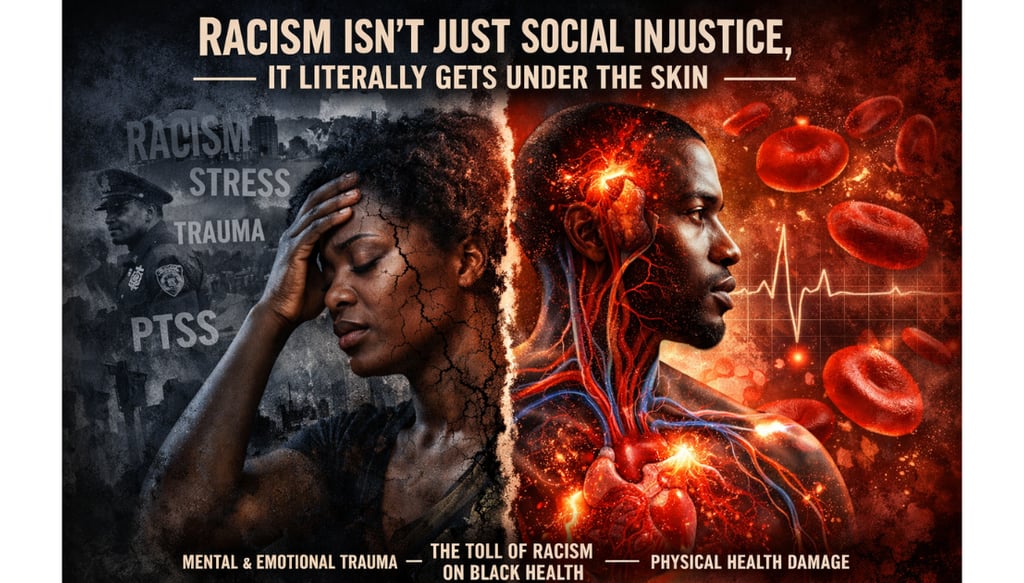
For generations, African American communities have articulated a truth that is now being empirically confirmed. Racism is not merely a social or moral issue. It is a chronic health hazard that shortens lives. A major study published on January 26, 2026 in JAMA Network confirms that the accumulated stress of discrimination and structural inequality across a lifetime is directly linked to earlier death among African Americans. This disparity is not driven by individual choices or personal failure, but by the enduring biological toll of systemic racism on both the mind and the body.
The research was led by Isaiah D. Spears at Washington University in St. Louis and is based on data from the St. Louis Personality and Aging Network SPAN Study. This longitudinal cohort study followed more than 1,500 African American and White adults for up to 17 years, allowing researchers to examine how stress exposure unfolds over time, how it becomes biologically embedded, and how it ultimately affects survival.
This long term design is critical. Stress exposure was measured first, inflammation was assessed years later, and mortality was evaluated afterward using national death records. This temporal ordering strengthens the conclusion that chronic stress related to racism contributes to earlier death rather than merely being correlated with it.
The findings were stark.
Black/African American participants were more than twice as likely to die during the study period as White participants. Approximately 25 percent of African American participants died, compared with about 12 percent of White participants.
Nearly half, 49.3 percent, of the mortality gap between African American and White participants was statistically explained by cumulative stress across the lifespan and elevated inflammation.
Importantly, stress was not narrowly defined. Researchers constructed a comprehensive cumulative stress measure that included childhood maltreatment, lifetime trauma exposure, researcher verified major life stressors, major experiences of discrimination, and socioeconomic disadvantage, including both participants’ education and income as well as parental education. This approach captures how racism compounds across generations, beginning early in life and continuing through adulthood.
To understand how stress becomes biologically embedded, researchers analyzed inflammatory markers in participants’ blood, specifically C reactive protein and interleukin 6. These biomarkers remain elevated when the body’s stress response is repeatedly activated over long periods. Chronic activation of this fight or flight response accelerates immune dysfunction, cardiovascular strain, and cellular aging.
In practical terms, this means that enduring racism, whether through overt discrimination, economic exclusion, or subtler daily stressors such as microaggressions, code switching, and internalized negative stereotypes, does not simply affect emotions or mental health. It alters immune function and speeds up physical aging. This physiological pattern mirrors what clinicians recognize as post traumatic stress symptoms, where the nervous system remains locked in survival mode because the threat is ongoing rather than past.
These findings strongly support the weathering hypothesis, first articulated by Arline T. Geronimus. The hypothesis explains how constant exposure to inequality and discrimination wears down the body over time, much like erosion, producing earlier onset of disease and premature death among marginalized populations.
Crucially, the study also highlights that its estimates are conservative.
Even after accounting for cumulative stress and inflammation, more than half of the mortality gap between African American and White participants remained unexplained. The authors note that additional factors likely contribute, including environmental toxin exposure, unequal access to healthcare, medical mistrust, neighborhood conditions, and intergenerational biological effects shaped by historical trauma and structural neglect.
The study also acknowledges that many everyday stressors experienced by African American people are difficult to quantify. Microaggressions, constant vigilance, identity suppression, and internalized racism are rarely captured fully in survey instruments, suggesting the true toll of racism on health may be even greater than documented here.
Public health experts are clear that these outcomes cannot be resolved through individual coping strategies. Stress management classes and personal resilience are insufficient responses to a system that continually produces stress. The researchers explicitly conclude that policies addressing structural racism are necessary to reduce mortality disparities, alongside interventions that limit stress exposure and reduce inflammation.
This is precisely why the Sovereignty series exists.
This research makes one reality undeniable. Racism operates structurally, and it produces structural harm. Addressing its health consequences requires collective solutions that reshape economic systems, healthcare access, education, environmental conditions, and political power. It cannot be solved at the individual level alone.
The Sovereignty series was designed in recognition that real change will require all hands on deck. Building healthier futures for African American communities means dismantling the systems that generate chronic stress in the first place and replacing them with structures rooted in autonomy, protection, and collective well being.
Racism is not just a social injustice. It is a public health crisis with measurable psychological and physiological consequences. And meeting it will require structural change, not survival strategies alone.
THE BLUEPRINT
Building the future of the global African Diaspora through data-driven storytelling and the Eight Pillars of Sovereignty. From survival to ownership.
Contact
Subscribe To the NewsLETTER
hello@blackmetrics.space
Copyright © 2026 The Black Metrics. All Rights Reserved.
The BlaCK METRICS