Understanding the Layers of Cultural Identity: A Strategic Breakdown of Influence and Control
Systemic power. Community influence. Individual agency. We break down the three layers of cultural identity and how to move with strategy instead of default.
EDUCATIONAL & POLITICAL SOVEREIGNTY
The Black Metrics
1/19/202610 min read
Understanding the Layers of Cultural Identity: A Strategic Breakdown of Influence and Control
Identity is not abstract. It is engineered through exposure, repetition, and decision. Every belief you hold, every standard you measure yourself against, and every move you make is shaped by forces operating at different levels of power.
If you do not understand those levels, you will mistake influence for truth.
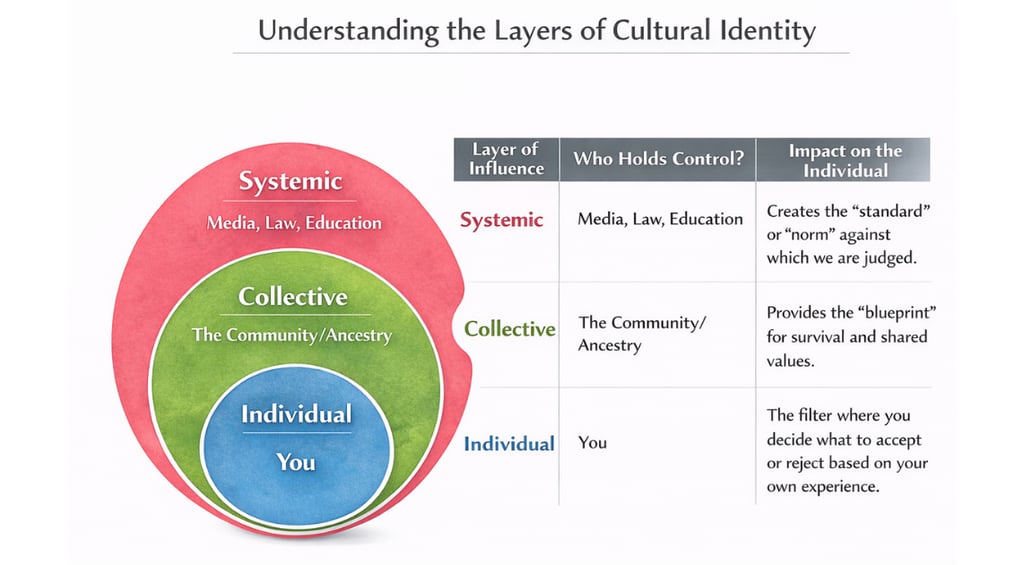
This framework breaks identity into three layers of control: systemic, collective, and individual. Each layer operates differently. Each layer carries a different weight. Together, they determine whether you are operating with intention or reacting to pressure.
This is not theory. This is structure.
Why This Framework Matters Now
Before we move through the layers, it is worth naming why this analysis is urgent.
The 2026 JAMA study confirmed what Black communities have long understood: the chronic stress of operating under systems that do not recognize your full humanity embeds itself biologically and shortens lives. That stress does not only come from overt discrimination. It comes from the daily labor of navigating layers of influence you may not have names for. Naming them is the first act of sovereignty. For the full breakdown of how that biological toll operates, read The Silent Killer: New 2026 Study Proves Racism Is a Public Health Emergency.
Sylvia Wynter's work gives us the philosophical foundation for this framework. The modern definition of humanity was constructed narrowly, and that narrow construction was embedded into every institution that followed. Understanding the layers of cultural identity is the practical application of Wynter's analysis. It is how you locate where that narrow definition is operating in your daily life and how you begin to interrupt it. For the full theoretical grounding, read Who Decides What It Means to Be Human? Du Bois, Wynter, and the Foundation of Black Sovereignty.
Systemic Influence: The Standard Is Set Before You Arrive
At the outer layer sits the system. Media. Law. Education. These are not background elements. They are the architects of the environment you navigate every day.
The system defines normal. It defines success. It defines legitimacy. It decides which behaviors are rewarded and which are penalized. It determines what is visible and what is erased. You do not enter a neutral space. You enter a constructed reality that was built before you arrived and that has been running long enough to feel natural.
Before you speak, before you act, before you choose a direction, the system has already established the rules of engagement. It has already defined what excellence looks like. It has already determined what is considered acceptable and what is treated as deviant.
This is why two people can perform the same action and receive different outcomes. The system is not only measuring behavior. It is interpreting it through pre-existing standards that carry the weight of historical hierarchy.
Media shapes perception at scale. It tells you what to aspire to and what to avoid. It frames narratives about intelligence, beauty, success, and value. It repeats those narratives until they feel like observation rather than construction. Law enforces the boundaries of that construction. It determines access to opportunity, protection, and mobility. Education distributes knowledge but also filters it, deciding which histories are taught, which perspectives are centered, and which frameworks are treated as legitimate.
These forces operate continuously and simultaneously. You do not opt in or out. You operate within them whether you are aware of it or not. Awareness does not remove you from the system. It gives you the ability to see it clearly enough to navigate it strategically rather than absorbing it as truth.
The impact is structural. The system creates the measuring stick. It defines the baseline against which you are judged. If you internalize systemic standards without analysis, you will spend significant energy trying to fit into a structure that was not designed with your full humanity as the reference point. Anna Julia Cooper named this clearly when she refused to allow Black children to be educated toward compliance rather than sovereignty. The battle over whose standards define excellence has always been a battle over systemic influence. For the full strategic framework she built around Educational Sovereignty, read Anna Julia Cooper: The Blueprint for Black Educational Sovereignty and Intellectual Power.
Collective Influence: The Blueprint You Inherit
Inside the system sits the collective. Your community. Your ancestry. Your shared lived experience.
If the system defines the environment, the collective defines your approach to navigating it. This layer is where identity becomes specific. It is where culture is transmitted, where survival strategies are developed, and where those strategies are passed to the next generation as received wisdom.
You are not raised in isolation. You are trained, directly and indirectly, on how to move. The collective teaches you what matters. It defines respect, discipline, loyalty, and success within the context of your group. It shapes your language, your behavior, your expectations, and your interpretation of situations before your conscious analysis begins.
It also provides protection. In environments where the system is inconsistent or hostile, the collective becomes a stabilizing force. It offers guidance, support, and a sense of belonging. This is where resilience is built and where the tools for survival under pressure are stored and transmitted. This is the layer where mutual aid networks live, where community economics are practiced, where cultural identity is preserved when the system refuses to honor it.
But the collective is not neutral. It is shaped by history and it carries both strength and limitation simultaneously. Every community develops patterns based on its experiences with the system. Some of those patterns are strategic and remain relevant. Others were designed for conditions that have shifted. When conditions change, patterns that once protected can become constraints.
A community that faced consistent economic exclusion may emphasize security over risk. A community that survived through invisibility may be cautious about visibility. These were rational responses to real conditions. The question every generation must answer is which of those inherited strategies still serve and which ones were built for a world that no longer exists in the same form. For a community-level framework on distinguishing between survival strategies and sovereignty strategies, read Stop Asking Start Building: The Blueprint for Black Community Economic Self-Determination.
The pressure from the collective is not always explicit. It shows up in expectations, in what is praised, in what is questioned, and in what is discouraged without explanation. Deviation from inherited patterns can feel like disloyalty. Conformity can feel like safety. Both of those feelings are real, and both require examination rather than automatic response.
Individual Influence: The Point of Decision
At the center is the individual. This is where influence becomes action.
You do not control the system. You did not choose your collective starting point. But you control how you process both. This layer is your filter. Every message from the system and every expectation from the collective passes through you. You decide what to accept, what to reject, and what to redefine. This is where awareness becomes leverage.
Two individuals can be exposed to the same system and raised in the same collective environment and produce completely different outcomes. The difference is not external. It is in how each person processes the input they receive. One operates on default. The other operates with intention. Default behavior is unexamined behavior. It is the repetition of patterns without questioning their origin or current relevance. It feels natural because it is familiar. Familiarity is not the same thing as alignment.
Intentional behavior is strategic. It requires you to ask where a belief came from, whether it serves your current objectives, and whether it aligns with the sovereignty you are trying to build. This is where most people lose control. Not because they lack ability but because they were never given tools for evaluation. Education, as it is currently structured in most institutions, does not teach this kind of analysis. It teaches compliance with systemic standards. The work of reclaiming this analytical capacity is itself an act of Educational Sovereignty.
The individual layer is not about rejecting everything that came before you. It is about selecting deliberately. There are elements of the system that you can leverage. There are elements of the collective that you should preserve with intention. The objective is alignment: knowing why you are doing what you are doing, where that instruction came from, and whether it is moving you toward or away from sovereignty.
Interaction: How the Layers Reinforce or Conflict
These layers do not operate independently. They interact continuously and the interaction between them determines the quality of your decisions.
The system defines the environment. The collective develops the strategy for navigating it. The individual executes. When these layers align, movement is efficient. When they conflict, friction increases and the energy that should go toward building goes toward managing internal tension instead.
Consider a scenario where the system defines success narrowly, through individual wealth accumulation and corporate advancement. Your collective may reinforce that definition because it represents security in a hostile environment. You then carry that standard into your individual decisions without examining whether it is building the sovereignty you actually want or simply a more comfortable participation in a system that was not built for your long-term freedom.
This is not hypothetical. It is the structural tension that Marcus Garvey named when he argued that Black people needed to build independent institutions rather than competing for inclusion in systems that were not designed to serve them. The UNIA was built on the premise that collective standards, not systemic ones, should define Black success. For the full architectural breakdown of that model, read Marcus Garvey and the UNIA: How the Largest Black Movement in History Built the Blueprint for Global Black Sovereignty.
Misalignment: Where Identity Becomes Reactive
When you operate without awareness of these layers, identity becomes reactive. You chase systemic validation without questioning its relevance to your actual objectives. You follow collective patterns without evaluating their current effectiveness. You make individual decisions based on immediate social pressure rather than long-term strategic direction.
This creates cycles. You pursue goals that do not align with your values because the system rewards them. You conform to expectations that do not serve your growth because the collective enforces them. You measure success using metrics that were never designed for your context. Over time, this produces frustration not because effort is lacking but because direction is misaligned.
The issue is not discipline. The issue is clarity about whose measuring stick you are using and why.
This is directly related to what the internalized racism research documents. When you absorb systemic standards and apply them to yourself and your community, you are operating at the intersection of all three layers without awareness of any of them. You experience the result as personal failure rather than as the predictable outcome of unexamined influence. For a deep clinical and community breakdown of how this process operates and how to interrupt it, read Internalized Racism in the Black Community: Causes, Effects, and the Path to Collective Healing.
Alignment: Turning Identity Into Strategy
Alignment occurs when you understand each layer and position yourself intentionally within them. This is not passive awareness. It is active positioning.
You recognize the system for what it is. You analyze its standards, its incentives, and its limitations. You identify where it can be leveraged and where it must be challenged or bypassed entirely. You engage the collective with discernment, preserving what strengthens you, questioning what limits you, and understanding the historical context of inherited patterns without being permanently confined by them. You operate at the individual level with intention, filtering inputs, making decisions based on strategy rather than pressure, and defining success in terms that serve your sovereignty rather than someone else's system.
When alignment is present, effort compounds. Decisions become consistent because they flow from a clear understanding of where you stand in relation to each layer of influence. Identity becomes stable under pressure because you are no longer trying to satisfy incompatible demands simultaneously.
Strategic Application: From Awareness to Execution
Understanding these layers is only valuable if it changes how you move.
Start with observation. Identify the standards you are currently operating under. Write them down. Where did they come from? Who benefits from your adherence to them? Are they aligned with the sovereignty you are trying to build or with someone else's definition of what your life should look like?
Analyze your collective environment. What behaviors are reinforced without explanation? What beliefs are treated as unquestionable? Which of those are strategic for your current conditions and which are inherited responses to conditions that have shifted?
Then examine your decision-making process. Before accepting any idea as truth, ask whether it is useful for the direction you are moving in. Before rejecting any idea, ask whether it has value you have not yet examined. Remove automatic responses. Build a deliberate filter.
This is not a one-time process. It is continuous maintenance. As the system evolves and your environment changes, your analysis must adjust. The leaders studied throughout The Black Metrics briefing series all demonstrated this. Claudia Jones did not apply the same strategy in Trinidad, in New York, and in London. She analyzed the conditions in each context and built accordingly. For the full strategic breakdown of how she adapted her model across environments, read Claudia Jones: The Blueprint for Black Economic Internationalism and Pan-African Sovereignty.
The Broader Implication for Sovereignty
Every pillar of the Eight Pillars of Sovereignty requires this layer analysis to function.
Economic Sovereignty requires you to recognize when your spending and investment decisions are shaped by systemic standards rather than community benefit. Educational Sovereignty requires you to identify when curriculum is serving the system's need for compliant workers rather than your community's need for liberated thinkers. Political Sovereignty requires you to distinguish between political engagement that builds collective power and political activity that channels energy into systems designed to absorb and neutralize it.
The cycle of internalized programming, which is addressed in depth in the companion post, explains the mechanism through which systemic and collective influence becomes individual belief. Understanding the layers is the diagnostic tool. Understanding the cycle gives you the repair manual. Together they form the foundation for intentional identity construction rather than default reproduction of inherited programming. For the full breakdown of how programming installs itself and how to interrupt it, read The Cycle of Internalized Programming: How Beliefs Are Installed, Reinforced, and How to Break the Loop.
The Bantaba: Discussion Questions
Name one standard you currently operate under at the systemic level. Where did it come from? Who benefits from your adherence to it? Does it serve your sovereignty?
Identify one inherited pattern from your collective environment that once served a protective function. Is that function still necessary in your current conditions, or has the pattern become a constraint?
What is the difference between a decision you made from intention this week and one you made from pressure? What determined which layer was operating?
When the system, collective, and individual layers conflict in your life, how do you currently resolve that tension? Is that resolution strategic or reactive?
What would it look like to introduce a new standard at the collective level in your community? What resistance would it face and from which layer would that resistance come?
Recommended Reading
The Mis-Education of the Negro by Carter G. Woodson — The foundational analysis of how education designed by external systems installs limiting beliefs in Black communities.
Pedagogy of the Oppressed by Paulo Freire — The theoretical framework for education as either domestication or liberation, directly relevant to the systemic layer analysis.
Black Skin, White Masks by Frantz Fanon — The psychological analysis of how colonial systems install their standards at the individual level and what decolonization requires.
Post-Traumatic Slave Syndrome by Dr. Joy DeGruy — Documents how collective trauma is transmitted across generations through the collective layer of influence.
This is the work of Educational Sovereignty. Volume Four, Reclaiming the Mind, drops May 2026. → Join the waitlist → Ebooks
THE BLUEPRINT
Contact
hello@blackmetrics.space
Copyright © 2026 The Black Metrics. All Rights Reserved.
The BlaCK METRICS
The Pillars
Strategic Stream Blog