What Our Pan-African Ancestors Were Trying to Tell Us
This Strategic Briefing argues that the central message of Pan African leaders across generations was always unity, coordination, and global Black sovereignty. Highlighting figures such as Henry Sylvester Williams, Alexander Crummell, Martin Delany, W. E. B. Du Bois, Marcus Garvey, Kwame Nkrumah, and Malcolm X, the post explains that while their strategies differed, their goal was the same: collective self determination and control over political, economic, and cultural systems. The article critiques modern diaspora conflicts, arguing that internal divisions between African descended communities mirror colonial fragmentation and distract from building institutions and structural power. It emphasizes that identity debates without infrastructure delay sovereignty. The blog then introduces The Sovereignty Series as a modern, systems based framework designed to translate Pan African philosophy into practical action across eight pillars, including economic, educational, political, and justice sovereignty. At its core, the message is clear. The blueprint has already been given. The responsibility of this generation is to align, organize, and execute.
PAN AFRICAN HISTORY
The Black Metrics
12/20/20254 min read
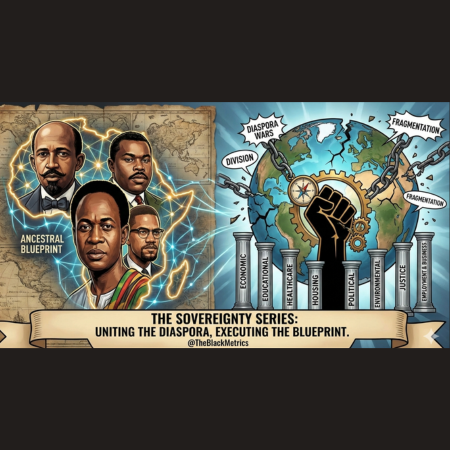
What Our Pan-African Ancestors Were Trying to Tell Us
And Why Diaspora Wars Are Blocking the Blueprint
Across centuries, continents, and political realities, Pan-African thinkers delivered a remarkably consistent message. From Henry Sylvester Williams and Alexander Crummell to Martin Delany and W.E.B. Du Bois, and from Marcus Garvey and Kwame Nkrumah to Malcolm X, the core instruction never changed. Black people cannot advance while fragmented.
Different strategies emerged and different languages were used. Different political paths were debated with ferocity. But the destination was always the same. Unity, sovereignty, and self determination on a global scale. Yet today, one of the greatest threats to that vision is not colonial rule or overt empire. It is the rise of diaspora wars. These are the internal divisions between African Americans, Caribbeans, continental Africans, Afro Latinos, and Black people across Europe and the global South. This fragmentation is not what the ancestors fought for.
The Blueprint Was Never About Division
The pioneers of this movement did not work in isolation. They understood that the struggle in London was connected to the struggle in Lagos and the struggle in New York.
Henry Sylvester Williams did not organize the first Pan-African Conference in 1900 so that Black people could compete over who has experienced the most suffering. He intended to create a global legal and political network. Alexander Crummell did not build Black intellectual institutions so that we could abandon education and moral leadership in favor of social media disputes.
Martin Delany did not argue for Black nationhood so we could remain politically dependent on the very systems that rejected our humanity. W.E.B. Du Bois did not map the global color line so that we could deny each other legitimacy based on where a boat landed centuries ago. Marcus Garvey did not build the UNIA with millions of followers so that Black identity could be reduced to a passport or a nationality.
Kwame Nkrumah did not warn against the dangers of neo colonialism so we could reproduce those same toxic hierarchies internally. Malcolm X did not internationalize the Black struggle by going to the United Nations so that we could fight one another instead of fighting the systems that profit from our disunity. These leaders understood an essential truth. Colonial power survives by keeping African people fragmented geographically, psychologically, economically, and culturally. Diaspora wars are not organic. They are inherited traps.
Diaspora Wars Are a Trap, Not a Debate
When Black people argue over who is more African, who suffered more, whose culture is authentic, or who owes whom allegiance, they are operating inside a colonial logic designed for containment. These conflicts do three highly destructive things:
They waste political energy: Massive amounts of intellectual and emotional labor are directed toward internal policing rather than toward building global institutions.
They fracture economic coordination: Disunity prevents collective ownership and global leverage. It stops a business in Atlanta from seamlessly partnering with a farm in Ghana or a tech hub in London.
They delay sovereignty: These wars keep us emotionally invested in identity disputes instead of structural power.
Our ancestors did not agree on every tactic, but they never mistook an internal disagreement for the primary enemy. The enemy was always dispossession. The enemy was the lack of collective power.
Sovereignty Was the End Goal, Not Recognition
Every Pan-African leader understood that survival inside hostile systems was not the final objective. Williams emphasized global unity through organized coordination and international political advocacy. Crummell focused on intellectual discipline and the creation of rigorous institutions. Delany emphasized the necessity of political independence and self rule.
Du Bois emphasized global consciousness and the development of leadership that could think across borders. Garvey emphasized mass unity and economic self reliance. Nkrumah emphasized continental unity and the fierce resistance to neo colonialism. Malcolm X emphasized self determination and the transition from seeking civil rights to demanding international human rights.
These were different methods leading to one destination. Sovereignty meant more than just having a voice. It meant controlling wealth instead of just earning wages. It meant defining education instead of just attending schools. It meant governing communities instead of just voting occasionally. It meant owning land, institutions, narratives, and futures. Pan-Africanism was never just a matter of cultural pride. It was a rigorous political and economic strategy for global survival.
Why the Ancestors Would Reject Today’s Fragmentation
If the ancestors were alive today, they would be baffled by our obsession with borders. They would not ask who is African American or Caribbean, or who is continental or diaspora. They would not care who came first or who suffered most in a competition of trauma.
Instead, they would ask what you own. They would ask who controls your institutions. They would ask how you are coordinating your resources globally and what you are building that will outlive your current generation. They would remind us that identity without infrastructure leads to a dead end.
The Sovereignty Series: A Modernized Blueprint
This is precisely why The Sovereignty Series exists. The Black Metrics created this series to do what the ancestors could not fully accomplish in their time due to the lack of technology. We are translating Pan-African philosophy into a modern, systems based blueprint for success.
The Sovereignty Series modernizes these ancient ideas into eight actionable pillars:
Economic Sovereignty
Educational Sovereignty
Healthcare Sovereignty
Housing Sovereignty
Political Sovereignty
Environmental Sovereignty
Justice Sovereignty
Employment and Business Sovereignty
These pillars are not theoretical. They are practical architecture designed for a digital and interconnected world. This is Pan-Africanism moved beyond slogans and into the realm of strategy.
Why This Matters Right Now
The ancestors laid the foundation, but our generation is responsible for the execution. We live in a unique moment in history. We have instant global communication, cross border economic tools, diaspora capital, and cultural influence at a massive scale.
What we lack is not potential. What we lack is coordination. Diaspora wars delay that coordination. Sovereignty, however, demands alignment. Moving forward together does not mean erasing our unique cultural differences. It means organizing across them. It means understanding that no single Black community can win this struggle alone. No region holds the full solution and no single identity has a monopoly on truth or leadership.
The ancestors gave us the blueprint. The only remaining question is whether we are disciplined enough to follow it.
What Comes Next
The Sovereignty Series launches in 2026 as an eight part framework. Each pillar will be released as its own eBook and workbook. We are bringing together history, data, strategy, and modern systems thinking to support global Black advancement. This is not about nostalgia or symbolism. This is about preparation.
A people who control their systems control their destiny. The ancestors are still speaking through us. It is time to join the movement, build sovereignty, end the wars, and execute the blueprint.
THE BLUEPRINT
Building the future of the global African Diaspora through data-driven storytelling and the Eight Pillars of Sovereignty. From survival to ownership.
Contact
Subscribe To the NewsLETTER
hello@blackmetrics.space
Copyright © 2026 The Black Metrics. All Rights Reserved.
The BlaCK METRICS