What Our Pan-African Ancestors Were Trying to Tell Us: Unity, Sovereignty, and the Blueprint Diaspora Wars Are Destroying
From Henry Sylvester Williams to Malcolm X, every Pan-African leader delivered the same message across centuries: Black people cannot advance while fragmented. Here is what they were building — and why diaspora wars are the greatest threat to finishing it.
PAN AFRICAN HISTORY
The Black Metrics
12/20/20257 min read
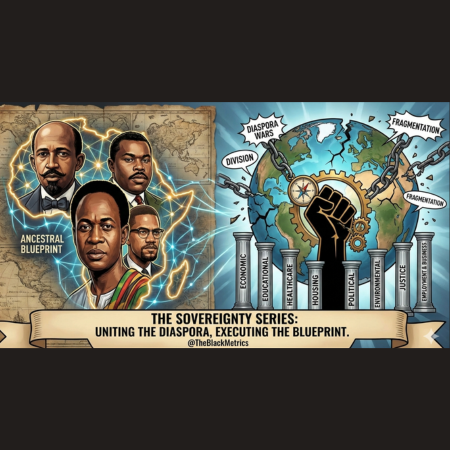
What Our Pan-African Ancestors Were Trying to Tell Us: Unity, Sovereignty, and the Blueprint Diaspora Wars Are Destroying
There is a message that runs like a thread through every major Pan-African voice across two centuries. The names change. The languages change. The political contexts shift from chattel slavery to colonialism to neo-colonialism to digital-age fragmentation. But the message itself never changes.
Black people cannot advance while fragmented.
Say it again slowly: cannot advance while fragmented.
Not advance more slowly. Not advance with greater difficulty. Cannot advance. Not while fragmented. This was not a suggestion. It was not a motivational slogan. It was a strategic diagnosis delivered by the most rigorous political minds the African diaspora has ever produced — and they delivered it not once but repeatedly, across generations, because they kept watching it go unheeded.
This essay is an attempt to hear it clearly, perhaps for the first time.
The Remarkable Consistency of the Blueprint
What is striking, when you study Pan-African thought across its full historical arc, is not the diversity of its strategies. It is the consistency of its destination. The leaders disagreed fiercely about tactics. They debated, sometimes bitterly, about the relative priority of emigration versus integration, cultural pride versus political organizing, intellectual development versus mass mobilization. But every single one of them was trying to reach the same place: a world in which African people governed themselves, controlled their own resources, defined their own cultural narratives, and could not be exploited by external powers because they had built the institutions that made exploitation impossible.
That is the blueprint. It is not complicated. The difficulty was never in understanding it. The difficulty was and remains in the doing of it — specifically, the doing of it together.
Henry Sylvester Williams, the Trinidadian lawyer who organized the first Pan-African Conference in London in 1900, understood this with extraordinary clarity. He was not organizing a cultural celebration. He was building a global legal and political network — a structure through which African people from different nations, different colonial contexts, and different cultural backgrounds could coordinate their demands and present a unified front to the world's most powerful empires. His tool was not rhetoric. It was infrastructure. He was trying to create, more than a century before the internet made it logistically simple, the kind of cross-border coordination that colonial power depended on preventing.
Martin Robison Delany, writing in 1852, identified the core problem from a different angle but arrived at the same conclusion. His famous declaration that Black Americans were "a nation within a nation" was not simply a statement of grievance. It was a strategic observation. A nation within a nation, if it recognized its own coherence and organized accordingly, could build the economic and political power that individual advancement within a hostile system could never provide. Delany did not believe the solution was to demand better treatment from the same system that had reduced Black people to property. He believed the solution was to build a competing system — one owned, governed, and sustained by Black people themselves.
Alexander Crummell spent his entire career making a related argument in the language of intellectual and institutional development. He watched the post-Civil War moment of possibility collapse into the violence of Redemption-era America and concluded that political rights without an independent intellectual and institutional infrastructure were fragile things. Rights that depended on the goodwill of hostile governments could be withdrawn. Institutions built by Black people, for Black people, and sustained by Black excellence were harder to destroy. His founding of the American Negro Academy in 1897 was not an academic exercise. It was an act of collective sovereignty.
Marcus Garvey built the most successful mass Black political organization in history — the Universal Negro Improvement Association drew millions of members across the United States, the Caribbean, Latin America, and Africa in the 1920s — on a simple premise: that Black people worldwide were one people with one collective interest, and that their liberation required them to act like it. His model was economic self-sufficiency combined with cultural pride combined with political organization. His reach was global because his analysis was global. He did not believe the problem was local or that the solution could be.
Kwame Nkrumah, leading Ghana to independence in 1957 and spending the rest of his political life trying to build continental African unity, kept returning to a single warning: that political independence without economic independence was a fiction. That neo-colonialism — the continuation of colonial exploitation through debt, dependency, and the control of Africa's resources by outside powers — was more dangerous than classical colonialism precisely because it was harder to see and therefore harder to organize against. His answer was the same answer Williams had given sixty years earlier: coordinated, institutional, cross-border Pan-African power.
Malcolm X, who had spent the early years of his public life arguing for Black nationalism within America, shifted in the final year of his life toward an explicitly international framework. He traveled to Africa, met with heads of state, addressed the Organization of African Unity, and brought a complaint against the United States government to the United Nations on the grounds that the treatment of Black Americans was not a domestic civil rights issue but an international human rights violation. He was doing what Delany had theorized, what Williams had organized, what Du Bois had mapped: connecting the local struggle to the global one and demanding that the world's most powerful institutions take notice.
What "Sovereignty" Actually Meant
One of the ways the ancestors' message gets diluted is through an imprecise understanding of what they were actually demanding. The word that best captures their collective destination is sovereignty — but sovereignty, as they used it, was not a simple or single thing.
It was not just the right to vote. Voting inside systems designed to marginalize you produces representation that cannot fundamentally alter the balance of power. The ancestors knew this. They were not naive about electoral politics.
It was not just cultural pride or the celebration of African heritage. Cultural pride without material power is aesthetically beautiful and politically insufficient. The ancestors were not building museums. They were building institutions.
Sovereignty, as the ancestors understood it, meant something comprehensive and structural. It meant controlling the wealth your community generates rather than simply earning wages from systems that extract that wealth upward and outward. It meant defining the education your children receive rather than accepting curricula designed to produce compliant subjects. It meant governing the communities you live in rather than being governed by structures designed without your participation. It meant owning the land, the institutions, the narratives, and the futures that determine what your people's lives actually look like from generation to generation.
This is why Delany's emphasis on economic control was inseparable from his political philosophy. This is why Crummell's insistence on independent Black intellectual institutions was not elitism but strategy. This is why Garvey's business ventures were not incidental to his political vision but central to it. This is why Nkrumah spent as much time on African economic integration as he did on political independence. This is why Malcolm X's shift to international human rights was not a change of direction but a deepening of the same analysis.
The destination was always sovereignty. Not as a feeling, but as a structure. Not as symbolism, but as infrastructure.
Why Diaspora Wars Are a Betrayal of the Blueprint
Given this context, the phenomenon we now call diaspora wars — the internal conflicts, competitions, and contempts that fragment African-descended people across the globe — is not simply unfortunate or counterproductive. It is a precise inversion of everything the ancestors built and died trying to accomplish.
The full historical analysis of how these divisions were engineered reveals something important: the fragmentation we mistake for natural cultural difference is in large part the residue of deliberate strategies of division that colonial and slave powers deployed because they understood, with the same clarity the ancestors had, that a unified African diaspora was an existential threat to the systems of extraction they depended on.
The Oppression Olympics — the competition over who suffered most, whose experience is most legitimate, whose claim to Black identity is most authentic — is the most effective contemporary expression of this engineered division. When African Americans dismiss the Caribbean experience, when continental Africans view the diaspora with condescension, when Caribbean communities compete with Afro-Latino ones for cultural legitimacy, all of them are playing a game that was designed by people who feared what would happen if they ever compared notes and decided to act together.
Williams did not organize the 1900 conference so that we could argue about which of the delegates had suffered most. Du Bois did not map the global color line so we could use it to disqualify each other. Garvey did not build a transnational movement so that its inheritors could police the boundaries of Black identity. The ancestors were trying to build something together. The diaspora wars are a refusal to build.
The Question the Ancestors Would Ask
If the ancestors were observing the current moment — with its unprecedented technological connectivity, its diaspora capital concentrated in major global cities, its cultural influence reaching every corner of the world — they would not be impressed by the representation. They would be asking about the infrastructure.
They would want to know what is owned. Not just consumed, but owned. Not just created, but controlled. They would want to know how the resources of the diaspora are being coordinated across borders — whether the business in Atlanta and the farm in Ghana and the tech company in London are building anything together or simply existing in parallel. They would want to know what institutions have been built that will outlive the current generation and that cannot be dismantled by a hostile administration or an economic downturn.
They would, above all, want to know why, with all the tools available that they lacked, the coordination they spent their lives trying to create still has not been accomplished.
The answer is complicated. But part of it — a significant part of it — is that diaspora wars keep consuming the energy that coordination requires. Every argument about authenticity is energy not spent on institution building. Every competition over suffering is attention not directed toward collective power. Every internal hierarchy reproduced from colonial logic is a betrayal of the blueprint the ancestors left.
What Comes After the Recognition
The first step is recognition: understanding that the divisions within the diaspora are not primarily the product of genuine cultural incompatibility. They are the inherited residue of systems designed to produce exactly this fragmentation. Recognizing this does not make the conflicts disappear. But it changes the frame. It means we are not obligated to keep playing the game.
The second step is the deliberate choice to build anyway — across the differences, not despite them. The ancestors did not share a single language, a single national origin, a single religious tradition, or a single political strategy. What they shared was a clear-eyed understanding of the common condition their people faced and a commitment to doing something about it at scale. That is the threshold for solidarity. Not sameness. Not resolved trauma. Not perfect agreement. A common analysis and the will to act on it together.
The blueprint exists. It was drawn by people who paid for their vision with everything they had. The only remaining question is the one the ancestors would ask if they were here: what are we building?
Explore the full record:
Martin Robison Delany: The Blueprint for Black Economic Self-Determination
THE BLUEPRINT
Contact
hello@blackmetrics.space
Copyright © 2026 The Black Metrics. All Rights Reserved.
The BlaCK METRICS
The Pillars
Strategic Stream Blog