When the Declaration Became Conditional
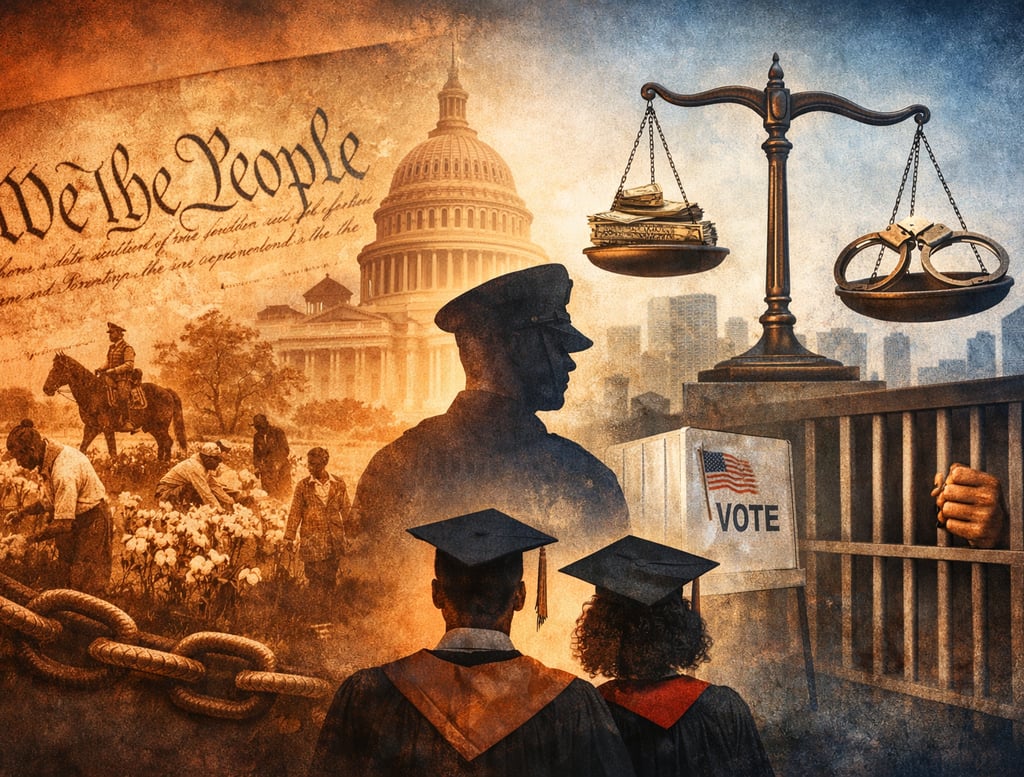
This Strategic Briefing examines the gap between America’s founding ideals and the lived reality of Black communities from 1776 to today. It traces how the promises outlined in the Declaration of Independence were applied selectively, shaping long-standing disparities in wealth, justice, political power, education, and economic opportunity. By connecting historical foundations to present-day outcomes, the piece outlines clear, data-driven policy solutions aimed at closing systemic gaps and advancing measurable progress. Readers can expect a focused analysis of where inequality originated, how it persists, and what concrete steps are necessary to move forward.
ECONOMIC, EDUCATIONAL, JUSTICE, & POLITICAL SOVEREIGNTY | AFRICAN AMERICAN HISTORY
The Black Metrics
1/20/20265 min read
A Black History, A Present Day Reality, A Path Forward
The Declaration of Independence is often presented as a universal promise of freedom. It declares that all men are created equal and that governments exist to secure the rights of the people. Yet from the moment it was signed, that promise was conditional.
For Black people, the Declaration did not mark liberation. It marked the beginning of a nation that named tyranny abroad while institutionalizing it at home.
This post examines how the grievances that justified independence from Britain became lived realities for Black people, how those conditions continue to shape life today, and what policies and actions are required to move forward.
Freedom Declared, Exclusion Enforced
When the Declaration was adopted in 1776, nearly one in five people living in the colonies were enslaved. Black people were denied citizenship, political voice, and legal protection. The foundational safeguard of the new nation, consent of the governed, did not include us.
The founders built a system designed to protect liberty, but only for those recognized as full participants. Black people lived under government authority without access to its protections. From the start, freedom existed on paper while racial control operated in practice.
This contradiction shaped the political, legal, and economic structures that followed and it still shapes outcomes today.
Labor Without Consent and the Roots of the Wealth Gap
One of the Declaration’s central grievances condemned taxation without consent. For Black people, the reality was labor without consent.
Enslaved Africans generated immense wealth through unpaid labor. That wealth built institutions, industries, and family fortunes that still exist. After emancipation, freedom was undermined by systems like sharecropping and convict leasing that trapped Black families in cycles of debt.
The safeguard against this abuse was supposed to be property rights and free labor markets protected by law. Those safeguards failed because Black people were denied land, capital, credit, and legal enforcement.
Today, the result is measurable. Wealth compounds across generations, and exclusion compounds with it. Median household wealth among White families remains several times higher than that of Black families not because of effort, but because of inherited access.
What Must Change
Working in tandem, Federal, State, and Local governments can expand targeted first-time homeownership programs through grants and land trusts, enforce fair lending laws, invest in cooperative and community-owned enterprises that keep wealth circulating locally, and implement restorative cash reparations for the descendants of those whose labor built this nation’s wealth.
Policing and the Legacy of Control
The Declaration warned against standing armies used to control civilian populations. For Black people, that control began with slave patrols, the earliest organized policing systems in the United States.
These patrols were not designed for public safety. They were designed to monitor, capture, and punish. That logic carried forward through Black Codes, Jim Crow enforcement, and modern policing practices.
The constitutional safeguard was civilian law enforcement accountable to the public and constrained by constitutional rights. In practice, policing in Black communities evolved to emphasize control rather than protection.
Today, Black people are disproportionately stopped, searched, arrested, and subjected to force. These outcomes are consistent and documented.
What Must Change
Accountability requires enforceable national, state, and local standards. Congress, States, and Cities can end qualified immunity, establish national and state use of force rules, limit military equipment transfers, and mandate independent civilian oversight with subpoena power. Simultaneously, states and localities must implement officer decertification databases and invest in alternative public safety models such as non-police crisis response that reduce harm while increasing community safety.
Justice Delayed Is Justice Denied
Another grievance listed in the Declaration was the obstruction of justice. Black history is filled with examples of justice delayed or denied.
Crimes against Black people were routinely ignored. Lynchings went unprosecuted. Civil rights violations were dismissed. Today, disparities in charging, sentencing, and incarceration remain severe.
The safeguards meant to prevent these abuses come from the Sixth Amendment right to a fair trial and the Fourteenth Amendment guarantee of equal protection. Yet most cases never reach a jury. Plea bargaining, cash bail, and mandatory minimums pressure outcomes before justice can be fully examined.
What Must Change
A fair system cannot depend on wealth to determine freedom. Congress, States, and Localities can reform or eliminate cash bail, roll back mandatory minimums, and achieve budget parity by increasing funding for public defenders. To ensure equity, states and local prosecutors must mandate transparency in charging and plea bargaining decisions and invest in pretrial support services that prioritize community stability over incarceration.
Political Power Granted and Taken Away
The Declaration framed government legitimacy as rooted in representation. For Black people, political power has repeatedly been granted and then withdrawn.
After the Civil War, Reconstruction briefly expanded Black political participation. That progress was dismantled through violence, voter suppression laws, and the withdrawal of federal enforcement. The right to vote existed on paper but not in practice.
Today, felony disenfranchisement, gerrymandering, and restrictive voting laws continue this legacy.
What Must Change
Democracy cannot function when participation is conditional. Congress, States, and Localities can restore and strengthen the Voting Rights Act, ban racial and partisan gerrymandering, and expand automatic and same-day voter registration. Together, they can restore voting rights to formerly incarcerated citizens and invest in local election infrastructure that ensures every community has equal access to the ballot box.
Education, Opportunity, and Economic Mobility
Liberty requires opportunity. The founders understood that education and economic participation were essential to a functioning democracy.
Yet Black students have historically attended underfunded schools with fewer resources. That pattern continues today as school funding remains tied to neighborhood wealth. Zip code still predicts opportunity.
Student debt has also become a barrier. Black students borrow more, face higher default rates, and carry debt longer even when earning degrees.
What Must Change
Opportunity should not be determined by geography or family wealth. Congress, States, and Localities can equalize school funding by investing in under-resourced districts and moving away from inequitable property tax models. By reforming student debt and expanding paid apprenticeships through local workforce pipelines, every level of government can ensure that career success is tied to talent and effort rather than zip code or inheritance.
Petitioning Without Redress
The Declaration stated that repeated petitions ignored by those in power are evidence of tyranny. Black people have petitioned for justice for centuries.
From abolitionist appeals to anti lynching legislation to modern civil rights complaints, the response has often been delay, denial, or repression. Even when laws are passed, enforcement is inconsistent.
What Must Change
Rights without enforcement are permissions, not protections. Congress, States, and Localities must attach enforceable timelines, transparency requirements, and meaningful penalties to civil rights laws to ensure they are upheld. By empowering state attorneys general and local human rights commissions with subpoena and sanction power, we can ensure that civil rights are treated as mandatory obligations rather than optional suggestions.
From Declaration to Responsibility
Black people are not experiencing a broken system. We are experiencing a system that was never fully constructed to include us.
The Declaration of Independence was not only a statement of separation. It was a warning about what happens when power concentrates and accountability disappears.
Moving forward requires policy, enforcement, and collective action grounded in data. Communities must continue organizing, building cooperative institutions, and demanding measurable outcomes rather than symbolic gestures.
Understanding the metrics is the first step. Building the future is the work.
This is the purpose of The Black Metrics. Not to debate whether inequality exists, but to document it, measure it, and push toward solutions rooted in truth.
Because a promise declared is meaningless unless it is fulfilled.
THE BLUEPRINT
Building the future of the global African Diaspora through data-driven storytelling and the Eight Pillars of Sovereignty. From survival to ownership.
Contact
Subscribe To the NewsLETTER
hello@blackmetrics.space
Copyright © 2026 The Black Metrics. All Rights Reserved.
The BlaCK METRICS