Who Decides What It Means to Be Human?
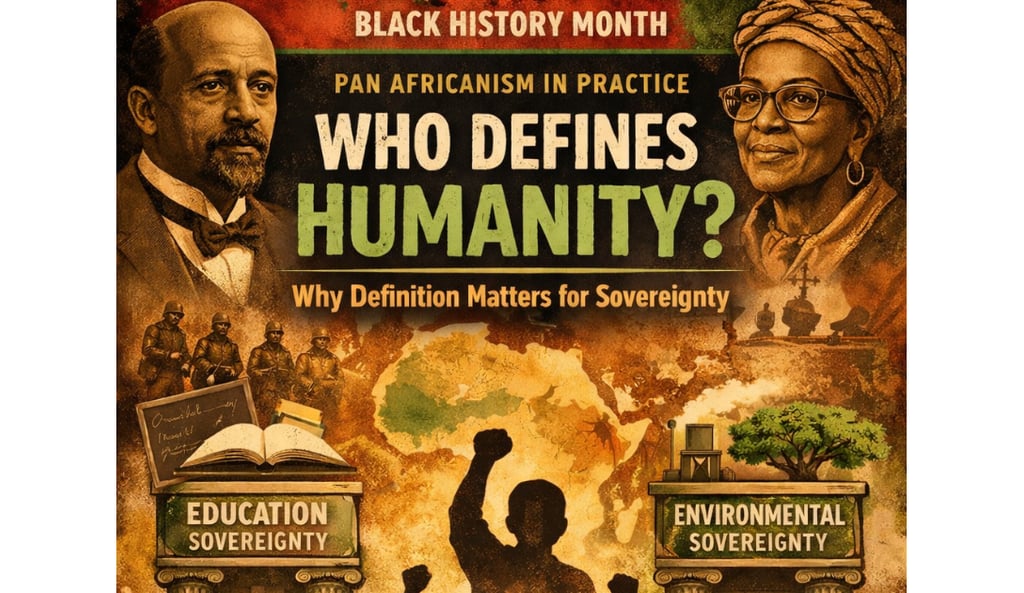
This Strategic Briefing examines how definitions of humanity shape power and sovereignty, drawing on the work of W. E. B. Du Bois and Sylvia Wynter. It shows that who is recognized as fully human determines access to protection, resources, and justice, and that reclaiming this definition is essential for educational, healthcare, and environmental sovereignty. By connecting historical analysis to modern systems, the post highlights how Pan Africanism begins with asserting humanity on our own terms, laying the foundation for true collective freedom.
JUSTICE SOVEREIGNTY | PAN-AFRICAN HISTORY
The Black Metrics
2/2/20265 min read
Who Decides What It Means to Be Human and Why That Question Shapes Sovereignty.
Most people learn African American history as a sequence of moments. Slavery. Emancipation. Jim Crow. Civil rights. Protests. Progress. Important moments, yes. But incomplete.
Because long before laws were written or movements were formed, something more fundamental was decided.
Someone decided who counted as human.
And whoever controls that definition controls everything that follows. Who deserves protection. Who receives resources. Who is believed. Who is ignored. And who is sacrificed.
This opening episode of Pan Africanism in Practice begins where power actually begins. Not with policy, but with definition.
Humanity as a Political Decision
We often treat humanity as a biological fact. But history shows us it has always been a political choice.
W E B Du Bois named this clearly when he wrote, “The problem of the twentieth century is the problem of the color line.” He was not talking only about prejudice or interpersonal bias. He was describing a global system that sorted people into categories of full humanity and conditional humanity.
On one side of the line were those assumed to be rational, capable, deserving, and protected. On the other were those treated as labor, risk, or burden.
That line determined where people lived, how they were educated, what work they could do, how healthy they could be, and how long they were expected to live.
Du Bois made something else unmistakable. This was not just an American issue. The same logic linked Black life in the United States to Africa, the Caribbean, and colonized people worldwide. Racism was not simply an attitude. It was an organizing principle of modern systems.
When a group is defined as less than fully human, no system built on that definition can ever serve them equitably.
Sylvia Wynter and the Invention of “Man”
Sylvia Wynter pushes this analysis even deeper by asking a question most people never consider.
Who defined the human in the first place?
Her answer is unsettling but clarifying. The modern world does not operate on a universal definition of humanity. It operates on a specific one that Wynter calls Man.
This version of humanity emerged in Europe and centers a particular figure. European. Male. Wealthy. Rational. Positioned as separate from and superior to nature. Once this figure becomes the standard, everyone else is measured against it.
Those who do not fit are framed as deficient, dangerous, irrational, unhealthy, or disposable.
This is not abstract theory. It shows up everywhere.
Black communities are heavily policed because they are coded as threats rather than people to be protected. Black neighborhoods are placed near environmental hazards because they are treated as expendable. Black pain is dismissed in healthcare because Black bodies are seen as problems to manage instead of lives to heal. Black knowledge is devalued because intelligence is defined through narrow European norms.
None of this is accidental. It is the logical outcome of a limited definition of humanity embedded into modern institutions.
Sovereignty Begins in the Mind
Sovereignty is often discussed in terms of economics, politics, or state power. But none of those can exist meaningfully without something more basic.
You cannot build free systems using a definition of humanity that was designed to exclude you.
If education teaches Black children that their history begins in deficiency, educational sovereignty is impossible. If healthcare systems approach Black bodies as inherently risky, healing will always be incomplete. If environmental policy treats Black land and communities as disposable, environmental sovereignty will remain out of reach.
This is why reclaiming definition is not symbolic. It is structural.
This episode activates three interconnected pillars of sovereignty.
Educational sovereignty requires the authority to define Black intelligence, history, and value.
Healthcare sovereignty requires seeing Black people as fully human, deserving of care, dignity, and belief.
Environmental sovereignty requires recognizing that Black life is inseparable from land, air, water, and place.
Du Bois exposed the line. Wynter explains who drew it and why.
Why This Still Matters Now
When people today ask why African American outcomes are worse, why communities struggle, or why inequality persists, they are often starting from a broken definition of humanity. One that quietly assigns blame instead of questioning the system itself.
Pan Africanism is not simply about unity or identity. At its core, it is about reclaiming the authority to define ourselves across borders, histories, and conditions.
Not asking to be included. Not proving worth. But asserting humanity as a given.
Strong communities are not built by policy alone. They are built by shared understanding. A collective agreement about who we are and what we deserve.
Sovereignty begins when a people say, without negotiation or apology,
We are human on our own terms.
A Question to Carry Forward
Before conversations about economics, politics, or reform, there is a more foundational question we must sit with.
Who taught us what it means to be human?
And what would change if we answered that question for ourselves?
This is Pan Africanism in practice.
Pillar by pillar.
Mind first.
Suggested Readings
W E B Du Bois and Sylvia Wynter
Foundational Works by W E B Du Bois
The Souls of Black Folk
Du Bois introduces the concepts of double consciousness and the color line, showing how Black life is shaped by being seen through a hostile definition of humanity.
Black Reconstruction in America
A powerful challenge to how history defines intelligence, labor, and democracy. Du Bois reframes Reconstruction by centering Black agency rather than deficiency.
The World and Africa
This work connects African history to global development and challenges the idea that Africa exists outside of modernity or human progress.
Dusk of Dawn
Du Bois reflects on race as a social and historical construct, not a biological fact, offering an early critique of how humanity is politically defined.
Foundational Works by Sylvia Wynter
Unsettling the Coloniality of Being, Power, Truth, and Freedom
Wynter’s most cited essay. She explains how the modern definition of “Man” became universalized and how this definition structures inequality across institutions.
The Ceremony Must Be Found
An early and important text where Wynter begins rethinking human identity outside of European frameworks.
No Humans Involved
A critical essay that examines how certain populations are treated as disposable through legal, social, and institutional language.
We Must Learn to Sit Down Together and Talk About a Little Culture
Wynter explores culture as a governing force that shapes who is recognized as human and whose knowledge is valued.
Entry Points and Companion Readings
Frantz Fanon, Black Skin, White Masks
Explores how imposed definitions of humanity shape psychology, identity, and self perception under colonialism.
Aimé Césaire, Discourse on Colonialism
A clear indictment of how colonialism dehumanizes both the colonized and the colonizer through false definitions of civilization and humanity.
Cedric J Robinson, Black Marxism
Introduces racial capitalism and connects economic systems to racialized definitions of human worth.
Achille Mbembe, Necropolitics
Examines how power decides who may live and who must die, extending the conversation about humanity into modern governance.
How to Use This List
Start with Du Bois to understand how the color line organizes the world. Move to Wynter to see how that line is rooted in a narrow definition of humanity itself. Then use the companion readings to connect those ideas across psychology, economics, and global power.
Together, these works form an intellectual foundation for understanding why sovereignty begins with definition.
THE BLUEPRINT
Building the future of the global African Diaspora through data-driven storytelling and the Eight Pillars of Sovereignty. From survival to ownership.
Contact
Subscribe To the NewsLETTER
hello@blackmetrics.space
Copyright © 2026 The Black Metrics. All Rights Reserved.
The BlaCK METRICS