Who Decides What It Means to Be Human? Du Bois, Wynter, and the Foundation of Black Sovereignty
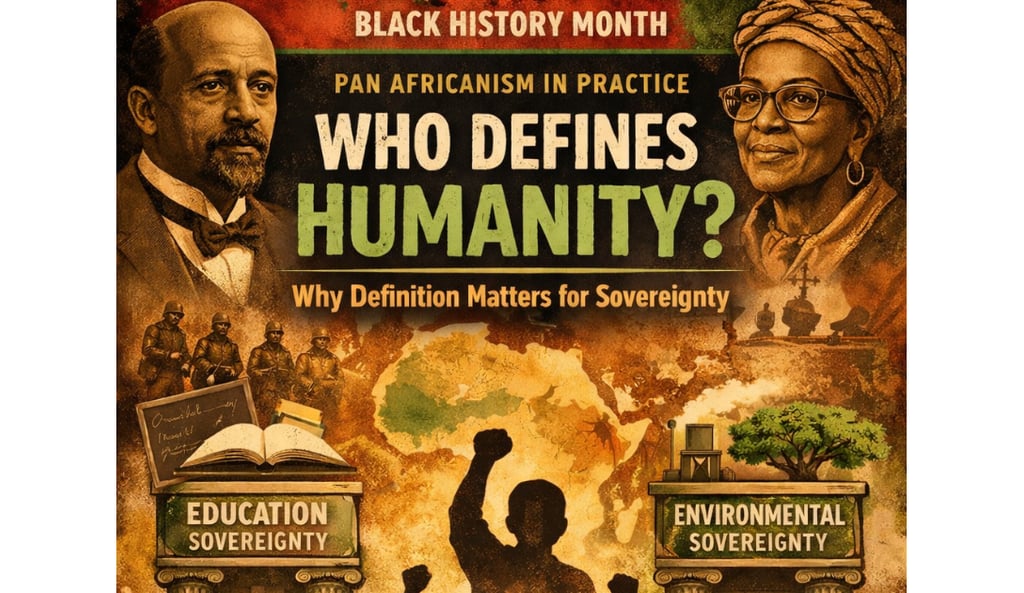
Before policy, before protest, someone decided who counted as human. We break down how Du Bois and Sylvia Wynter reveal why sovereignty begins with definition.
EDUCATIONAL, HEALTHCARE, & ENVIRONMENTAL SOVEREIGNTY
The Black Metrics
2/2/20269 min read
Who Decides What It Means to Be Human — and Why That Question Shapes Sovereignty
Most people learn Black history as a sequence of moments: slavery, emancipation, Jim Crow, civil rights, protests, progress. Important moments, yes. But incomplete.
Because long before laws were written or movements were formed, something more fundamental was decided.
Someone decided who counted as human.
And whoever controls that definition controls everything that follows: who deserves protection, who receives resources, who is believed, who is ignored, and who is sacrificed. This opening episode of Pan-Africanism in Practice begins where power actually begins. Not with policy. With definition.
Humanity as a Political Decision
We often treat humanity as a biological fact. But history shows us it has always been a political choice.
W.E.B. Du Bois named this clearly when he identified the problem of the color line as the defining challenge of the twentieth century. He was not talking only about prejudice or interpersonal bias. He was describing a global system that sorted people into categories of full humanity and conditional humanity.
On one side of the line were those assumed to be rational, capable, deserving, and protected. On the other were those treated as labor, risk, or burden. That line determined where people lived, how they were educated, what work they could do, how healthy they could be, and how long they were expected to live.
Du Bois also made something unmistakable: this was not an American issue in isolation. The same logic linked Black life in the United States to Africa, the Caribbean, and colonized people worldwide. Racism was not simply an attitude. It was an organizing principle of modern systems.
When a group is defined as less than fully human, no system built on that definition can ever serve them equitably. You can reform the policy. You cannot reform the outcome without changing the foundation. This is why the work of The Black Metrics begins not just with economic or political strategy but with the deeper question of whose reality gets to count as real.
Double Consciousness and the Cost of the Line
Du Bois introduced the concept of double consciousness in The Souls of Black Folk to describe the particular psychological burden placed on Black people in America: the sense of always looking at oneself through the eyes of a society that measures you against a standard you did not create and were not meant to meet.
Double consciousness is not simply self-awareness. It is the exhausting labor of navigating a world that simultaneously demands your participation and denies your full humanity. It is code-switching in the workplace. It is the calculation Black parents make before calling the police. It is the medical encounter where a patient must decide whether to advocate for themselves forcefully enough to be heard without being dismissed as difficult.
The JAMA study published in January 2026 put biological data to what Du Bois described philosophically. The chronic stress of operating under that double burden does not stay in the mind. It embeds in the body, elevates inflammation markers, and accelerates death. For the full breakdown of that research and what it demands of Healthcare Sovereignty, read The Silent Killer: New 2026 Study Proves Racism Is a Public Health Emergency.
Du Bois spent his life documenting how the color line operated at every institutional level. His work in Black Reconstruction in America demonstrated how intelligence, labor, and democratic participation were redefined specifically to exclude Black contribution from the American story. His work in The World and Africa connected that domestic exclusion to the global project of colonial extraction. He understood that the line was not local. It was a global architecture. The same architecture that Kwame Nkrumah would spend his political career fighting in Ghana. To understand how that colonial architecture persisted even after independence, read Kwame Nkrumah & Funmilayo Ransome-Kuti: Independence vs Black Sovereignty.
Sylvia Wynter and the Invention of Man
Sylvia Wynter pushes this analysis even deeper by asking a question most people never think to ask. Who defined the human in the first place?
Her answer is unsettling and clarifying. The modern world does not operate on a universal definition of humanity. It operates on a specific one, what Wynter calls Man. This version of humanity emerged in Europe during the Renaissance and was consolidated through colonialism. It centers a particular figure: European, male, propertied, rational, and positioned as separate from and superior to nature. Once this figure becomes the universal standard, everyone who does not fit is measured against it and found lacking.
Those who do not fit are framed as deficient, dangerous, irrational, unhealthy, or disposable.
This is not abstract theory. It shows up in every institution that was built during the colonial era and has not been fundamentally restructured since. Black communities are over-policed because they are coded as threats rather than people to be protected. Black neighborhoods are placed near environmental hazards because they are treated as expendable. Black pain is dismissed in healthcare settings because Black bodies are approached as problems to manage rather than lives to heal. Black knowledge is consistently devalued because intelligence itself has been defined through a framework that excludes it.
None of this is accidental. It is the logical outcome of a narrow definition of humanity embedded into the foundations of modern institutions.
Wynter's contribution is not pessimism. It is precision. You cannot fix what you have not correctly diagnosed. And the diagnosis, in her framework, is that the problem is not simply bias or prejudice within otherwise functional systems. The problem is that the systems were built on a definition of humanity that was always exclusionary by design. Reform within that definition produces better management of the excluded. Only redefining the human produces liberation.
Why This Is an Organizational Problem, Not Just a Philosophical One
It would be easy to receive the work of Du Bois and Wynter as purely intellectual, important for study but distant from the practical work of building sovereignty. That reading misses the strategic core of what both thinkers were doing.
Du Bois spent decades building institutions. He co-founded the NAACP. He edited The Crisis magazine for twenty-four years, using it as a tool of mass education and political coordination. He understood that ideas without infrastructure dissipate. The Negro World newspaper that Amy Jacques Garvey edited, the West Indian Gazette that Claudia Jones founded, the M Street School curriculum that Anna Julia Cooper defended, all of them were material responses to the same problem Du Bois named philosophically: if you do not control the definition, you do not control the narrative. If you do not control the narrative, you do not control what is built. For the full breakdown of how organizational infrastructure sustains the message, read Amy Jacques Garvey: The Blueprint for Black Organizational Strategy and Sovereignty Systems.
Wynter's work extends this into the present digital moment. Today the algorithm is one of the most powerful definition-making tools in human history. It determines what content is promoted and suppressed, what knowledge is treated as credible, whose experiences trend and whose disappear. If the human being at the center of the algorithmic model is still, functionally, Wynter's Man, then the most advanced communication technology in history is reproducing the same exclusionary hierarchy at unprecedented scale. Digital sovereignty is not a tech question. It is a philosophical one. For a deeper look at what owning your platform means in this context, read Claudia Jones: The Blueprint for Black Economic Internationalism and Pan-African Sovereignty.
Sovereignty Begins in the Mind
Sovereignty is often discussed in terms of economics, politics, or state power. But none of those can exist meaningfully without something more foundational. You cannot build free systems using a definition of humanity that was designed to exclude you.
If education teaches Black children that their history begins in enslavement or deficiency, Educational Sovereignty is impossible regardless of who runs the school. If healthcare systems approach Black bodies as inherently risky or defective, healing will always be incomplete regardless of how many Black doctors are in the building. If environmental policy treats Black land and communities as sacrifice zones, environmental justice will remain out of reach regardless of how many environmental laws are on the books.
This is why reclaiming definition is not symbolic. It is structural. It is the precondition for every other pillar to function as intended.
Anna Julia Cooper understood this when she fought for classical education at M Street. She was not just arguing for Latin and Greek. She was arguing that Black children deserved a definition of intellectual capacity that was not calibrated to produce compliant laborers. That argument was about the definition of humanity applied to Black children in a classroom. For the full strategic framework she built, read Anna Julia Cooper: The Blueprint for Black Educational Sovereignty and Intellectual Power.
Anna Julia Cooper: The Blueprint for Black Educational Sovereignty
Marcus Garvey understood this when he built the UNIA around a doctrine of Black dignity and self-determination. Before the economics, before the shipping line, before the newspaper, there was a claim: Black people are fully human, globally connected, and capable of building their own sovereign institutions. That claim, made publicly and at scale, was itself a political act. For the full architectural breakdown of what the UNIA built on that foundation, read Marcus Garvey and the UNIA: How the Largest Black Movement in History Built the Blueprint for Global Black Sovereignty.
Three Pillars Activated
The work of Du Bois and Wynter activates three interconnected pillars of sovereignty directly.
Educational Sovereignty requires the authority to define Black intelligence, history, and contribution on our own terms. This means curriculum designed to produce liberated thinkers, not credentialed workers. It means platforms, schools, and content that begin from a definition of Black humanity as complete, capable, and historically rich.
Healthcare Sovereignty requires recognizing Black people as fully human, deserving of care, dignity, and belief. The 2026 JAMA study demonstrates what happens when a healthcare system operates on a definition of Black bodies as less sensitive to pain, more capable of tolerating stress, or inherently more risky. The definition kills. Changing the definition is not optional. It is medical necessity.
Environmental Sovereignty requires acknowledging that Black life is inseparable from land, air, water, and place and that none of these should be treated as sacrificial. When Black neighborhoods are consistently selected as sites for industrial waste, power plants, and toxic exposure, that selection reflects a definition of whose environment is worth protecting. Reclaiming environmental sovereignty begins with reclaiming the definition of whose life the environment is for.
Pan-Africanism as Definitional Sovereignty
Pan-Africanism is not simply a politics of unity. At its deepest level it is a politics of definition. It is the collective assertion that the African diaspora constitutes a people with a shared humanity, a shared history, and a shared claim to self-determination that does not require external validation.
Every leader in The Black Metrics briefing series was engaged in this definitional project in their own domain. Du Bois named the color line globally. Wynter explained who drew it and why. Garvey built institutions on the counter-definition. Cooper defended intellectual capacity. Amy Jacques Garvey sustained the organizational machine. Claudia Jones converted cultural expression into economic infrastructure. Malcolm X took the jurisdictional argument to the world stage. Queen Mother Moore built the legal architecture for restitution. Nkrumah attempted to build the state on that foundation. Ransome-Kuti organized the people who would have to sustain it.
Together they form a continuous project. The project of answering, in every institutional domain, the question this post begins with: who decides what it means to be human?
The answer Pan-Africanism gives is consistent across all of them.
We do.
How to Study This: A Reading Strategy
The recommended reading list for this post is extensive because the argument is foundational. Here is how to move through it strategically.
Start with Du Bois. The Souls of Black Folk establishes the psychological and social reality of living on the wrong side of the color line. Black Reconstruction shows how that line was actively redrawn after emancipation to re-exclude Black political and economic participation. The World and Africa globalizes the analysis.
Move to Wynter. Unsettling the Coloniality of Being is her most complete argument and the most important. No Humans Involved shows how institutional language enacts dehumanization in the present tense. Together, Du Bois and Wynter give you the historical origin and the philosophical architecture of the problem.
Then use the companion readings to connect those ideas across psychology, economics, and global power. Fanon's Black Skin, White Masks addresses the psychological internalization of the colonial definition. Césaire's Discourse on Colonialism shows how that definition deforms the colonizer as well. Robinson's Black Marxism connects the definitional project to the economic system built on it. Mbembe's Necropolitics extends the analysis into contemporary governance.
Together, these works form the intellectual foundation for understanding why sovereignty begins with definition. Before the economy. Before the politics. Before the institutions. The mind.
The Question to Carry Forward
Before conversations about economics, politics, or reform, there is a more foundational question that every pillar of sovereignty must sit with.
Who taught us what it means to be human?
And what would change if we answered that question for ourselves?
This is Pan-Africanism in practice. Pillar by pillar. Mind first.
The Bantaba: Discussion Questions
Wynter argues that the modern world operates on a definition of humanity that was never universal. Where do you see that narrow definition operating in institutions you interact with daily?
Du Bois described double consciousness as always seeing yourself through the eyes of others. What would it look like to build community institutions specifically designed to reduce that psychological burden?
The algorithm amplifies certain definitions of humanity and suppresses others. What does digital sovereignty look like if we understand it as a definitional project rather than just a platform strategy?
Each of the women in the briefing series built infrastructure that operated on a counter-definition of Black humanity. Which of their models is most applicable to your current work?
If sovereignty begins with definition, what is the first definition your community needs to reclaim, and in which institutional domain?
This is the work of Educational, Healthcare, and Environmental Sovereignty. The full framework is in the series. → Get your copy → Black Sovereignty
THE BLUEPRINT
Contact
hello@blackmetrics.space
Copyright © 2026 The Black Metrics. All Rights Reserved.
The BlaCK METRICS
The Pillars
Strategic Stream Blog