Women of Pan-Africanism: A Historical Timeline
This Strategic Briefing presents a historical timeline highlighting the central role women have played in shaping Pan-Africanism across Africa and the global diaspora. From early resistance leaders like Yaa Asantewaa to movement architects such as Amy Ashwood Garvey and Amy Jacques Garvey, the post traces how women built the intellectual, political, and cultural foundations of global Black liberation. It moves through anti-colonial strategy, internationalism, reparations advocacy, cultural bridge-building, and modern intersectional theory—featuring figures like Funmilayo Ransome-Kuti, Queen Mother Audley Moore, Audre Lorde, and Wangari Maathai. The core message is clear: Pan-Africanism was not built around women—it was built through them. The article reframes women not as supporting figures, but as strategists, theorists, organizers, and visionaries who have sustained the movement from resistance to modern global advocacy.
PAN AFRICAN HISTORY
The Black Metrics
12/27/20252 min read
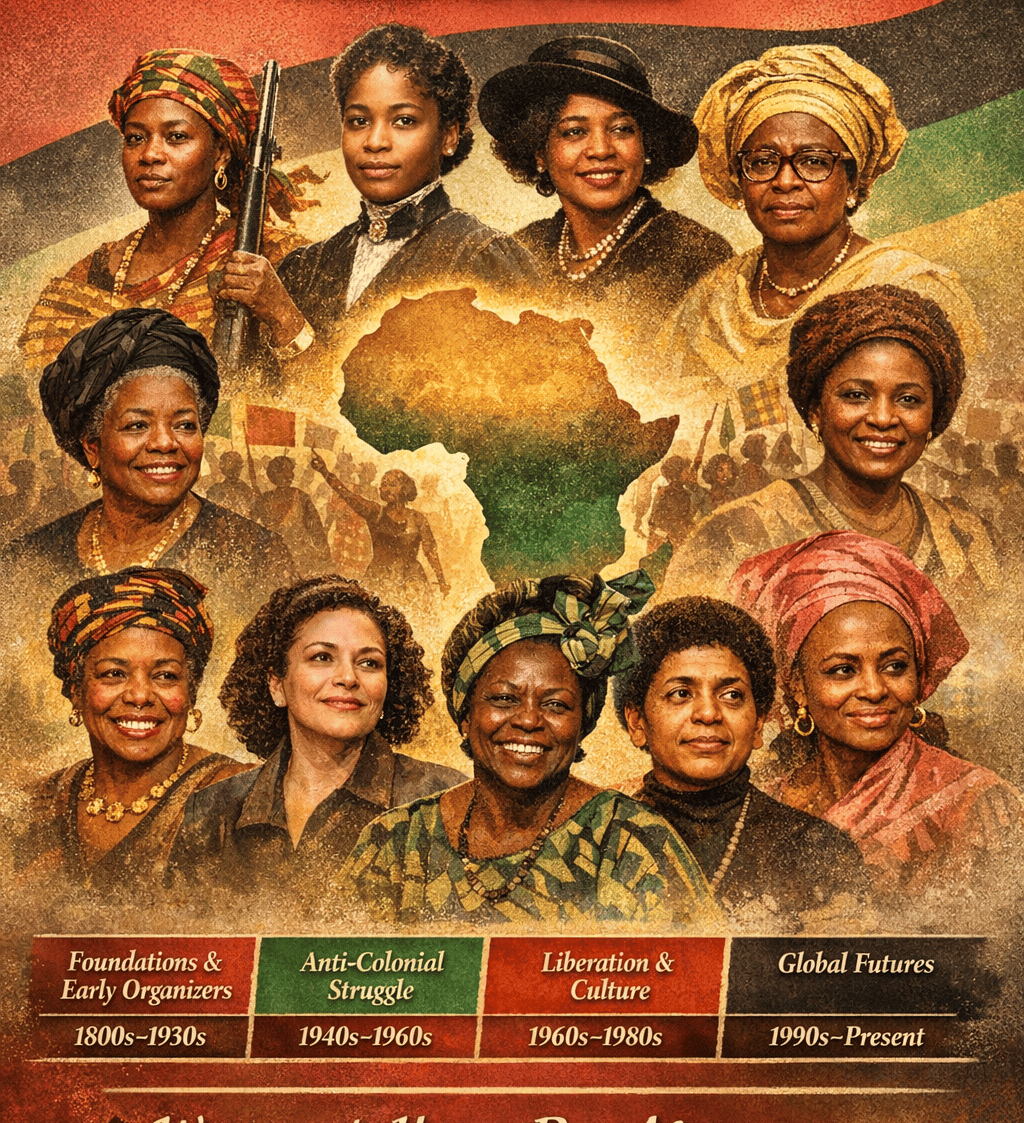
Women of Pan-Africanism: A Historical Timeline
This timeline centers women as architects, strategists, intellectuals, and freedom fighters of Pan-Africanism across Africa and the global African diaspora.
Pre-1900: Foundations of Resistance & Consciousness
1800 – 1870s | African Women of Resistance
Across the continent, women led and sustained resistance to colonial intrusion, preserving sovereignty, culture, and political authority. Their leadership forms the spiritual and political roots of Pan-African thought.
1875 | Anna Julia Cooper (U.S.)
Born into slavery-era America, Cooper later articulated one of the earliest philosophies linking Black liberation, African consciousness, and the central role of Black women in global freedom.
1896 | Yaa Asantewaa (Ghana)
Leads the War of the Golden Stool against British colonization, becoming a lasting symbol of African resistance, sovereignty, and women’s leadership.
1900–1930s: Birth of Organized Pan-Africanism
1900 | Amy Ashwood Garvey (Jamaica)
Co-founds the Universal Negro Improvement Association (UNIA), helping shape Pan-Africanism as a mass-based global movement.
1914–1920s | Amy Jacques Garvey (Jamaica)
Serves as editor, theorist, and organizer, embedding women, family, and social uplift into Pan-African political ideology.
1920s | Adelaide Casely-Hayford (Sierra Leone)
Advances African-centered education and cultural pride, reinforcing intellectual self-determination as a Pan-African pillar.
1930s–1950s: Internationalism & Anti-Colonial Strategy
1930s–1940s | Eslanda Robeson (U.S.)
An anthropologist and global diplomat who connects Africa, the Caribbean, and African America through research and political advocacy.
1940s | Claudia Jones (Trinidad & Tobago)
Develops a global Black internationalist framework linking class struggle, colonialism, and racial liberation across borders.
1947–1950s | Funmilayo Ransome-Kuti (Nigeria)
Leads mass women’s movements, challenges colonial authority, and ties women’s rights directly to African independence.
1960s–1970s: Liberation, Culture & Global Solidarity
1960s | Queen Mother Audley Moore (U.S.)
Frames reparations and self-determination as central Pan-African demands for African-descended people worldwide.
1960s | Maya Angelou (U.S./Ghana)
Lives and works in Ghana, helping bridge continental Africa and the diaspora through culture, storytelling, and organizing.
1960s–1970s | Assata Shakur (U.S.)
Becomes a global symbol of resistance, linking state violence, imperialism, and Black liberation across borders.
1980s–1990s: Expanding the Intellectual Framework
1980s | Audre Lorde (U.S./Caribbean roots)
Expands Pan-Africanism to include gender, sexuality, and intersectionality as necessary tools for liberation.
1980s–1990s | Mariama Bâ (Senegal)
Centers African women’s voices in post-colonial society, culture, and governance through literature.
1990s | Sylvia Wynter (Jamaica)
Rewrites the philosophical foundations of humanity, colonialism, and liberation—shaping modern Pan-African theory.
2000s–Present: Sustainability, Memory & Global Futures
2000s | Wangari Maathai (Kenya)
Links environmental justice, land sovereignty, democracy, and Pan-African self-determination.
2010s–Present | Contemporary Women Organizers
Across Africa, the Caribbean, Europe, and the Americas, women continue to advance Pan-Africanism through grassroots organizing, digital movements, cultural preservation, and policy advocacy.
Core Truth
Pan-Africanism has always been sustained by women, not as a footnote, but as its backbone. From resistance to theory, from culture to governance, women shaped Pan-Africanism as a living, global system of liberation.
THE BLUEPRINT
Building the future of the global African Diaspora through data-driven storytelling and the Eight Pillars of Sovereignty. From survival to ownership.
Contact
Subscribe To the NewsLETTER
hello@blackmetrics.space
Copyright © 2026 The Black Metrics. All Rights Reserved.
The BlaCK METRICS