Women of Pan-Africanism: The Complete Historical Timeline of Black Women as Architects of Global Liberation
From Yaa Asantewaa's war against British colonization to Sylvia Wynter's philosophical revolution, this comprehensive timeline centers Black women as the builders, theorists, and strategists who sustained Pan-Africanism across every era.
PAN AFRICAN HISTORY
The Black Metrics
12/27/202513 min read
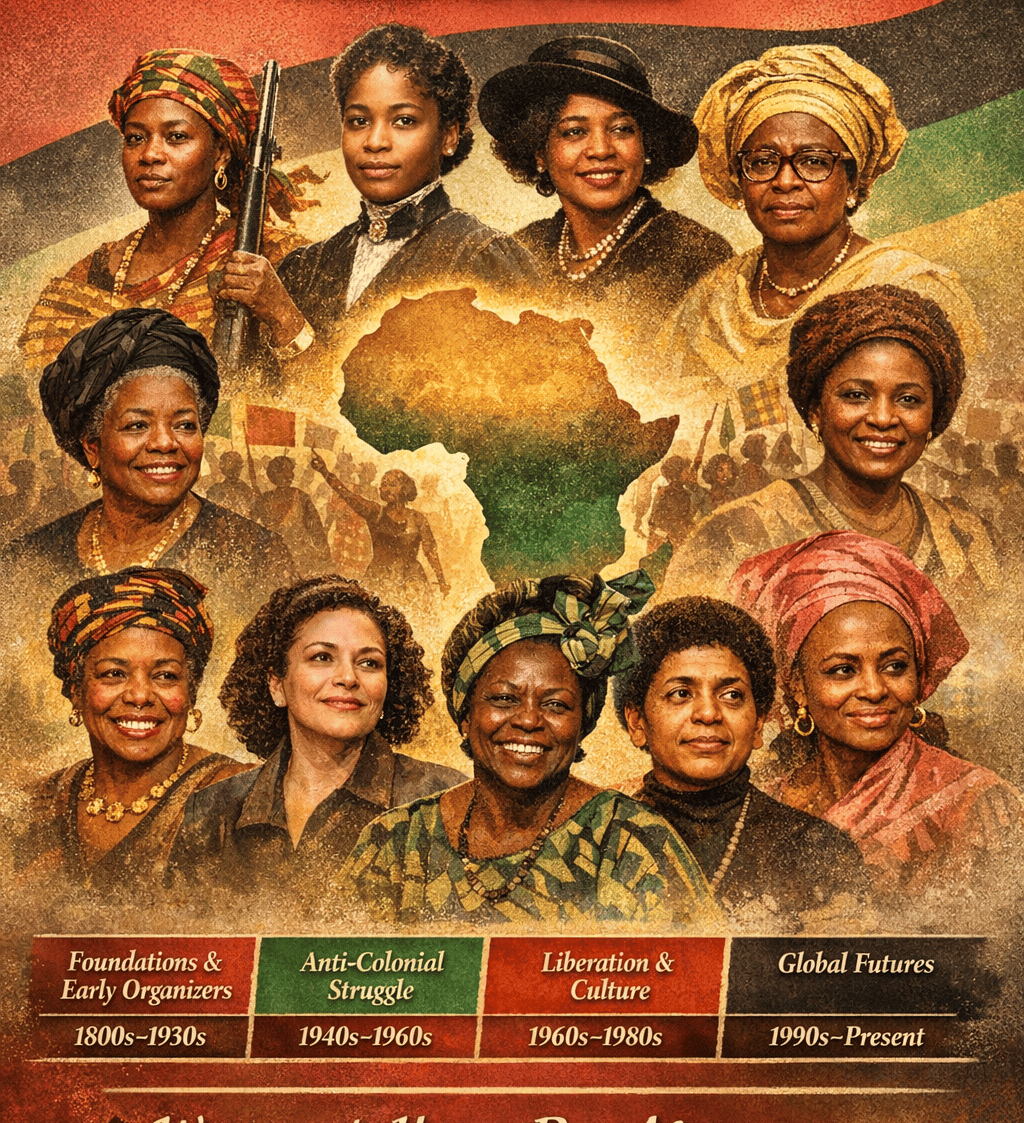
Women of Pan-Africanism: The Complete Historical Timeline of Black Women as Architects of Global Liberation
Pan-Africanism has a founding story that most people know only partially. When historians recount the movement's origins, names like Henry Sylvester Williams, Marcus Garvey, and W.E.B. Du Bois dominate the narrative. But embedded within every chapter of that story is another, less told truth: women were not spectators. They were the architects.
This timeline is a corrective record. It does not position women at the margins of Pan-Africanism. It places them where the historical evidence demands they be placed — at the center of its theory, its organizing, its sacrifices, and its survival across more than two centuries of struggle.
Pre-1900: Foundations of Resistance and Consciousness
1800–1870s | African Women of Resistance
Long before the term Pan-Africanism was coined in London drawing rooms, women across the African continent were defending sovereignty with their lives. Queen Nzinga of Ndongo had already set a precedent for diplomatic and military resistance against European encroachment centuries before. In the 1800s, that tradition continued.
Women in West, Central, and East Africa led and sustained acts of resistance against colonial intrusion — protecting trade networks, cultural knowledge, and political authority. They preserved the oral traditions that carried collective identity across generations. Their resistance was not only physical but also cultural and spiritual, ensuring that the memory of sovereignty survived even when kingdoms were dismantled. These women form the spiritual and political roots of everything Pan-African thought would eventually articulate in institutional form.
1875 | Anna Julia Cooper (United States)
Born into slavery-era America in 1858, Anna Julia Cooper grew up to become one of the most rigorous Black feminist intellectuals of the 19th century. Her 1892 masterwork, A Voice from the South, articulated something that no one else had said with such clarity at the time: the liberation of Black people could not be complete without the liberation of Black women. The two struggles were not separate.
Cooper linked African consciousness, global Black solidarity, and the indispensable role of Black women's leadership into a single, coherent philosophical framework. She was not simply arguing for inclusion. She was arguing that the movement could not succeed without the full intellectual and political participation of women. Decades later, the feminist scholars who expanded Pan-African theory would stand on the foundation she built.
Cooper earned her doctorate from the Sorbonne in 1924, becoming one of the first African American women to do so — a living demonstration that Black women's intellectual excellence was global in scope and unstoppable in drive.
1896 | Yaa Asantewaa (Ghana)
In 1900, the same year that Henry Sylvester Williams convened the first Pan-African Conference in London, Yaa Asantewaa was already at war. As Queen Mother of Ejisu in the Ashanti Empire, she had led what became known as the War of the Golden Stool against British colonial authority — a conflict that began in 1900 and stands as one of the last major wars in Africa led by a woman.
Her famous speech to the Ashanti chiefs has become iconic. When male leaders hesitated to confront British demands for the sacred Golden Stool, Asantewaa reportedly declared that if the men would not fight, the women would. She organized and commanded an armed campaign that forced the British to deploy thousands of troops before they could suppress the uprising.
Her significance to Pan-Africanism is profound. She demonstrated that African women held political authority and military leadership not as exceptional outliers but as recognized leaders within their own governance systems. She also demonstrated that sovereignty was worth fighting for with everything available — a lesson that Pan-African organizers on the other side of the Atlantic were simultaneously trying to articulate in meeting halls and legal briefs.
1900–1930s: The Birth of Organized Pan-Africanism
1900 | Amy Ashwood Garvey (Jamaica)
When Marcus Garvey founded what would become the Universal Negro Improvement Association, he did not do it alone. Amy Ashwood Garvey co-founded the UNIA with him and was central to its earliest organizing. She was a strategist, a speaker, and a coalition builder who understood that a mass movement required mass infrastructure.
Amy Ashwood's contribution has been systematically minimized in mainstream accounts of Garveyism — often reduced to a footnote about her marriage to Marcus Garvey, which ended in separation. But her organizing work extended well beyond that relationship. She spent decades working across the Caribbean, London, and West Africa connecting Black activists, artists, and intellectuals. She was present at nearly every major Pan-African gathering of the early 20th century and brought with her a network that crossed national and cultural lines.
Her life's work is a direct answer to the question that Alexander Crummell spent his career asking: what institutions must Black people build to sustain their own freedom?
1914–1920s | Amy Jacques Garvey (Jamaica)
While Amy Ashwood built the early UNIA infrastructure, Amy Jacques Garvey became the movement's intellectual backbone during its peak years. As editor of the Negro World newspaper's women's page and later as the compiler of Garvey's writings in Philosophy and Opinions of Marcus Garvey (1923 and 1925), she did something that is often underestimated: she preserved and systematized Pan-African ideology for future generations.
Amy Jacques Garvey did not simply record Garvey's words. She advanced the theoretical framework herself. She argued that Pan-Africanism had to address the specific conditions of Black women — their labor, their families, their political exclusion — or it would remain incomplete as a liberation philosophy. She embedded social uplift and women's leadership into the UNIA's public ideology at a time when most political movements, radical or otherwise, treated women as supporters rather than architects.
1920s | Adelaide Casely-Hayford (Sierra Leone)
While many Pan-African figures focused on political organizing, Adelaide Casely-Hayford understood that cultural and educational sovereignty were equally foundational. Born in Sierra Leone to an elite Krio family, she was educated in Britain before returning to West Africa committed to a different kind of institution building.
In the 1920s, Casely-Hayford founded a vocational school in Freetown designed specifically to provide African-centered education for girls. This was a deliberate political act. Colonial education systems were designed to produce subjects, not leaders. They taught African children to see themselves through European frameworks — to value European knowledge over African knowledge, European beauty over African beauty. Casely-Hayford challenged this directly by building an institution that affirmed African identity as the foundation of learning.
Her work echoes the educational philosophy that Alexander Crummell developed during his years in Liberia and his founding of the American Negro Academy — the conviction that intellectual self-determination is inseparable from political freedom.
1930s–1950s: Internationalism and Anti-Colonial Strategy
1930s–1940s | Eslanda Robeson (United States)
Eslanda Goode Robeson is best known to history as the wife of Paul Robeson. She was, in her own right, a scientist, anthropologist, journalist, and global political strategist. She earned a PhD in anthropology from Hartford Seminary in 1945, writing a dissertation that examined African culture through a lens that rejected the colonial frameworks dominating the discipline at the time.
More significantly, Robeson used her travels through Africa, the Caribbean, and Europe to build connections between Black communities across the diaspora. She attended the San Francisco Conference in 1945 where the United Nations was founded and agitated for the inclusion of colonized peoples' rights in the UN charter. She testified before the McCarthy-era Senate committees and refused to be intimidated into political silence.
Eslanda Robeson represents the kind of figure that Martin Robison Delany's vision of global Black solidarity required — someone who could move between continents, translate between political contexts, and hold the international dimensions of the Black freedom struggle in focus at all times.
1940s | Claudia Jones (Trinidad and Tobago)
Claudia Jones may be the most underappreciated figure in the entire history of Black internationalism. Born in Trinidad in 1915, she immigrated to the United States as a child, became a leader in the Communist Party USA, and developed what scholars now recognize as one of the earliest and most sophisticated analyses of the triple oppression facing Black women — the interlocking weight of race, class, and gender.
Her 1949 essay, An End to the Neglect of the Problems of the Negro Woman, is a landmark document in both feminist and Pan-African thought. She argued that the super-exploitation of Black women was the most acute expression of American racial capitalism, and that any movement seeking genuine liberation had to center their conditions.
Deported from the United States in 1955 during the McCarthy era, Jones moved to London where she founded the West Indian Gazette, the first major Caribbean newspaper in Britain, and organized the first Notting Hill Carnival in 1959 — an act of cultural resistance that became one of the most enduring celebrations of Black diasporic culture in Europe.
1947–1950s | Funmilayo Ransome-Kuti (Nigeria)
In Nigeria, Funmilayo Ransome-Kuti was building one of the most powerful women's political organizations on the African continent. As founder of the Abeokuta Women's Union, she led mass protests against colonial taxation, organized literacy programs, and tied the demand for women's rights directly to the demand for national independence.
Her organizing philosophy was rooted in the understanding that colonial authority and patriarchal authority were mutually reinforcing systems. To dismantle one without addressing the other was to leave the structure of domination intact. This analysis put her decades ahead of most of her male contemporaries in both the Nigerian independence movement and the broader Pan-African world.
Ransome-Kuti's work demonstrates the depth of what Pan-Africanism looked like when women led it — not just symbolic representation, but mass movement building that connected everyday material conditions to the largest questions of sovereignty and self-determination.
1960s–1970s: Liberation, Culture, and Global Solidarity
1960s | Queen Mother Audley Moore (United States)
Audley Moore, known as Queen Mother Moore, was one of the most persistent and politically sharp voices in 20th-century Black American radicalism. She joined the Universal Negro Improvement Association as a teenager in New Orleans, became a Communist Party organizer, and eventually developed into one of the foremost advocates for reparations as a Pan-African demand.
Queen Mother Moore understood that the question of reparations was not simply a domestic American issue. It was a global matter — an accounting for centuries of extracted labor, stolen land, and destroyed cultural wealth that connected enslaved Africans in the Americas to colonized Africans on the continent. She began formally advocating for reparations in the 1950s and spent decades petitioning the United Nations, long before the mainstream political conversation in America took the idea seriously.
Her framing of reparations as a matter of international human rights rather than domestic policy is a direct line of connection to the internationalist strategies that figures like Claudia Jones and Eslanda Robeson had been developing simultaneously.
1960s | Maya Angelou (United States and Ghana)
In the early 1960s, Maya Angelou made a decision that has been somewhat obscured by her later fame as a poet and memoirist: she moved to Ghana. She lived in Accra from 1962 to 1965, part of a community of African Americans who relocated to Kwame Nkrumah's Ghana in the belief that the newly independent nation represented the possibility of a continental home for the diaspora.
In Ghana, Angelou worked as a journalist, taught at the University of Ghana, and built relationships with Ghanaian artists, intellectuals, and political leaders. She encountered Malcolm X there in 1964, a meeting that deepened her understanding of the international dimensions of Black liberation. Her time in Africa became central to her intellectual and artistic identity — a bridge between the storytelling traditions of Black America and the living cultures of the continent.
Angelou's experience in Ghana illustrates what Pan-Africanism looked like as a lived practice: not just ideology but physical relocation, cultural exchange, and the deliberate construction of diaspora belonging.
1960s–1970s | Assata Shakur (United States)
Assata Shakur became a target of the FBI's COINTELPRO program — the systematic government campaign to destroy Black liberation organizations — while she was a member of the Black Panther Party and the Black Liberation Army. After a 1977 conviction that her supporters have long contested, she escaped from prison in 1979 and was granted political asylum in Cuba in 1984, where she has lived ever since.
Her autobiography, published in 1987, became one of the foundational texts of the Black radical tradition and is read across the diaspora — in the United States, the Caribbean, Europe, and Africa — as a testament to the personal costs of resistance and the global dimensions of state violence against Black people. She frames her own story not as an individual criminal case but as part of an international pattern of political repression, drawing connections between the treatment of Black activists in the United States and the colonial violence imposed on people of African descent worldwide.
Her continued exile in Cuba, a nation that itself stood outside the American imperial order, gives her story a permanent Pan-African dimension that no amount of government pressure has been able to erase.
1980s–1990s: Expanding the Intellectual Framework
1980s | Audre Lorde (United States, with Caribbean roots)
Audre Lorde was born in New York to Caribbean parents from Barbados and Grenada. She became one of the most important theorists of the 20th century not despite the complexity of her identities — Black, woman, lesbian, mother, poet, activist — but because of them. She insisted that all of those identities were politically relevant and that any liberation movement that required people to fragment themselves to participate was reproducing the logic of domination it claimed to oppose.
Her 1984 essay collection Sister Outsider contains some of the most cited texts in Black feminist thought, including The Master's Tools Will Never Dismantle the Master's House — a challenge to liberation movements to interrogate the frameworks they use, not just the targets they oppose. She expanded Pan-Africanism's intellectual terrain to include gender and sexuality not as peripheral concerns but as central axes of analysis.
Lorde also maintained deep connections to Africa and the African diaspora throughout her life, including her relationship with South African anti-apartheid activism, and in the final years of her life took the African name Gamba Adisa, meaning "warrior who makes her meaning clear."
1980s–1990s | Mariama Bâ (Senegal)
Mariama Bâ's 1979 novel Une Si Longue Lettre (So Long a Letter), published in French and translated into dozens of languages, became one of the most widely read works of African literature of the 20th century. Written as a letter from a grieving widow to her childhood friend, it centers the interior lives of African women in post-colonial Senegal with a precision and emotional honesty that had rarely appeared in African literature.
Bâ was making a Pan-African argument through fiction: that the freedom promised by political independence was hollow if the social structures governing African women's lives remained unchanged. Colonialism had ended, but patriarchy had not. Her writing challenged both the continuing influence of Western cultural domination and the internal hierarchies within post-colonial African societies that limited women's full participation in governance, culture, and public life.
She died in 1981, just before the novel won the inaugural Noma Award for Publishing in Africa. Her work remains a defining text in any serious curriculum on women and Pan-Africanism.
1990s | Sylvia Wynter (Jamaica)
Sylvia Wynter is arguably the most intellectually ambitious figure in this entire timeline. A Jamaican scholar and novelist who spent much of her career at Stanford University, she spent decades developing a body of work that asked a question so fundamental it shook the philosophical ground Pan-Africanism stood on: what is the definition of the human, who gets to decide it, and how does that definition reproduce colonial power?
Wynter's argument, developed across a long series of essays and conversations, is that the Western liberal concept of the human — the universal, rational, self-determining individual at the center of Enlightenment thought — is not actually universal. It is a specific, racialized model that positioned European man as the human template and everyone else as varying degrees of deviation from it. Colonialism, slavery, and racism were not aberrations from Enlightenment values. They were expressions of them.
For Pan-Africanism, Wynter's work is clarifying and demanding. It means the goal cannot simply be gaining equal inclusion within existing systems. The systems themselves — including their philosophical foundations — must be challenged and reimagined. Her influence on contemporary Pan-African and decolonial thought is enormous, though she remains less famous than her intellectual contributions deserve.
2000s–Present: Sustainability, Memory, and Global Futures
2000s | Wangari Maathai (Kenya)
When Wangari Maathai won the Nobel Peace Prize in 2004, she became the first African woman to receive it. The Nobel Committee's recognition acknowledged something that Pan-African thinkers had been arguing for generations: that the struggle for environmental justice, democratic governance, and Black sovereignty were not separate fights. They were the same fight.
Maathai founded the Green Belt Movement in Kenya in 1977, organizing rural women to plant trees, combat deforestation, and build community-level environmental resilience. What looked like an environmental project was also a political one. She connected the degradation of Kenya's land to the colonial extraction that had stripped the continent's resources for centuries. She connected women's economic marginalization to the loss of the land-based knowledge and sovereignty that colonialism had deliberately dismantled.
Maathai was imprisoned, beaten by Kenyan security forces, and relentlessly harassed by the government of Daniel arap Moi for her activism. She continued anyway. Her life is a demonstration that Pan-African self-determination in the 21st century includes the right of African people to their land, their ecosystems, and the environmental futures of their communities.
2010s–Present | Contemporary Women Organizers
The tradition continues across every geography. In West Africa, women are leading land rights movements and building alternative governance structures in the face of continued resource extraction. In the Caribbean, feminist scholars and organizers are building the theoretical frameworks for reparations as a regional and global demand. In the United Kingdom, Black British women are organizing against the Windrush scandal's ongoing consequences, connecting immigration policy to the long history of Caribbean colonial exploitation. In the United States, Black women have led the most significant social movements of the past decade, from the founding of the Movement for Black Lives to global campaigns against anti-Black violence.
Digital platforms have created new organizing infrastructures that allow diaspora coordination in ways that earlier Pan-African organizers could only theorize about. Women are disproportionately represented in the labor of that coordination — building networks, archiving history, translating local struggles into global demands, and insisting that Pan-Africanism remain a living, evolving, and intersectional practice.
The Core Truth
Pan-Africanism has always been sustained by women. Not as a footnote. Not as the supportive background to male genius. As its backbone.
Every era of the movement — from the armed resistance of Yaa Asantewaa to the philosophical revolution of Sylvia Wynter, from the mass organizing of Funmilayo Ransome-Kuti to the environmental sovereignty of Wangari Maathai — was shaped by women who understood that liberation is indivisible. You cannot separate political freedom from cultural freedom, or economic sovereignty from women's full participation in its architecture.
The men whose names appear most frequently in Pan-African history operated within networks, movements, and intellectual traditions that women built alongside them. Henry Sylvester Williams organized the first Pan-African Conference in 1900, but Amy Ashwood Garvey was already in the room of the movement it would inspire. Martin Robison Delany argued for Black nationhood and global solidarity, but it was the women around him — educators, journalists, organizers — who turned those arguments into institutions. Alexander Crummell built the American Negro Academy to advance Black intellectual excellence, but Anna Julia Cooper was already articulating why that excellence had to include Black women or it would remain structurally incomplete.
Reclaiming the full history of Pan-Africanism means reclaiming the full record. These women were not waiting to be included. They were already there, building what needed to be built, thinking what needed to be thought, and fighting what needed to be fought.
The blueprint was always theirs too.
Continue the series:
Martin Robison Delany: The Blueprint for Black Economic Self-Determination
THE BLUEPRINT
Contact
hello@blackmetrics.space
Copyright © 2026 The Black Metrics. All Rights Reserved.
The BlaCK METRICS
The Pillars
Strategic Stream Blog