Surviving Sickness Is Not Sovereignty: The Case for Black Healthcare Ownership
A 2026 study measured racism in the blood. Healthcare Sovereignty, Vol 5 of The Sovereignty Series, shows why Black health must be owned, not requested.
HEALTHCARE SOVEREIGNTY
The Black Metrics
6/1/20268 min read
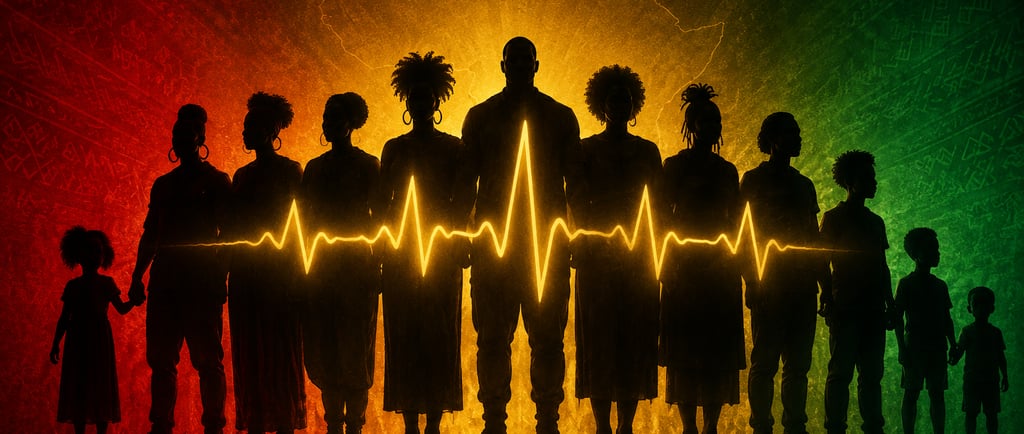

The Sovereignty Series • Volume 5
Surviving Sickness Is Not Sovereignty: The Case for Black Healthcare Ownership
In January 2026, a study published in JAMA Network Open did something the medical establishment had spent decades avoiding. It measured, in the bloodstream, the cost of being Black in America. Led by Isaiah Spears at Washington University in St. Louis and drawing on the St. Louis Personality and Aging Network, the research followed more than 1,500 Black and White adults for roughly two decades. It found that the higher mortality among Black participants was driven, in part, by two forces working together: greater cumulative stress across the lifespan and elevated inflammation in the blood, tracked through markers such as C-reactive protein and interleukin-6.
Read that again. The daily weight of discrimination is not only felt. It is recorded in the body, and it is shortening lives. For generations, Black communities said exactly this and were told it was imagined. The science now confirms they were right all along.
This finding is the foundation of Healthcare Sovereignty, Volume 5 of The Sovereignty Series. And it leads to a conclusion that reorders the entire conversation about Black health. If the harm is structural, the cure cannot be individual. You cannot meditate your way out of a system engineered to keep your alarm switched on, and no amount of discipline lowers an inflammation level that the conditions of your life keep raising. The only intervention that reaches the bloodstream is the one that changes the conditions, and changing the conditions means owning them.
The Harm Is a Design, Not a Gap
We are trained to describe Black health outcomes as a gap, as though the distance between Black and White survival were an accident that better awareness might close. It is not an accident. It is the predictable output of systems that were never built with Black life as the standard of care.
Consider the scale. An estimated 1.63 million excess Black deaths occurred between 1999 and 2020. Black life expectancy stood at roughly 74 years in 2023, among the shortest in the country. These figures are not the sum of individual failures of diet or willpower. They are the downstream result of conditions imposed and maintained.
The science calls the mechanism weathering. Chronic stress is not merely a feeling. It is a biological process that keeps the body's alarm system switched on, drives inflammation, and accelerates the conditions that appear on death certificates as heart disease and cancer. A single traumatic event has an end. Structural racism does not. There is no recovery period and no return to baseline, because the danger is still present. Sustained alertness is what wears the body down, and that wear is what arrives early as disease.
This produces a trap. A community forced into permanent survival mode cannot plan in generations, because it is consumed by getting through the day. The very state that kept us alive becomes the instrument that grinds us down. The way out is not more endurance. Endurance kept families alive and deserves respect, but it was never the same thing as power.
Surviving sickness was never the same as designing wellness.
What the Numbers Actually Show
Strategy without numbers is opinion, so look closely at the numbers, because they reveal a pattern rather than random misfortune.
Black women in the United States die from pregnancy related causes at three to four times the rate of White women, and that gap holds across income and education. A college degree and a high salary do not erase it, which means the cause is not personal circumstance. It is the system itself.
Cancer tells the same story. According to the American Cancer Society, death rates run roughly twice as high in Black people for myeloma and for cancers of the stomach, prostate, and uterine corpus. Black women are 38 to 41 percent more likely to die of breast cancer despite similar or lower diagnosis rates, and Black men carry the highest prostate cancer death rate of any group in the country.
Then there is the clearest signal of all: where the money goes. Research funding is supposed to follow disease burden. In practice it follows something else. Sickle cell disease, which predominantly affects people of African descent, is the most common inherited blood disorder in the country and roughly three times more prevalent than cystic fibrosis, which predominantly affects White people. Yet sickle cell has historically received a fraction of the funding per patient. The result shows up in survival. Cystic fibrosis now has new therapies and a near normal life expectancy. Sickle cell advances lagged for decades. The same neglect repeats with lupus and with uterine fibroids, which reach nearly 80 percent of Black women by age 50 and remain understudied.
Here is the part that changes the strategy. Fifty years of measuring these disparities has not closed a single one, because measurement was never the missing piece. What is missing is control of the clinics, the research budgets, the data, and the institutions that decide which diseases get solved and which are left to kill quietly. The gap is not an information problem. It is an ownership problem, and ownership is the only thing that closes it.
The Three Pillars of Healthcare Sovereignty
Healthcare sovereignty is the collective ability of a community to determine the conditions, the institutions, and the priorities of its own health. It moves the conversation from seeking care to building the systems that deliver it. The framework rests on three pillars.
Control
Control is the power to own and govern the institutions that deliver care, conduct research, and hold data. Without it, even well intentioned care drifts toward the priorities of whoever funds and runs it. Control means clinics, cooperatives, training programs, and data systems that answer to the community rather than to distant shareholders or agencies.
Capacity
Capacity is the trained people and the physical infrastructure required to heal ourselves. A community cannot govern what it cannot staff. That means a pipeline of clinicians, researchers, and community health workers, along with the buildings, equipment, and networks they need to practice. Sovereignty without capacity is an empty mandate.
Continuity
Continuity is the financial and cultural foundation that lets health institutions sustain themselves across generations. A clinic that opens on a grant and closes when the grant ends has not produced sovereignty. Continuity means cooperative financing, community investment, and a culture that treats wellness as a shared value rather than a private burden.
The strategic implication is blunt: access alone is a trap. For two generations the goal was a seat inside the existing system, more Black patients in the waiting room and more Black faces in the medical school. That goal is necessary and nowhere near enough, because a community with perfect access to a system built around someone else's priorities has achieved only a more efficient dependency. Inclusion asks permission. Sovereignty does not.
Health is infrastructure to be owned, not a service to be requested.
The Proof Already Exists
None of this is theory. Every model in the framework exists somewhere in practice already.
Between 1969 and the mid 1970s, the Black Panther Party operated free medical clinics in roughly thirteen cities, staffed by volunteer doctors, nurses, and health science students. These People's Free Medical Clinics delivered preventive care, physicals, immunizations, and screenings, and they pioneered the use of community health workers. Their sickle cell campaign, launched in 1971, exposed the racial bias in which diseases received attention and helped drive the passage of the National Sickle Cell Anemia Control Act in 1972. That is control, capacity, and continuity demonstrated inside a single movement.
Go back further. In 1965, physicians established a health center in Mound Bayou, Mississippi, a town founded in 1887 by formerly enslaved people and long regarded as a model of Black self sufficiency. It became the first rural community health center in the country, and it did far more than treat illness. It built clean water systems, trained local residents as health workers, and ran a cooperative farm so families could grow the food malnourished patients needed, on the theory that the prescription for hunger is food. Its success inspired the national community health center movement, now more than a thousand centers strong.
The pipeline persists today. The historically Black medical schools, led by Howard and Meharry, have together graduated more Black doctors over the last decade than the top ten predominantly White medical schools combined. Their graduates are far more likely to enter primary care and to practice in underserved communities. When a community builds and sustains its own training institutions, it produces not just professionals but the renewable capacity to heal itself across generations.
The Newest Frontier Is Your Data
Modern medicine increasingly runs on data, which makes genetic and biometric information one of the most valuable assets in the entire system. Black bodies have long been a source of that data, and far too often the people it came from received neither consent nor any share of the benefit.
The pulse oximeter is the clearest example. The small device clipped to a finger to read blood oxygen overestimates oxygen levels in patients with darker skin. Studies showed this as early as 1990, yet the finding was largely ignored for decades. During the pandemic the cost became undeniable, as research found the device masked the need for treatment in Black patients more often than in White patients. The federal regulator moved to update its standards only afterward. A flaw known for thirty years was addressed only when the bodies became impossible to ignore.
The same pattern is now repeating in software, where diagnostic algorithms trained mostly on non African data perform less accurately for Black and African descended patients. Waiting for the manufacturers to fix it is not a strategy. It is how three decades and untold lives were lost. The answer is data sovereignty: community owned data cooperatives, validation across skin tones and ancestries as a condition of use, and Black led health technology. Our biological information is one of the most valuable assets in medicine. The only question is whether it is mined from us or held by us.
From Data to Destiny
Healthcare Sovereignty is one pillar of eight, and it cannot be separated from the rest. Economic stress is a health issue. Housing instability is a health issue. Educational exclusion, environmental harm, and political powerlessness are all health issues, because the body keeps the score of every one of them. Weakness in one pillar creates vulnerability in all of them. That is why this work cannot wait for the others, and why the others cannot succeed without it.
So the call is clear. In your life, treat rest, nourishment, and preventive care as maintenance of an asset you intend to use, and seek care early from people you trust. In your community, support and build the owned institutions that keep care and wealth circulating within it. In your strategy, own what describes you, fund what saves you, train who heals you, and connect what you build to the broader diaspora.
Sovereignty is not the absence of struggle. It is the presence of strategy. And before we can build the world we deserve, we must first be well enough to build it.
The Bantaba: Questions for the Circle
If the harm of racism is now measurable in the bloodstream, what does that change about how your community talks about health, stress, and personal responsibility?
Name one health institution your community uses every week. Who owns it, who governs it, and what happens to your community if its owners decide to close or relocate it?
The Black Panther clinics and Mound Bayou both built care around the conditions that produce health, not just the treatment of illness. What would that look like where you live right now?
Of the three pillars, control, capacity, and continuity, which is weakest in your community, and what is one concrete step toward strengthening it?
Who currently holds the data generated by your body, and what would it take for your community to hold it instead?
Recommended Reading
Medical Apartheid by Harriet A. Washington, the definitive history of experimentation on Black Americans.
The Immortal Life of Henrietta Lacks by Rebecca Skloot, on consent, data, and ownership of the Black body.
Body and Soul: The Black Panther Party and the Fight against Medical Discrimination by Alondra Nelson.
The weathering hypothesis, the research tradition pioneered by Arline Geronimus that the 2026 JAMA Network Open study now confirms in the blood.
Healthcare Sovereignty: The Sovereign Body, Volume 5 of The Sovereignty Series by The Black Metrics.
Build the Sovereign Body
This article is the doorway. The full blueprint lives in Healthcare Sovereignty: The Sovereign Body, Volume 5 of The Sovereignty Series. Twelve chapters move from the biology of oppression through the data, then into the build: community owned clinics, the healer pipeline, cooperative health economics, data sovereignty, birth justice, cultural medicine, and the global diaspora network. Each chapter closes with a documented case study, and the volume ends with a Strategic Assessment Checklist your organization can use to measure its own progress.
→ Get Healthcare Sovereignty, Vol. 5
Next week: The Biology of Oppression. Why you cannot meditate your way out of a system built to make you sick.
THE BLUEPRINT
Contact
hello@blackmetrics.space
Copyright © 2026 The Black Metrics. All Rights Reserved.
The BlaCK METRICS
The Pillars
Strategic Stream Blog