Kwame Nkrumah & Funmilayo Ransome-Kuti: Independence vs Black Sovereignty
ECONOMIC, JUSTICE, & POLITICAL SOVEREIGNTY
The Black Metrics
2/9/20268 min read
Independence Is a Moment. Sovereignty Is a Practice.
Black History Month often celebrates independence as an endpoint. A flag is raised. A new anthem is sung. A leader gives a speech. But history tells a more complicated story.
Independence can arrive in a single moment. Sovereignty must be built, defended, and renewed over time.
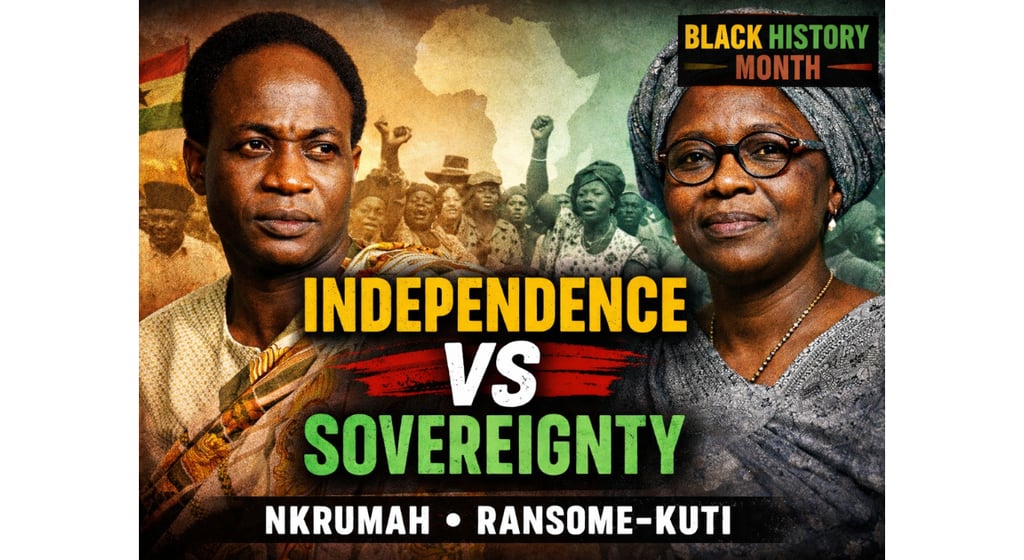
The lives of Kwame Nkrumah and Funmilayo Ransome-Kuti help us understand this distinction. Together, they reveal why many post-colonial states struggle and why real freedom depends not only on leadership but on organized people. Their stories are not simply African history. They are the operating manual for every diaspora community still navigating the gap between nominal freedom and actual power.
What the Post-Colonial Moment Revealed
When Ghana raised its flag in 1957 and Nigeria followed in 1960, the world witnessed something historic. African nations reclaiming the right to govern themselves after decades of colonial extraction. But the years that followed revealed a structural truth that independence celebrations rarely address.
Changing the flag does not change the architecture beneath it.
Colonial systems were not simply foreign governments. They were economic extraction machines built with deliberate infrastructure: trade agreements that favored the colonizer, educational systems designed to produce administrators rather than architects of sovereignty, and financial institutions that kept capital flowing outward. When the foreign administrators left, that infrastructure largely remained.
This is not an argument against independence. It is an argument for understanding what independence does and does not deliver. And it is the exact question that The Black Metrics was built to answer. Sovereignty is not a moment of declaration. It is a system of capacity. For a deeper look at how sovereignty must be actively constructed rather than waited for, read Marcus Garvey and the UNIA: How the Largest Black Movement in History Built the Blueprint for Global Black Sovereignty.
Kwame Nkrumah and the Dream of Political Power
Kwame Nkrumah was born in 1909 in the British colony known as the Gold Coast. Like many African leaders of his generation, he came of age in a world where political decisions affecting African lives were made elsewhere. Through his education in Ghana, the United States, and the United Kingdom, Nkrumah encountered Pan-African thought and global Black liberation movements. He studied alongside Caribbean and African intellectuals who were asking the same foundational question: how does a colonized people reclaim not just territory but capacity?
For Nkrumah, colonialism was not simply foreign rule. It was the systematic removal of African control over political decision-making, economic resources, and social direction. When Ghana gained independence in 1957, he believed political sovereignty meant more than symbolic self-rule. It meant transforming the collective will of the people into organized, strategic power capable of resisting foreign influence and shaping national priorities.
This vision aligns directly with what The Black Metrics defines as Political Sovereignty: transforming collective voice into organized, strategic power. Nkrumah pursued this through strong central government, national development projects, and Pan-African unity. He believed the state could act as a vehicle for liberation if it was strong enough to protect national interests and coordinated enough to pursue long-term goals.
He launched ambitious infrastructure projects. He invested in education and industrialization. He hosted the first Conference of Independent African States in 1958 and became a leading voice for the unification of the African continent under a single political framework. He understood, as Malcolm X would later argue from the diaspora side, that the Black world needed to coordinate globally or remain vulnerable individually. For the full breakdown of how Malcolm X extended this internationalist framework, read Malcolm X & Queen Mother Moore: The Blueprint for Black Reparations and Sovereignty.
But Nkrumah's approach also revealed a critical tension. When political sovereignty becomes concentrated primarily within institutions, and ongoing popular participation weakens, power can drift away from the people it claims to serve. His government became increasingly centralized. Opposition was suppressed. And in 1966, while he was abroad, a military coup removed him from power entirely.
The lesson is not that Nkrumah failed. The lesson is that sovereignty concentrated in one leader or one institution is always one disruption away from collapse. Amy Jacques Garvey understood this. Her entire contribution to the UNIA was ensuring the machine kept running when the personalities were removed. Sovereignty requires systems, not just visionaries.
Economic Control and the Limits of Independence
Nkrumah understood that political independence without economic control was structurally unstable. This insight speaks directly to Economic Sovereignty, defined by The Black Metrics as controlling the flow, ownership, and circulation of our own wealth.
Ghana remained deeply tied to global economic systems shaped by colonial extraction. Cocoa, the country's primary export, was priced in international markets that Ghana did not control. Foreign companies retained significant stakes in Ghanaian industries. The financial systems that moved capital in and out of the country were built by and largely still served external interests.
This pattern repeated across the post-colonial world. Independence changed who governed. It did not automatically change how power and resources were distributed. The wealth gap between formerly colonized nations and their colonizers did not close after independence. In many cases it widened, because the extraction infrastructure was still operational even without the foreign administrators.
This is the same structural reality Queen Mother Moore was addressing when she argued that political freedom without economic restitution is a change in vocabulary, not a change in condition. Reparations, in her framework, were not charity. They were the material correction required to make political sovereignty real. The argument that economic infrastructure must precede or accompany political freedom is one of the most consistent threads running through every serious Black sovereignty framework ever built. For a practical blueprint on building that economic infrastructure today, read Stop Asking Start Building: The Blueprint for Black Community Economic Self-Determination.
Funmilayo Ransome-Kuti and Sovereignty From Below
Funmilayo Ransome-Kuti was born in 1900 in Abeokuta, Nigeria, also under British colonial rule. Her political awakening emerged not from elite institutions but from everyday life. As an educator and organizer, she recognized that women bore the heaviest burdens of colonial taxation, economic hardship, and political exclusion. While men debated independence in formal chambers, women were managing the daily survival of entire communities under systems designed to extract from them.
For Funmilayo, sovereignty did not begin with the state. It began with people understanding their rights, organizing collectively, and refusing to accept unjust authority.
In the 1940s, she led the Abeokuta Women's Union in a sustained campaign against colonial taxation policies that disproportionately burdened market women. This was not a petition. It was organized mass action. Tens of thousands of women mobilized, documented grievances, and applied consistent pressure until the colonial administration was forced to respond. She forced the resignation of the Alake of Abeokuta, a traditional ruler who had been collaborating with colonial authorities. This was a community holding power accountable through organized collective force, which is Justice Sovereignty in practice.
Her work embodies what The Black Metrics defines as Justice Sovereignty: redefining safety, accountability, and restoration beyond punishment. She did not ask the colonial system to reform itself through goodwill. She built the organized capacity to make inaction costly.
The International Dimension of Her Work
What is less often discussed is Funmilayo Ransome-Kuti's international reach. She attended the Women's International Democratic Federation meetings. She traveled to the Soviet Union, China, and Eastern Europe, building connections with global women's movements and anti-colonial networks. She received the Lenin Peace Prize in 1970.
This matters strategically. She understood what Anna Julia Cooper understood at the 1900 Pan-African Congress and what Malcolm X understood in 1964: the local struggle gains leverage when it connects to the global one. Isolation is a tool of suppression. Coordination is a tool of sovereignty. To understand how educational frameworks supported this international thinking, read Anna Julia Cooper: The Blueprint for Black Educational Sovereignty and Intellectual Power.
Her son, Fela Kuti, would later use music as a political weapon, carrying her legacy into a new medium. The Ransome-Kuti family demonstrates something important about sovereignty: it transfers. Not automatically, but intentionally, through the deliberate cultivation of the next generation. This is the intergenerational principle that Queen Mother Moore practiced through decades of mentorship and that the Employment & Business Sovereignty pillar demands of every Black-owned enterprise.
Women-Led Movements and Political Stability
Funmilayo Ransome-Kuti's leadership illustrates a recurring historical truth. Women-led movements often serve as stabilizers of sovereignty. They anchor political demands in daily survival. They maintain pressure when formal leadership shifts. And they ensure that freedom is not reduced to symbolism.
Every woman studied in The Black Metrics briefing series demonstrates this pattern. Anna Julia Cooper built the intellectual infrastructure. Amy Jacques Garvey maintained the organizational infrastructure. Claudia Jones built the economic and cultural infrastructure. Queen Mother Moore built the legal infrastructure. Funmilayo Ransome-Kuti built the mass mobilization infrastructure. None of them waited for conditions to be favorable. All of them built under pressure.
That is not coincidence. That is the standard.
Why Post-Colonial States Struggle
Taken together, Nkrumah and Ransome-Kuti reveal why independence alone is insufficient. Political sovereignty without economic control remains vulnerable. Economic policy without justice reproduces inequality. Leadership without organized people becomes insulated and eventually brittle.
This is why The Black Metrics frames sovereignty as a system, not a single achievement. The Eight Pillars do not function in isolation. Economic Sovereignty ensures control over wealth. Political Sovereignty ensures collective power. Justice Sovereignty ensures accountability and restoration. Educational Sovereignty ensures the next generation inherits capacity, not just culture. Each pillar strengthens the others. Each pillar neglected weakens the whole structure.
The post-colonial failure is not a failure of African people. It is a failure of incomplete sovereignty. When you build political independence on an economic foundation you do not control, you have built on sand. When you build institutions without organizing the people those institutions are meant to serve, you have built a shell. Real sovereignty requires the full architecture.
The Modern Application: Building What the Post-Colonial Moment Left Incomplete
The diaspora is not exempt from these lessons. In fact, the diaspora occupies a unique position. Communities across the United States, the United Kingdom, Canada, and the Caribbean have accumulated significant economic resources, educational credentials, and political presence. But those resources have not yet been converted into the kind of coordinated, self-sustaining infrastructure that Nkrumah envisioned and that Ransome-Kuti demonstrated was possible through organized people.
The African Continental Free Trade Area now represents the largest free trade zone in the world by number of participating countries. It is creating conditions for intra-African economic coordination at a scale that did not exist during Nkrumah's era. His vision of Pan-African economic unity is structurally more possible today than at any point since independence. The diaspora that positions itself now, building bridges between Western-accumulated capital and continental productive capacity, will be early movers in an economic transformation that will define the next generation of Black sovereignty. For a full breakdown of how to position yourself in that transition, read Black Employment Sovereignty: Why the Job Is Just the Starting Point to Real Wealth.
The Bantaba: Discussion Questions
Nkrumah believed the state could be a vehicle for liberation. Ransome-Kuti believed liberation came from organized people. Which approach does your community currently lean toward, and what are the risks of that leaning?
Ghana's economic vulnerability after independence came partly from dependence on a single export crop priced in external markets. Where does your community have similar single points of economic vulnerability?
Ransome-Kuti forced real concessions through organized mass action without holding formal political office. What would that model look like in your city in 2026?
The post-colonial infrastructure of extraction remained even after independence. What extraction infrastructure is still operational in your community today, and what would replacing it require?
Sovereignty requires both institutions and organized people. What institutions does your community currently have? What organized people infrastructure exists alongside them?
Recommended Reading
Neo-Colonialism: The Last Stage of Imperialism by Kwame Nkrumah — His sharpest analysis of how economic control persists after political independence. Essential reading for anyone working on Economic Sovereignty.
Africa Must Unite by Kwame Nkrumah — The full case for Pan-African political and economic coordination.
Funmilayo Ransome-Kuti: The Life and Times of a Nigerian Patriot by Cheryl Johnson-Odim and Nina Emma Mba — The definitive account of her organizing strategy and international reach.
How Europe Underdeveloped Africa by Walter Rodney — The structural economic analysis that gives Nkrumah's concerns their full historical context.
This is the work of Black Sovereignty. The full political, economic, and justice framework, built for today's diaspora, is in Volume One.
→ Get your copy → Black Sovereignty
THE BLUEPRINT
Contact
hello@blackmetrics.space
Copyright © 2026 The Black Metrics. All Rights Reserved.
The BlaCK METRICS
The Pillars
Strategic Stream Blog